

The promise was simple. The outcome was not.
Replace the SDR. Cut the cost. Send more emails. Fill the calendar while your sales team sleeps.
That was the promise behind the AI SDR boom. New platforms could find accounts, build contact lists, research prospects, write personalized emails, send follow-ups, handle replies, and book meetings. If a business was spending thousands each month on sales development representatives, automation looked like an obvious way to get more for less.
The pitch landed because it spoke to a real problem. Building an outbound team is difficult. Data goes stale. New reps take time to learn a market. Managers spend hours coaching and correcting work. A good salesperson should not have to waste half the day moving fields around a CRM.
But the early conversation skipped a critical distinction. An email sent is not an opportunity created. A meeting booked is not a meeting qualified. And a positive reply is not proof that the buyer has a problem worth solving.
By 2025 and 2026, several prominent AI SDR companies had adjusted the way they described their products. Some began talking less about replacing salespeople and more about making salespeople productive. At the same time, buyers were starting to ask harder questions about data, deliverability, personalization, and the quality of meetings.
The result is not a simple victory for humans over machines. The evidence is mixed, and the market is still evolving. But the practical question for every B2B company is much clearer now: who should own each part of outbound, and how do you know the whole system is producing real pipeline?
This guide examines the evidence, explains where AI and people each add value, and gives you seven questions to ask any AI SDR vendor or outsourced SDR agency before they contact your market.
What happened to the AI SDR boom?
The replacement story was too easy to sell
In 2023 and 2024, generative AI made it possible to produce readable prospecting emails at extraordinary speed. Connect those language models to contact databases, enrichment tools, sending infrastructure, calendars, and CRMs, and the familiar activities of an SDR could appear almost fully automated.
Businesses were already under pressure to reduce acquisition costs. An automated outbound agent that ran every day, never needed a ramp period, and could be scaled through software was an attractive story. Vendors including 11x, Artisan, Regie.ai, and AiSDR helped turn AI SDRs into a major sales-technology category.
The issue was not whether AI could perform a task. It could. The issue was whether doing the task automatically produced the same commercial result as doing it well.
Prospecting involves deciding which problems matter, recognizing a weak signal, knowing when not to send a message, understanding a reply that does not follow a script, and carrying context into the next conversation. Those are difficult activities to judge from a sending dashboard.
11x became a cautionary case
In March 2025, TechCrunch investigated 11x, reporting complaints from employees and customers about product performance and disputed customer endorsements. ZoomInfo told TechCrunch that a short trial of the product performed substantially worse than its own SDR employees. Airtable said it conducted a short trial but never put the system into production.
11x disputed aspects of the reporting and said some customer references were removed when requested. TechCrunch also confirmed that other named companies were legitimate users. These distinctions matter. A documented problem at one company is not evidence that an entire technology category failed.
Still, the reporting showed why purchasers needed to demand actual performance data. Attractive demos, logos, and automated activity are not a substitute for held meetings and accepted opportunities.
Artisan changed a very public message
Artisan helped define the replacement narrative with its "Stop Hiring Humans" billboard campaign. The slogan was designed to generate attention, and it did.
In August 2026, Artisan retired the slogan and announced it was hiring its first human BDR. The company explained that AI should handle repetitive work while humans should focus on work that needs them. It continued selling AI outbound software, so this was not a retreat from automation. It was a more nuanced description of where automation fits.
Regie.ai made a related move toward a unified workflow for AI agents and human sales reps, with automation supporting research, prioritization, and execution rather than being the only actor in the process.
The interesting point is not that these companies have suddenly become pro-human. The point is that some highly visible AI SDR messaging now recognizes something experienced sales leaders knew already: a completed task is not the same as a buyer conversation.
What these stories do and do not prove
There is no trustworthy public dataset showing that most AI SDR companies failed. Some vendors continue to operate autonomous models, and some customers report strong results. Others have struggled or changed direction. Claims about success or failure should be tested at the account and opportunity level.
What the available evidence supports is narrower and more useful: fully automated outbound is not automatically a substitute for a managed sales development function. The quality of targeting, messaging, response handling, and sales handoff still determines the outcome.
Are human SDRs actually making a comeback?
The data points in different directions depending on the market.
Kyle Poyar's H1 2026 analysis of U.S. GTM hiring found that SDR job postings across the broader digital-native B2B market were down 21% year over year. That is not evidence of a universal SDR hiring boom.
But the same analysis found that SDR headcount at AI-native companies had more than doubled. The companies building advanced AI products were still hiring people to explain, qualify, and sell those products.
Separately, 6sense's 2026 State of the BDR research found that 58% of surveyed respondents reported BDR team growth and 8% reported reductions. It also found that 99% were using AI. This survey represents its own respondent base and should not be combined with the U.S. hiring data as though the two measured the same thing.
Together, the findings show a role in transition. Hiring is not uniformly rising, yet human BDR teams are far from obsolete. In many companies, the work is shifting away from basic research and CRM administration toward conversation, judgment, and buying-group engagement.
Buyer research tells a similar story. Gartner reported in May 2026 that 69% of surveyed B2B buyers wanted a salesperson to validate AI-generated information. At the same time, 67% preferred an overall rep-free experience.
That is not contradictory. Buyers want to research at their own pace. They do not want interruption or generic pitches. But when they need reassurance, business context, or help resolving risk, they still value a useful person.
The new SDR job is not to be the first source of information. It is to be the most useful person in the conversation when information is no longer enough.
AI SDR vs. human SDR: where each actually wins
The debate often compares two stereotypes: a tireless AI agent that does everything perfectly, and a human SDR who spends the day manually typing emails. Neither reflects how strong teams work.
An AI SDR can rapidly summarize account information, draft variations, classify routine replies, identify useful signals, and keep systems updated. It is valuable when the work is structured, repetitive, and measurable.
A trained human SDR can ask unexpected questions, distinguish between a polite rejection and a real objection, build trust over a phone call, and decide that a meeting should not be booked. People are not automatically better at every sales task, but they can add judgment where the path is uncertain.
The highest-potential model for many complex B2B offers is an AI-assisted human SDR. AI speeds up preparation and administrative work. The person manages buyer-facing conversations, qualification, and the handoff to sales.
| Sales activity | AI SDR strength | Human SDR advantage |
|---|---|---|
| Researching hundreds of accounts | Fast aggregation and summaries | Separating meaningful signals from noise |
| Enriching contacts | Speed and structured data | Verifying roles, relationships, and accuracy |
| Writing first drafts | Fast variations and testing | Understanding what will sound credible |
| Running follow-ups | Reliable scheduling and routing | Choosing when to stop or change direction |
| Cold calling | Call preparation and prioritization | Real-time discovery and objection handling |
| Qualifying interest | Standard questions and classification | Nuanced exploration of business needs |
| Mapping a buying group | Finding probable stakeholders | Building influence across different roles |
| CRM documentation | Logging, summaries, and reminders | Applying commercial judgment |
The answer depends on the size of the deal, the complexity of the problem, the maturity of the sales process, and the risk of a bad interaction. Selling a simple, inexpensive product is very different from opening conversations about an enterprise ERP replacement or cybersecurity architecture.
The right question is not "Can AI write this email?" It is "What does the business need to happen after the email?"
The 7 questions to ask before an agency touches your pipeline
Who is actually representing our brand, and where does AI stop?
Start here. Before discussing prices, ask who will speak to your market.
Will software choose the accounts? Write the message? Send it automatically? Read the response? Book the meeting? Will a human approve the copy, handle objections, and make the call? Who takes responsibility if the system invents a fact, misunderstands the buyer, or contacts someone who should have been excluded?
A provider should be able to map the entire workflow from account selection through qualification and sales handoff. You need to know which steps are autonomous, which are reviewed, and which belong to trained people.
Imagine a cybersecurity prospect replies, "We have enough tools. Our problem is making the current ones work together." A basic automation may send the next product pitch or a calendar link. A thoughtful SDR might ask, "Is the bigger issue too many tools, or getting one clear view from the ones you already use?" That question can reveal a new problem and a different route into the account.
AI can assist with that reply. It may even produce a good draft. But the agency needs rules for when the conversation requires a human and for verifying what the system says.
What a strong answer includes: a clear automation map, human-review checkpoints, escalation rules, call-quality reviews, and examples of what real prospects receive. Ask to see anonymized reply chains and to hear sample calls where recording and sharing are lawful.
Red flag: The agency cannot explain whether a prospect is talking to a person or a bot, or it considers "the AI handles everything" a complete quality-control policy.
How do you decide which accounts and people deserve outreach?
The best message in the world fails when it is sent to the wrong person.
Many agencies begin with a broad industry filter, a revenue band, and a collection of job titles. Then they describe the list as your ideal customer profile. That is contact selection, not market understanding.
A useful ICP explains where your product creates real value. For an ERP vendor, the best prospect might be a company with multiple warehouses, rising inventory complexity, outdated accounting tools, and disconnected sales channels. The job title matters, but the operational situation matters more.
AI can help analyze a large account universe, identify installed technologies, find hiring changes, and surface buying signals. But someone must decide whether those signals are truly relevant. A new CFO is not automatically shopping for ERP. A funding round does not prove the business needs your service. Third-party intent can be helpful, but it is rarely proof of an active purchase decision.
For enterprise accounts, ask how the agency maps the buying group. IT may care about security and integration. Finance may care about cost and control. Operations may care about downtime and process change. The same generic message to all three departments is not account-based selling.
What a strong answer includes: a written ICP, account-exclusion rules, evidence behind account selection, stakeholder mapping, data verification, and a plan for updating the list based on actual buyer feedback. Request a sample of ten target accounts and ask why each belongs in the campaign.
Red flag: The agency leads with the size of its database or the number of contacts it can email but cannot explain why a specific account is worth approaching.
What will you say that makes a buyer want to respond?
AI made it cheap to write a polite email. That is useful, but a polite email is not necessarily a good one.
Consider: "Congratulations on your growth. We help companies like yours improve efficiency and drive innovation." The sentence is smooth and empty. It could be sent to almost anyone. Buyers can recognize that pattern because they receive versions of it constantly.
Now compare: "When companies add new warehouses, the stock shown by Sales can stop matching what Operations actually has. Is that becoming a problem as you expand?" The second message identifies a specific issue. It gives the reader something real to agree with, reject, or correct.
That is the difference between personalization and relevance. Mentioning a prospect's university, last LinkedIn post, or recent promotion can create the appearance of research without connecting to a problem. Strong outbound connects a credible reason to reach out, a problem the buyer might recognize, and a simple next step.
The same rule applies to phone and LinkedIn. A cold call should not be a memorized feature pitch. It should create permission to explore whether a problem exists. LinkedIn should add context and familiarity rather than becoming another channel for the same copied message.
Gartner reported in 2025 that 73% of surveyed B2B buyers actively avoid suppliers who send irrelevant outreach. Bad messages do more than reduce response rate. They teach potential customers to ignore you.
What a strong answer includes: draft messages for each persona, the business problem behind each angle, an approval process, testing plans, and a method for changing the copy when real conversations reveal new objections.
Red flag: The agency promises thousands of "hyper-personalized" messages but every example sounds like the same generic template with a different company name.
What happens when a prospect replies, objects, or answers the phone?
Booking a meeting is rarely as simple as receiving the word "interested."
A prospect might say they have an incumbent vendor, they tried a similar product before, they cannot get budget this quarter, or they need IT to approve the idea. Each response deserves a different next step. Some can be routed through defined workflows. Others require discovery.
Imagine a CFO replies, "We looked at something like this last year, but IT could not support the rollout." A weak system treats that as either an objection or an invitation to send a calendar link. A skilled SDR explores what stopped the project. Was it implementation effort? Resource availability? Security review? A failed integration? The answer could determine whether a meeting makes sense at all.
Phone calls make the distinction more obvious. "Not interested," "not interested right now," and "not interested because we have a supplier" are different situations. A trained SDR can ask one respectful follow-up, recognize whether the person wants to continue, and stop when appropriate.
Quality matters as much as conversion. A prospect who accepts a meeting after being pressured may not attend. A prospect who feels understood is more likely to know why the meeting was booked.
Ask your agency how it coaches calls and evaluates responses. 6sense's 2026 BDR research found that certain AI-assisted coaching and conversation-analysis practices were associated with better performance, while automated content and outreach alone did not show the same consistent link to quota attainment.
What a strong answer includes: a response-handling playbook, call recordings and QA where permitted, escalation rules, human coaching, documented objections, and a handoff that explains the buyer's problem in their own words.
Red flag: Every reply is considered a reason to push for a calendar slot, and nobody can explain what the buyer actually needs.
How will you protect our brand, deliverability, and compliance?
Your brand is on every message, whether a person or software sends it.
A campaign can show impressive sending numbers while silently damaging the business. Bounce rates rise. Prospects report spam. Domains lose reputation. An automated agent invents an acquisition or congratulates someone on an event that never happened. Someone asks to stop being contacted and receives another sequence anyway.
Start with infrastructure. Who owns the domains and inboxes? How are SPF, DKIM, and DMARC configured? Who monitors bounces, complaints, reputation, and actual inbox placement? What happens when results deteriorate? Google's sender requirements set baseline rules for authentication and other safeguards. Following them does not guarantee delivery, but ignoring them creates needless risk.
Next ask about the law. The FTC's CAN-SPAM guidance explains that B2B commercial email is covered and that a company can remain responsible for campaigns sent by an agency on its behalf. Outbound calling may raise additional federal and state issues, particularly with automated dialing, artificial voices, consent rules, or location-specific restrictions. Your legal adviser should review the actual calling model rather than assume that B2B means unrestricted.
Finally, ask about data custody and brand controls. Where are contact records stored? Who can change the copy? How are exclusions maintained across channels? What happens to the data, sending assets, and suppression records when you stop working together?
What a strong answer includes: a written infrastructure map, message approval rights, opt-out processing, privacy controls, monitoring, incident response, and a clear contract covering data and assets.
Red flag: The vendor promises unlimited sending or guaranteed inbox placement and treats compliance as someone else's problem.
Are you measured on emails, booked meetings, held meetings, or pipeline?
This is the question that separates activity from outcomes.
A meeting can appear on the calendar without a real sales opportunity behind it. The prospect may be outside your ICP, lack any authority, misunderstand the topic, or fail to attend. A meeting count tells you almost nothing unless you know what kind of meeting it is.
Track the entire path: accounts targeted, meaningful conversations, meetings booked, meetings held, meetings accepted by sales, opportunities created, and revenue won. These stages should be defined before outreach begins. A booked meeting is not a held meeting. A held meeting is not automatically qualified. And a qualified discussion is not automatically an opportunity.
For example, a qualified meeting might require an account in the agreed ICP, a relevant stakeholder, a plausible problem your solution can address, a clear understanding of the proposed discussion, and attendance by the right participants. For strategic enterprise accounts, a useful early discovery call may not have budget or a timeline yet. Your definition should match your sales motion, not a vendor's easiest way to count success.
Ask about the held rate, sales acceptance rate, and opportunity creation rate. Ask what happens when a meeting is canceled or rejected. Ask whether the SDR supplies the context your AE needs: why the buyer engaged, what they said, what they use today, and what next step they expect.
A vendor may produce many inexpensive booked meetings and very little qualified pipeline. A more expensive team may generate fewer calendar events but more real opportunities. The cost per opportunity is often a better measure of commercial efficiency than the cost per email or the cost per booking.
What a strong answer includes: funnel reporting tied to your CRM, documented meeting criteria, reschedule and replacement policies, AE feedback, and shared reviews of pipeline progression.
Red flag: The agency proudly reports meeting volume but cannot show what happened after the calendar invitation was sent.
Who owns the outcome when the campaign does not work?
Even strong outbound programs run into resistance. Lists are imperfect. Markets change. Messaging stops working. Prospects reply but refuse meetings. Meetings happen and no opportunities follow.
A credible agency has a process for diagnosing these problems. It does not respond to every weak result by sending more messages.
Ask what it will review after the first two weeks, first month, and first quarter. If connect rates are low, will it validate phone data and number reputation? If replies are strong but meetings are weak, will it examine the offer and objection handling? If meetings are held but sales rejects them, will it change qualification criteria or the target account list?
Good agencies share what they are learning from conversations, including why buyers say no. Those insights can improve positioning and even the product strategy. A provider that only sends a dashboard misses much of the value of outsourced sales development.
The commercial agreement matters too. Who pays for setup, data, software, and infrastructure? Who owns campaign assets? What counts as a valid meeting? Who handles no-shows? How does termination work? Does the agreement auto-renew? What happens when the promised batch or quarterly goal is not completed?
Accountability is shared, not magical. Your sales team still has to make calendars available, attend meetings, provide feedback, and follow up on opportunities. An agency cannot be responsible for closing every deal. But it should own the quality and execution of the part it promised to deliver.
What a strong answer includes: an agreed operating cadence, named owners, clear benchmarks, transparent commercial terms, corrective-action plans, and a real explanation of what happens when targets are missed.
Red flag: The contract promises outcomes without defining them, or the only remedy for poor results is another month of fees.
The economics: cheaper outreach does not always mean cheaper pipeline
Comparing a software subscription with an SDR's salary is the wrong test. An AI-heavy program may also require contact data, email accounts, infrastructure, deliverability monitoring, integrations, implementation, and human oversight. A human-led operation may include compensation, management, QA, software, and data costs. An agency may bundle several of those into one fee.
The useful comparison is the total cost required to create sales opportunities that your team accepts. Consider this hypothetical example:
| Metric | AI-heavy program | Human-led, AI-assisted program |
|---|---|---|
| Monthly all-in cost | $4,000 | $10,000 |
| Meetings booked | 20 | 15 |
| Meetings held | 10 | 12 |
| Qualified meetings | 4 | 9 |
| Opportunities created | 1 | 4 |
| Cost per opportunity | $4,000 | $2,500 |
Illustrative scenario only. These figures are not industry averages or claims about a particular vendor.
Looking only at the subscription or booked-meeting count, the AI-heavy program wins. Looking at opportunities created, the more expensive program wins. The reverse could also happen if a well-configured autonomous system produces excellent qualification and an expensive human team performs poorly.
The point is to measure the right thing. In a complex B2B sale, one accepted opportunity may be worth more than dozens of generic replies. Also consider average deal size, gross margin, sales-cycle length, and revenue conversion. If a vendor cannot help you follow the funnel beyond booking, be careful about any claimed return on investment.
The model to bet on: human-led outbound powered by AI
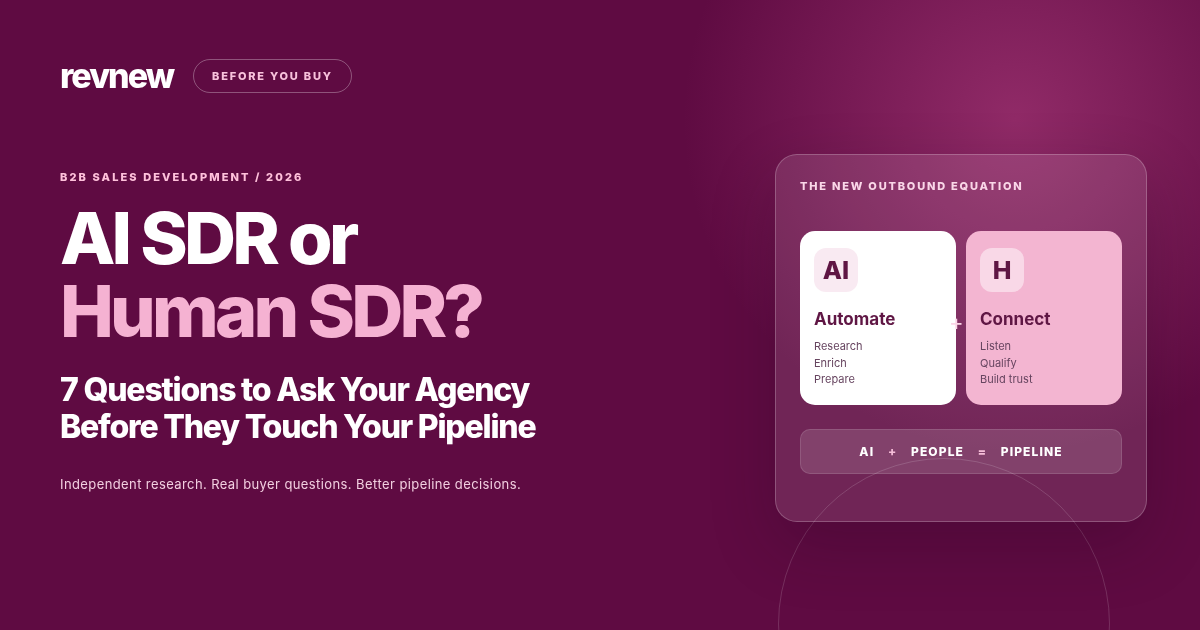
For many B2B companies, the best design is not a person doing everything by hand and not a bot operating without supervision. It is a coordinated system that gives each task to the resource best equipped to perform it.
AI handles preparation and repetitive operations. It can research accounts, flag intent signals, help enrich contact data, draft and test messages, schedule follow-ups, create call briefs, summarize conversations, and update the CRM. That should make a capable SDR faster and better informed.
People handle decisions and meaningful buyer conversations. They can challenge assumptions, explore objections, handle nuanced calling situations, qualify the business problem, build relationships across a buying group, and decide when a prospect should not be pushed into a meeting.
A manager owns quality and outcomes. The manager reviews messaging, samples calls, watches funnel conversion, coaches people, and changes the playbook based on buyer feedback. Software alone does not perform that accountability function.
This matters because time saved is not the same as revenue gained. Gartner reported in May 2026 that AI saved sellers nearly five hours per week on average, while many sales organizations struggled to reinvest that time in high-value selling activities.
If an AI tool frees two hours of administrative work, the company has to decide what those hours become. More random emails are not necessarily the answer. Better preparation, deeper account coverage, and more high-quality conversations might be.
A good operating model also connects channels. Email can introduce a useful idea. LinkedIn can give the buyer context. A well-timed phone call can turn curiosity into a conversation. Each touch should build on what happened before. When channels run as unrelated blasts, the buyer experiences noise rather than a coherent outreach effort.
For Revnew, the important decision is not whether technology belongs in outbound. It does. The differentiator is whether trained SDRs, quality data, coordinated phone, email, and LinkedIn outreach, and clear qualification are working together toward sales-ready meetings.
A 90-day pilot that reveals what you are really buying
Do not select an AI SDR vendor or outsourcing agency based on a demo alone. Run a pilot with agreed definitions and a clear decision at the end.
Days 1 to 30: Build and validate the foundation
Define the ICP, account exclusions, relevant personas, offer, channels, and qualification rules. Agree on what counts as booked, held, qualified, and accepted. Review the first messages and sample accounts before launch. Check deliverability, data sources, call rules, ownership, and reporting. Start with a manageable segment so the team can fix problems before reaching the entire market.
Success in this phase is not "we sent 8,000 emails." It is "we can explain who we are contacting, why they might care, and how we will know whether the first conversations are useful."
Days 31 to 60: Inspect the conversations
Review meaningful replies, objection patterns, connect rates, call quality, held meetings, and reasons for rejection. Listen to legally shareable recordings. Check whether different personas respond to different problems. Ask if messages are improving based on what buyers actually say. If people are replying but not moving forward, diagnose the offer before increasing volume.
A partner that takes learning seriously should produce both meetings and market intelligence.
Days 61 to 90: Judge commercial progression
Review accepted meetings, opportunities created, early pipeline, and total cost. For long enterprise sales cycles, won revenue may not yet exist. That is normal. But you should have evidence that conversations are moving through the agreed stages and that sales wants to continue them.
Use the results to decide whether to scale, revise, or stop. Write those decision criteria before the program starts, not after the first invoice arrives.
A simple 21-point agency scorecard
Score each item from 0 to 3. A zero means the agency cannot give a credible answer. A three means it demonstrates a clear process with proof.
| Area to evaluate | Maximum points |
|---|---|
| AI and human responsibilities are transparent | 3 |
| ICP, data quality, and account targeting are sound | 3 |
| Messaging is relevant and problem-led | 3 |
| Replies, calls, and qualification are handled well | 3 |
| Deliverability, compliance, and brand safeguards are clear | 3 |
| Success is tied to held meetings and opportunities | 3 |
| Ownership, reporting, and corrective action are defined | 3 |
| Maximum score | 21 |
A score under 14 should trigger deeper investigation. Scores from 14 to 17 suggest a potential fit with gaps to address. Scores of 18 to 21 are encouraging if the evidence supports them. These ranges are a practical decision aid, not a scientifically validated rating method. One serious failure involving honesty, compliance, or data protection should outweigh a high overall score.
Frequently asked questions
Is AI replacing SDRs in 2026?
AI is reducing some repetitive sales development work, but the human SDR role is not disappearing. Hiring trends vary by market and company type. Some employers are cutting roles; others, including AI-native companies, are increasing SDR headcount. The role is shifting toward better conversations, qualification, and account strategy.
Why did some AI SDR companies struggle?
Reported challenges include weak targeting, generic messages, inaccurate data, deliverability problems, low meeting quality, and expectations that did not match deployment results. Documented cases should not be generalized into a claim that most of the industry failed.
Are AI SDRs better than human SDRs?
Not universally. AI is strong at scale, research, scheduling, and structured tasks. Trained people often add value in discovery, objections, complex qualification, and relationship development. Compare them on qualified pipeline rather than task volume.
Can AI SDRs make cold calls?
AI voice systems can perform certain calling functions. Whether a particular campaign is permitted depends on the technology, consent, audience, jurisdiction, and applicable laws. A business should obtain appropriate legal review before deploying automated or AI-generated calling.
Is an AI SDR cheaper than an outsourced SDR agency?
A software license can be cheaper than hiring an employee, but the full operating costs of data, infrastructure, configuration, oversight, and campaign management matter. Compare total costs per accepted opportunity, not just subscription fees.
Should we hire SDRs internally or outsource them?
Internal teams offer direct control and may develop deep product knowledge. Outsourcing can provide specialized people, infrastructure, training, and faster deployment. The right choice depends on your market, your management capacity, and the maturity of your offer.
What is the best setup for enterprise B2B sales?
A human-led, AI-assisted process is a sensible starting point for complex, high-value buying cycles. AI helps with research and preparation; experienced SDRs handle conversations, qualification, and buying-group engagement. A pilot should determine whether that model outperforms your alternatives.
What metric matters most when choosing an agency?
No single metric tells the whole story. Start with qualified held meetings, then sales acceptance, opportunities created, pipeline value, and eventual revenue. Use intermediate conversion rates to understand where the process succeeds or fails.
The bottom line: do not buy more activity. Buy a better sales process.
The first wave of AI SDR marketing suggested that automating the tasks of sales development would automatically deliver the outcomes of sales development. Those are different things.
A bot may research faster. A trained SDR may run a better conversation. A strong agency builds a system in which both contribute and somebody is accountable for the outcome.
Before you let a provider represent your brand, ask who will speak to prospects, how accounts are selected, why a buyer should care, what happens after a reply, how the operation is governed, what counts as qualified pipeline, and who owns weak results.
The future of outbound is not a contest between AI and people. It is a contest between activity without accountability and systems that create conversations worth having.
At Revnew, we combine account research, phone, email, LinkedIn, and trained SDR conversations to help B2B teams build qualified pipeline. AI supports the work, but meeting quality and the buyer's experience remain central.
The cheapest way to send an email is not always the smartest way to win a customer.