

Fintech Marketing Strategies to Win B2B Clients in 2026
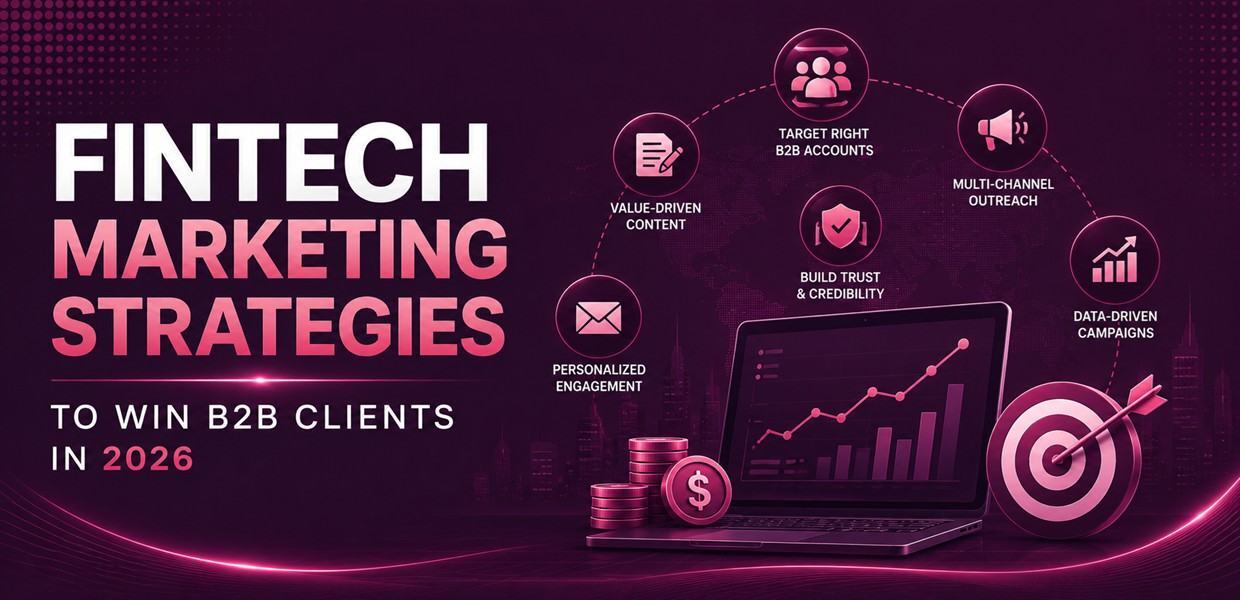
The most effective fintech marketing strategies for winning B2B clients combine trust-building, targeted content, account-based marketing, SEO, thought leadership, and proof of security and compliance. Fintech buyers typically have longer sales cycles and involve multiple decision-makers, so marketing should focus on demonstrating business value, regulatory credibility, security, and measurable outcomes rather than simply promoting product features.
The fintech companies winning the most valuable financial institution clients in 2026 are not necessarily the ones with the best product. They are the ones with the clearest understanding of who their ideal client is, what that client needs to believe before they'll buy, and how to build the marketing infrastructure that makes those beliefs form reliably and at scale.
This blog gives you the complete B2B fintech marketing strategy framework for attracting ideal financial institution clients in 2026.
The Foundation: ICP Architecture Built for Financial Services Complexity
Every effective fintech lead generation strategy begins with an ICP that is specific enough to inform every subsequent marketing decision: channel selection, content strategy, messaging architecture, outreach sequencing, and event investment. In financial services, where the variation between institution types is significant and the cost of pursuing the wrong segment is high, ICP precision is not a nice-to-have. It's the foundation everything else rests on.
A financial services ICP built for marketing strategy purposes requires five layers of definition that most fintech companies don't reach.
Layer 1: Institution Type and Charter Specificity
Not just "banks" or "financial institutions." The marketing strategy for a fintech company selling to community banks is different from the strategy for one selling to credit unions, which is different again from one selling to regional banks, insurance carriers, wealth management firms, or payment processors. Each institution type has different regulatory frameworks, different technology procurement processes, different stakeholder hierarchies, and different language and cultural norms.
Define the institution types that represent your genuine sweet spot based on closed-won deal analysis, not aspiration. Where have your best customers come from? What do they have in common beyond the broad category of "financial institution?"
Layer 2: Operational and Strategic Profile
Within your target institution type, what operational and strategic characteristics define the institutions most likely to buy and most likely to stay? Technology maturity level, digital transformation stage, regulatory examination history, asset quality profile, growth trajectory, and strategic initiative alignment are all variables that distinguish institutions that will convert from institutions that look right on paper but won't.
The fintech companies with the most efficient lead generation strategies have identified 3 to 5 specific operational profile criteria that, in combination, predict with high reliability whether a target institution will become a customer. These criteria shape every targeting decision in the marketing program.
Layer 3: Buying Trigger Identification
What specific event, condition, or organizational change creates the buying trigger that makes your solution urgent rather than interesting? Technology platform end-of-life, regulatory examination findings, leadership transitions, competitive pressure from digital-native institutions, M&A integration requirements, and growth milestones that strain existing infrastructure are common buying triggers in fintech.
Marketing programs built around trigger identification reach prospects at the moment of maximum receptivity. Marketing programs that ignore triggers reach prospects randomly, most of whom are not in a buying motion regardless of how well they fit the ICP profile.
Layer 4: Stakeholder Map by Deal Type
Different fintech solutions involve different stakeholder configurations. A core banking solution involves the CEO, CTO, CFO, and often the board. A compliance technology solution involves the CCO, the CRO, legal, and IT. A digital banking platform involves the Chief Digital Officer, the CTO, marketing leadership, and retail banking operations. Map the specific stakeholder configuration for your deal type and define the entry point stakeholder most likely to champion your solution internally.
Layer 5: Negative ICP Definition
Define explicitly which institution types, size ranges, technology profiles, and operational characteristics disqualify a prospect regardless of how attractive they appear in other dimensions. Negative ICP criteria prevent the waste of marketing resources on segments that generate lead volume without generating convertible pipeline.
The Fintech Content Marketing Strategy That Builds Buying Authority
Content is the most scalable component of a fintech lead generation strategy because it works continuously, compounds over time, and performs marketing functions that paid channels and outbound programs cannot. But content in financial services has a higher bar than in most B2B markets, because the buyers are expert-level professionals with low tolerance for shallow thinking dressed up as expertise.
The content strategy that attracts ideal financial institution clients in 2026 is built on three principles.
Principle 1: Depth Over Volume
A single piece of genuinely authoritative content on a topic that matters deeply to your target ICP is worth more in fintech lead generation than twenty pieces of surface-level thought leadership. Financial services professionals can distinguish between a vendor who has thought carefully about their specific challenges and a vendor who has generated content to appear credible.
The content investments that consistently produce the strongest fintech lead generation results are: original research built on proprietary data or customer insights, technical implementation guides that address specific integration or compliance challenges, regulatory analysis that connects specific rule changes to operational implications for target institution types, and benchmark reports that allow institutions to compare their performance or maturity against peers.
Each of these content types requires real intellectual investment. Each produces a credibility transfer that generic content cannot.
Principle 2: Regulatory and Compliance Intelligence as Content Currency
In financial services, regulatory intelligence is a form of currency. Financial institution buyers pay attention to vendors who demonstrate that they track the regulatory landscape that shapes their clients' operating environment. Content that connects specific regulatory developments to practical operational implications for target institution types is among the highest-value content a fintech company can produce.
This type of content accomplishes three things simultaneously. It demonstrates expertise in the buyer's operating environment. It positions your company as a source of ongoing intelligence rather than a periodic vendor. And it creates natural outreach triggers: regulatory developments give your team legitimate and timely reasons to reach out to prospects with relevant analysis, which produces response rates that generic outreach cannot achieve.
Principle 3: Customer Evidence That Reduces Institutional Risk
The content that converts most directly in fintech lead generation is customer evidence: specific, detailed, verifiable accounts of how comparable financial institutions solved real problems using your solution and what they achieved. Not vague case studies with anonymous clients and generic outcome descriptions. Named institutions, specific operational contexts, specific metrics before and after implementation, and specific quotes from the leaders who made the decision.
Financial institution buyers evaluating a new vendor use peer evidence as their primary risk reduction mechanism. Seeing that a comparable institution, one they know and respect in their peer network, made the same decision they're considering and achieved specific measurable outcomes is more persuasive than any marketing message, product demonstration, or sales argument.
Building a library of specific, credible customer evidence stories is among the highest-ROI content investments a fintech company can make.
The Fintech Lead Generation Channel Architecture
A complete B2B fintech marketing strategy requires a multi-channel demand generation architecture where each channel serves a defined role in the buyer journey and the channels reinforce each other's effectiveness rather than operating in isolation.
Channel 1: Account-Based Content Syndication
Content syndication through financial services media networks, including American Banker, Bank Director, Credit Union Times, Insurance Journal, and vertical-specific digital publications, reaches financial institution buyers in the context they trust most: the industry media they read for professional development.
Financial services media syndication commands higher CPL than general B2B content networks, typically $150 to $350 per lead depending on targeting criteria and institution type. The downstream conversion rate justifies the premium because the leads arrive with institutional context and editorial credibility that general network leads don't carry.
For fintech lead generation, content syndication through financial services media should be treated as a top-of-funnel relationship initiation tool rather than a bottom-of-funnel conversion mechanism. The leads generated require nurture before SDR engagement, but the quality of those nurture conversations is higher because the content context established credibility before the first direct outreach.
Channel 2: LinkedIn for Financial Services Decision-Maker Engagement
LinkedIn is the most direct access point to financial services decision-makers available in the digital marketing toolkit. But the LinkedIn strategy that produces fintech lead generation results in 2026 is fundamentally different from generic LinkedIn advertising.
Sponsored content targeting financial services audiences works best when the content being promoted is genuinely substantive: regulatory analysis, benchmark data, or implementation guidance that earns engagement on its own merits rather than relying on paid placement alone. Content that would earn organic engagement from the target audience produces sponsored content performance that generic promotional content cannot match.
LinkedIn conversation ads and message ads work in fintech when they are hyper-specific and highly personalized to a defined audience segment, not when they're broadcast versions of generic outreach. A message ad to Chief Risk Officers at regional banks that opens with a specific reference to a recent OCC guidance update has a materially different response rate than a generic message about risk management solutions.
Executive thought leadership through personal profiles is underutilized in fintech marketing strategy but consistently effective at building the relationship credibility that accelerates commercial conversations. When your CEO or Chief Product Officer is publishing specific, substantive analysis of financial services trends on LinkedIn, the company's commercial outreach arrives in a context where the relationship has already begun.
Channel 3: Outbound SDR with Trigger-Based Sequencing
Outbound SDR is the highest-cost per touch channel in the fintech lead generation mix, which makes its efficiency critically important. The outbound strategy that produces acceptable economics in financial services is not a high-volume, low-personalization model. It's a precision model built around the trigger-based sequencing framework described in the previous blog in this series.
For outbound to function effectively as part of an integrated fintech lead generation strategy, it needs to be coordinated with content and paid channels rather than operating independently. A financial institution contact who has engaged with your content syndication, seen your sponsored content on LinkedIn, and read a piece of your thought leadership before receiving an SDR email is a fundamentally different prospect than one receiving cold outreach with no prior brand exposure. The former is a warm outreach. The latter is a cold one. The difference in response rate is significant and measurable.
Building the marketing-to-SDR handoff process that ensures outbound outreach is informed by prior channel engagement is one of the highest-leverage process investments in fintech lead generation strategy.
Channel 4: Industry Events and Association Engagement
Financial services has a conference ecosystem that functions as a trust infrastructure for the industry. Associations like the American Bankers Association, the Credit Union National Association, LIMRA, SIFMA, and dozens of regional and vertical-specific associations convene the decision-makers your fintech company needs to reach in environments specifically designed for peer exchange and vendor evaluation.
The fintech companies that generate the most consistent pipeline from industry events treat conferences not as branding exercises but as relationship development programs with specific pipeline targets and defined follow-up processes.
Pre-conference outreach to registered attendees using the conference's networking platform or LinkedIn produces meeting bookings that arrive with conference context built in. Prospects who agree to a meeting at a conference have already self-selected for engagement and are more likely to show up and be present than cold outreach meeting bookings.
Hosted roundtables and working sessions at conferences or as standalone events position your company as the intellectual convener of conversations that your prospects care about. A breakfast roundtable for Chief Risk Officers on managing third-party vendor risk in the context of a specific regulatory development produces a different quality of engagement than a booth conversation or a panel sponsorship.
Association relationship development as a sustained strategy, not just event participation, builds the kind of community credibility that generates warm introductions and referral pipeline. Financial services associations have government affairs functions, educational programs, and member services that offer fintech companies meaningful ways to contribute value to their members before asking for commercial attention.
Channel 5: Partner and Referral Channel Development
The most economically efficient channel in the fintech lead generation mix is one that most companies underinvest in systematically: the partner and referral ecosystem.
Financial services has a dense ecosystem of firms whose clients overlap significantly with fintech target accounts: core banking providers, consulting firms specializing in financial institution strategy and technology, law firms serving financial institutions, accounting firms with bank and credit union practices, and technology implementation partners who provide the services that surround fintech software deployments.
Each of these ecosystem participants has relationships with financial institution decision-makers that took years to build and that carry trust and credibility your fintech company's direct outreach cannot replicate. Building formal partnership programs with the most relevant ecosystem participants, with clear value exchange, defined referral processes, and genuine mutual investment, creates a lead generation channel that compounds over time and produces the highest-quality pipeline available to most fintech companies.
Bottom Line
A successful B2B fintech marketing strategy combines ICP precision, credible content, targeted channels, and measurable campaigns to attract ideal financial institution clients. Fintech lead generation services help turn this strategy into a consistent pipeline by reaching the right decision-makers, building trust, and connecting marketing efforts to revenue.
The goal is not simply to generate more leads, but to build a market position where ideal fintech and financial institution clients find, trust, and choose your brand.