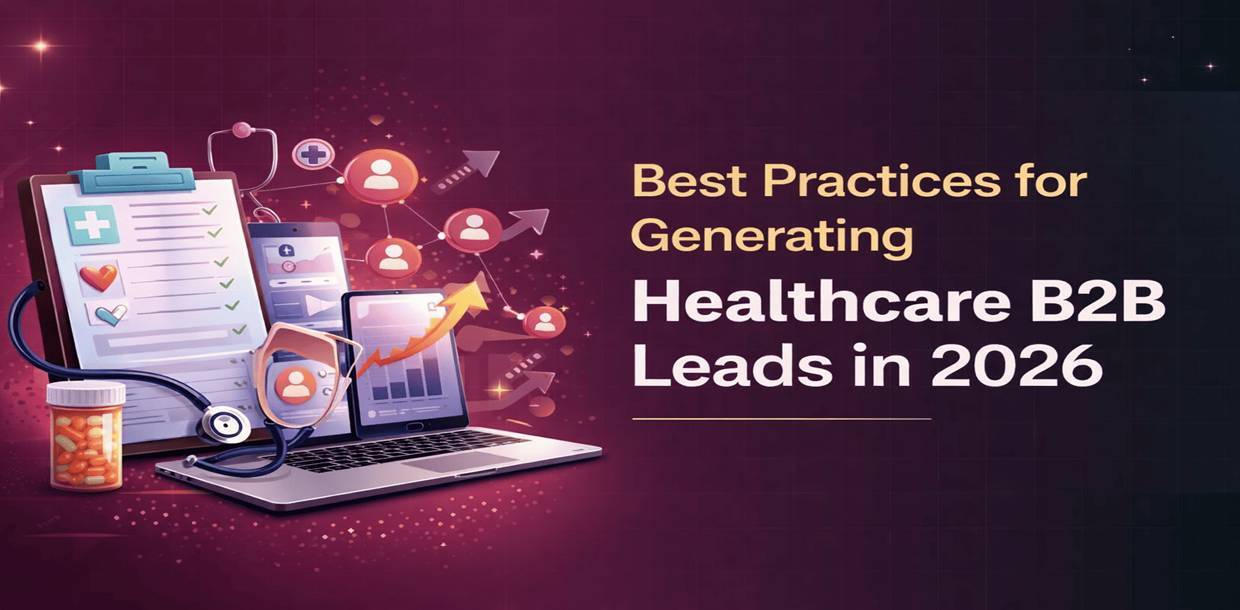


Best Practices for Generating Healthcare B2B Leads in 2026
Post-demo, healthcare B2B leads ghost sales teams, crippling pipeline flow. Cold calls vanish into healthcare executives' inboxes, wasting sales cycles with no pipeline gains.
For outbound marketers and sales teams targeting hospitals, health systems, or medical groups, the old playbook of cold emails and generic pitch decks simply does not cut it anymore.
Healthcare decision-makers ignore outreach that lacks industry-specific context. Over 68% of healthcare deals stall due to stakeholder misalignment (Source).
These numbers make one thing clear: precision, personalization, and patience are the new currency of healthcare lead generation.
This guide walks you through the most effective, data-backed strategies for high-quality healthcare B2B lead generation in 2026 built specifically for outbound teams that want to move fast, build trust, and close deals in one of the most regulated and complex industries in the world.
1. Understand the Healthcare Buyer Landscape Before You Dial
Before you build a single outreach sequence, you need to understand who actually makes purchasing decisions in healthcare. Because the answer is rarely just one person. In 2026, healthcare B2B lead generation is a committee sport, and your outbound strategy must reflect that complexity.
1.1 Map the Decision-Making Unit (DMU)
Healthcare organizations typically have a multi-layered buying committee. A single technology sale might involve a Chief Medical Officer, a CIO, a VP of Operations, a compliance officer, and department heads all of whom have different pain points, priorities, and vocabularies. Your outbound messaging must be tailored for each persona.
Table 1: Key Healthcare B2B Buyer Personas and Their Primary Pain Points
| Persona | Primary Role in Purchase | Key Pain Points | What They Want to Hear |
|---|---|---|---|
| Chief Medical Officer (CMO) | Clinical champion / veto power | Patient outcomes, clinical workflow disruption | Evidence-based ROI, peer-reviewed data |
| Chief Information Officer (CIO) | Technical gatekeeper | Integration, security, scalability | HIPAA compliance, EHR compatibility |
| VP of Operations | Budget approver | Cost efficiency, staff productivity | Cost savings, implementation timelines |
| Compliance Officer | Risk manager | Regulatory exposure, audit trails | HIPAA, CMS, HITECH adherence |
| Department Head / Director | End-user champion | Day-to-day usability, workflow fit | Ease of use, training support |
Understanding this matrix upfront allows your team to build multi-threaded outbound sequences reaching multiple stakeholders simultaneously with messages that resonate specifically with their function. Research from Forrester (2024) shows that multi-threaded deals close 31% faster than single-contact outreach.
1.2 Segment by Organization Type and Size
Not all healthcare buyers are the same. A 12-bed critical access hospital in rural Kansas operates completely differently from a 10-hospital IDN in a major metro.
Your ICP (Ideal Customer Profile) should factor in organization type (hospital, ASC, health plan, lab, pharma, device), bed count or revenue range, EHR environment, geography, and ownership model (nonprofit vs. for-profit vs. government).
The more granular your segmentation, the more relevant your outreach and the higher your reply rates.
2. Build a High-Quality, Verified Healthcare Contact Database
Lead generation in healthcare lives and dies by data quality. Bad data wastes your team's time, damages your sender reputation, and causes compliance headaches. In a sector where titles, affiliations, and organizations change frequently due to mergers and acquisitions, maintaining a clean, verified list is a continuous process, not a one-time task.
2.1 Source Healthcare-Specific Data Intelligently
General B2B databases often fall short for healthcare outreach. Instead, prioritize sources built specifically for the sector. CMS publicly available datasets including hospital cost reports, physician enrollment records (PECOS), and facility directories provide a reliable foundation.
Layer this with data from healthcare-specific vendors such as IQVIA, Definitive Healthcare, and SK&A, which offer enriched profiles including technology stack, purchasing history, and organizational hierarchy.
Additionally, NPI (National Provider Identifier) records are publicly accessible and can be used to verify provider affiliations and specialties.
2.2 Enrich and Continuously Validate Your Lists
Static lists decay quickly. B2B data decays 22.5% annually, hitting healthcare hardest at 20-30% due to physician mobility and M&A (Source). Implement a quarterly data hygiene process: verify emails, update titles, check for organization mergers, and remove invalid contacts. Tools like ZoomInfo, Cognism, and Clay can automate much of this enrichment at scale.
Table 2: Top Healthcare B2B Data Sources Compared
| Data Source | Coverage | Specialization | Best For |
|---|---|---|---|
| Definitive Healthcare | 6,000+ hospitals, 1M+ providers | Technology stack, org hierarchy | Enterprise health system targeting |
| IQVIA OneKey | Global, 10M+ HCPs | Pharma & device focus | Provider and payer outreach |
| CMS / NPI Registry | U.S. only, 7M+ providers | Licensing, affiliation | Verification & compliance |
| SK&A (IQVIA) | 420,000+ medical offices | Office-level targeting | Physician practice outreach |
| ZoomInfo + Clay | Cross-industry | AI enrichment, intent data | Enriching and scoring leads |
3. Craft Outbound Messaging That Speaks Healthcare
Even with a perfect list and the right personas identified, poor messaging will kill your healthcare pipeline generation rates. Healthcare buyers are among the most skeptical and time-constrained audiences you will ever reach.
They receive dozens of vendor pitches weekly, and they can spot a templated email from a mile away. Your outbound copy must be precise, credible, and immediately relevant.
3.1 Lead with Industry-Specific Pain, Not Product Features
The most effective healthcare cold emails open with a pain point or trigger event that is immediately recognizable to the recipient, not a boilerplate intro about your company. For example, if a hospital system recently announced a merger, reference the integration challenges that commonly follow.
If a new CMS reimbursement rule dropped, tie your solution to compliance readiness. This approach, known as trigger-based outreach, typically yields 2–4x higher reply rates compared to generic messaging.
3.2 Use Regulatory and Clinical Language Strategically
Healthcare buyers trust peers and regulators more than vendors. Referencing frameworks like MACRA, MIPS, HIPAA, HEDIS, or the No Surprises Act in your outreach immediately signals that you understand their world. Similarly, citing clinical outcomes data (e.g., reduced readmission rates, improved HCAHPS scores) resonates far more than abstract ROI claims.
Just be careful not to overload your emails with jargon, balance technical credibility with readable, conversational prose.
3.3 The Anatomy of a High-Converting Healthcare Cold Email
Based on benchmarking data from Lavender and healthcare sales consultants, the highest-performing cold emails in this sector follow a clear structure:
- Subject line: 4–7 words, no exclamation points, referencing a specific trigger or pain
- Opening line: Personalized to their organization, role, or a recent event — never generic
- Problem statement: One sentence naming the specific challenge they likely face
- Credibility bridge: A stat, case study reference, or mutual connection that builds trust
- Single CTA: One clear, low-friction ask (a 15-minute call, not a demo request)
- P.S. line: Optional but powerful — adds a second personal touch or proof point
Keep total email length under 150 words.
4. Build Multi-Channel Outbound Sequences for Healthcare
No single channel dominates outbound B2B healthcare marketing 2026. The most successful outbound programs orchestrate email, LinkedIn, phone, and even direct mail in a cohesive sequence meeting buyers where they are and reinforcing your message across touchpoints. Here is how to think about the channel mix specifically for healthcare demand generation.
Table 3: Multi-Channel Outbound Sequence Framework for Healthcare B2B
| Day | Channel | Action | Healthcare-Specific Tip |
|---|---|---|---|
| Day 1 | Intro email — pain-point led | Reference a recent regulatory change or merger | |
| Day 3 | Connection request + personalized note | Comment on their recent post before connecting | |
| Day 5 | Follow-up with a case study or stat | Use a peer health system as your proof point | |
| Day 8 | Phone | Cold call — reference prior email | Call in the morning; clinical leaders are often in meetings post-noon |
| Day 12 | Value-add content (white paper, report) | HIMSS or CMS-cited content performs best | |
| Day 17 | Engage with their content + InMail | Comment meaningfully, not just 'Great post!' | |
| Day 22 | Break-up email with low-friction CTA | Keep it light and respectful — they may resurface later |
4.1 LinkedIn as a Healthcare Lead Generation Engine
LinkedIn has become indispensable for healthcare B2B outreach. With over 1 million healthcare professionals active on the platform and LinkedIn's Sales Navigator offering filters by job title, health system, geography, and seniority, it is one of the most precise prospecting tools available.
The key differentiator between teams that succeed and those that do not on LinkedIn is engagement before outreach, liking, commenting on, and sharing a prospect's content before sending a message dramatically increases connection acceptance rates.
Paid media now claims 31% of B2B marketing budgets (up from 28% in 2024), with LinkedIn dominating at 39% for healthcare targeting. (Source)
4.2 The Role of Cold Calling in 2026
Cold calling is not dead in healthcare, it has just evolved. Decision-makers at the C-suite level often have gatekeepers, but mid-level champions like directors and managers are still reachable by phone.
The key is to call as a follow-up to a prior email touchpoint, so you can reference prior contact and avoid coming across as a random cold call. Keep calls under 90 seconds on voicemail and lead with the prospect's name and the one problem you solve.
5. Leverage Intent Data to Prioritize the Right Accounts
One of the most powerful upgrades outbound teams can make in 2026 is incorporating buyer intent data into their prospecting workflow. Intent data reveals which organizations are actively researching topics related to your solution before they ever raise their hand.
For healthcare B2B, this is a game-changer because it allows you to prioritize accounts that are already in-market over cold suspects.
5.1 Types of Intent Data Relevant to Healthcare Outreach
- First-party intent data comes from your own website and content. Tracking which companies are visiting your pricing page, downloading your clinical white papers, or returning to your case study library.
- Third-party intent data, sourced from platforms like Bombora, G2, or TechTarget, aggregates browsing behavior across thousands of B2B websites to show surge activity around topics like 'EHR optimization,' 'revenue cycle management,' or 'population health platform.'
5.2 Account Scoring: Combining Firmographic and Intent Signals
Build a simple scoring model that assigns point values to firmographic fit (organization type, size, EHR environment) and intent signals (recent website visits, content downloads, topic surges).
Accounts that score highly on both dimensions become your Tier 1 priority. The ones your best SDRs should work with a custom, high-touch sequence. Mid-scoring accounts move through automated sequences, while low-scoring accounts are nurtured through content until they become more qualified.
Conclusion
B2B Healthcare lead generation strategies in 2026 demands a sophisticated, multi-layered approach that goes far beyond blasting emails to a purchased list. The teams winning in this space are those that invest in deep buyer understanding, high-quality verified data, precision messaging, compliant multi-channel sequences, and continuous measurement.
Start by auditing your current outbound process against the frameworks in this guide. Identify the gaps. Whether in your data quality, messaging relevance, channel mix, or measurement rigor; and tackle them systematically. The teams that do will not just generate more leads. They will generate better ones: faster-converting, more strategic, and built on a foundation of genuine value.