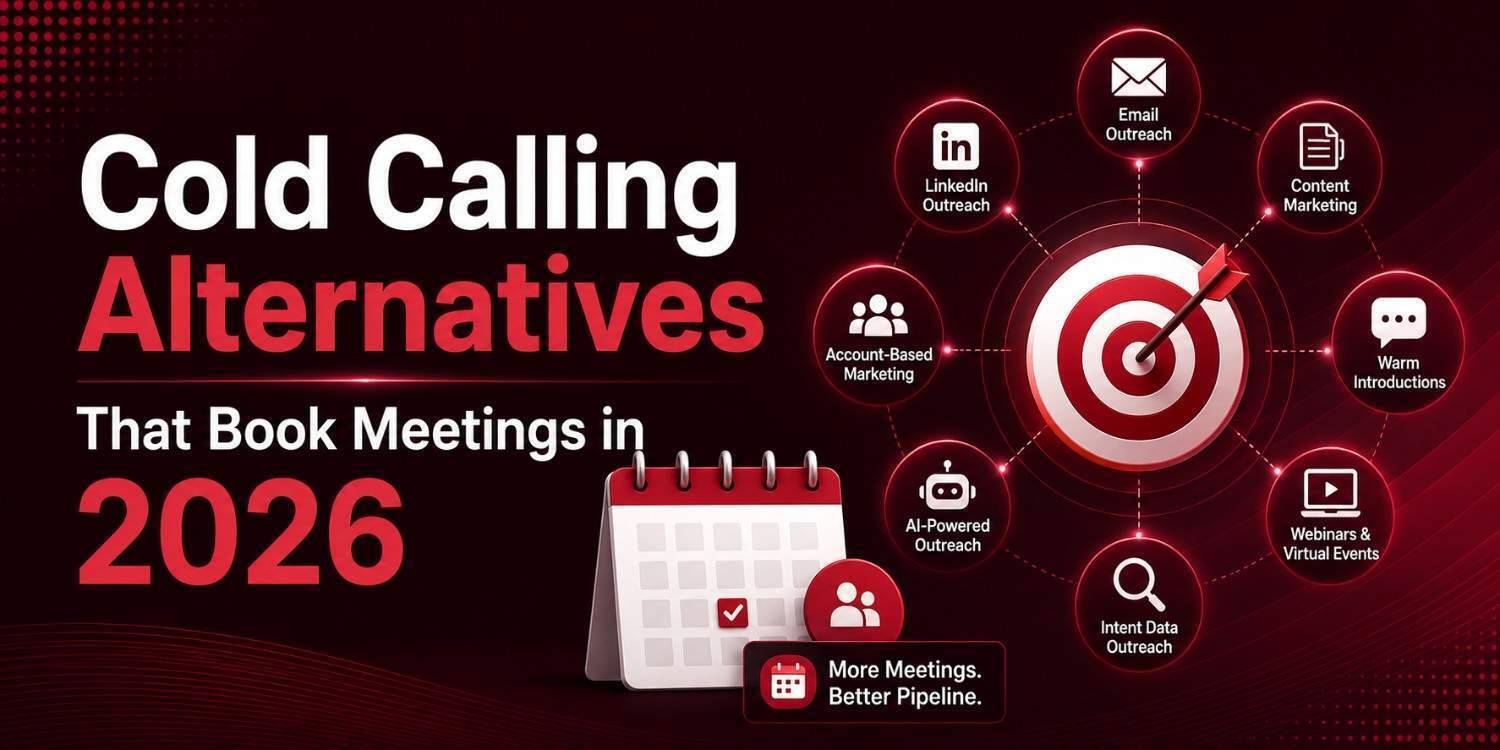

Cold Calling Alternatives That Book Meetings in 2026
The best cold calling alternatives in 2026 are signal-triggered email, LinkedIn outreach, warm referrals, intent data targeting, content syndication, webinars, and review-site presence. Belkins found cold calling takes roughly 370 dials per booked meeting, about $2,200 in loaded SDR time. The alternatives work better because they attach to a buying trigger instead of a calendar.
Highlights
- Roughly 370 dials per booked meeting. Belkins analyzed 175,000+ dials from 2025: a 9.9% per-dial connect rate, 58% of connects becoming conversations, and 4.6% of conversations becoming meetings.
- That works out to about $2,200 of loaded SDR time per meeting. Alleyoop's 2026 cost model puts a US SDR at roughly $154,500 in year one with only 8 productive months, landing at about $2,400 per qualified meeting all in.
- 86% of unknown calls go unanswered. Hiya's State of the Call 2026, surveying 12,000+ consumers across six countries, confirms the answer-rate problem is structural, not a script problem.
- 95% of B2B buyers purchase from their day-one shortlist. 6sense's 2025 Buyer Experience Report found 94% of buying groups rank vendors before speaking to any seller, and the day-one favorite wins about 80% of the time.
- Cold calling is not dead. Undifferentiated cold calling is. Cognism's 2026 report, covering 200,000+ calls, puts the industry average success rate at 2.7% while their own signal-driven team hits 11.3%. Same channel. Four times the result.
- The real switch is not phone to email. It is calendar-triggered to signal-triggered. Every alternative below fails the same way calling does if you fire it on a schedule instead of an event.
Terms Worth Knowing
Before the list, five definitions, because half the confusion in this category is vocabulary.
Cold calling is a phone call to someone who has taken no prior action indicating interest and has no prior relationship with you.
Warm calling is a phone call to someone who has taken an action, been referred, or appeared in a signal. Same channel, entirely different economics.
Signal-triggered outreach is any touch fired by an event in the prospect's world: a funding round, an executive hire, a job posting, a pricing page visit, a content download. The opposite is calendar-triggered outreach, fired because a sequence step came due.
Intent data is behavioral evidence that an account is researching your category, gathered from somewhere other than your own website. It is a targeting layer, not a channel.
Content syndication is placing a gated asset in front of a third party's permissioned audience and receiving contact details for each download, usually priced per lead.
Show rate is the percentage of booked meetings that actually happen. Booked-meeting counts are easy to inflate. Show rates are not.
First, the Honest Math on Cold Calling
Most "cold calling is dead" articles have no numbers in them. Here are the numbers.
Belkins analyzed more than 175,000 dials completed in 2025 and published the full funnel in June 2026:
|
Stage |
Rate |
|
Per-dial connect rate |
9.9% |
|
Per-prospect connect rate (across attempts) |
24.5% |
|
Connects that became real conversations |
58% |
|
Conversations that became booked meetings |
4.6% |
|
End to end |
~1 meeting per 370 dials |
At a sustainable 20 dials an hour, that is roughly 18 hours of dialing per meeting booked. Half a working week. For one meeting, which may or may not show up.
Now the other side of the argument, because it deserves a fair hearing.
Cognism analyzed over 200,000 calls for its 2026 report. The industry-average cold call success rate came in at 2.7%, up from 2.3% the year before. Their own SDR team, working from verified mobile numbers and intent-prioritized lists, hit 11.3%. Average attempts needed to reach a prospect fell from 2.9 to 1.55. Average call duration was 82 seconds industry-wide versus 2 minutes 38 seconds for their team.
So the phone is not broken. What is broken is calling a list because it is Tuesday.
The 2.7% team and the 11.3% team are using the same channel, the same scripts, and roughly the same effort. The difference is what feeds the list.
Hold that thought. It is the entire argument of this article.
The Cost Model: What a Meeting Actually Costs You
Almost nobody running outbound has done this arithmetic, and it changes the conversation completely.
Alleyoop's 2026 SDR cost model, built on mid-market US benchmarks, itemizes year one:
|
Line item |
Cost |
|
Cash compensation (OTE) |
$85,000 |
|
Benefits and employer overhead (25%) |
$21,250 |
|
Tooling and data ($1,200/month) |
$14,400 |
|
Recruiting (1.4 hires at $7,500) |
$10,500 |
|
Turnover re-ramp (0.4 replacements) |
$11,333 |
|
Management allocation |
$12,000 |
|
Total year one |
~$154,500 |
Three numbers in that model deserve attention on their own:
- Ramp time: 3.2 months. You get roughly 8 productive months out of year one, not 12.
- Annual turnover: 34% to 40%. You are re-hiring roughly every two and a half years per seat, and paying the ramp again each time.
- Cost per qualified meeting: about $2,400 at 8 meetings per month.
Now cross that with the Belkins dialing data.
$154,500 over roughly 1,280 productive hours works out to about $120 per hour of SDR time. At 18.5 hours of dialing per booked meeting, pure cold calling consumes roughly $2,200 in loaded labor per meeting before you count data, tools, or the meetings that no-show.
That is the number to put next to any alternative you are considering. Not "is cold calling dead," but "can I get a meeting for less than $2,200 and a week of somebody's life?"
For most of the sixteen channels below, the answer is yes.
How to run this model on your own numbers: take your fully loaded SDR cost, divide by productive hours (annual hours minus ramp), multiply by hours spent per booked meeting in each channel, then divide by your show rate. Do it per channel. The results usually reorder your entire outbound plan.
What Actually Changed: Five Forces
1. The answer rate collapsed and it is not coming back
Hiya's State of the Call 2026, based on a survey of more than 12,000 consumers across six countries, found 86% of unknown calls go unanswered. The same research found roughly one in three consumers now receive deepfake calls and average financial losses from phone scams exceed $800.
That is not a coaching problem. You cannot train your way past a structural behavior change. Carrier-level spam labeling, screening built into every phone OS, and a decade of robocall fatigue mean the default response to an unknown number is now "ignore."
The trust environment around the phone channel got worse, and it will keep getting worse as voice cloning spreads.
2. The shortlist forms before you ever dial
This is the finding that should reshape your outbound strategy, and most teams have not absorbed it.
6sense surveyed roughly 4,766 B2B buyers with a median purchase value of $200,000 to $300,000. What they found:
- Buyers place about 3.6 vendors on their shortlist on day one of the buying journey
- 94% of buying groups rank that shortlist in order of preference before engaging any seller
- The vendor ranked first wins about 80% of the time
- 95% of purchases come from the day-one shortlist, up from 85% in prior years
- Buyers already have prior experience with 3.8 of the 5 vendors they evaluate, and 97% have prior experience with at least one
- 79% of vendor engagements are buyer-initiated
- Buying groups average 10+ members
- First contact now happens at 61% of the journey, roughly six to seven weeks earlier than the prior year's 69%
Sit with that set. By the time a buyer picks up your call, the outcome is largely decided. Your cold call is not entering a fair competition. It is arriving at the end of one.
There is one exception worth knowing. In the 6% of cases where buyers had not pre-ranked their shortlist, the first vendor contacted won only 57% of the time. So even in the best case for interruption, being first is worth far less than being familiar.
This reframes the entire question. The job of outbound is no longer "interrupt someone into a meeting." It is "be on the day-one shortlist before the journey starts." Very few channels do that, and the telephone is not one of them.
3. Email got harder in a way most teams have not adjusted to
Google, Yahoo, and Microsoft now enforce bulk sender requirements that changed cold email economics permanently.
Per MarTech's summary of the rules:
- Bulk sender status applies at 5,000+ messages per day to personal inboxes
- SPF, DKIM, and DMARC authentication are mandatory. Microsoft requires at least p=none aligned with SPF, DKIM, or both
- Google requires senders keep spam complaint rates below 0.10% and never reach 0.30%
- One-click unsubscribe is required
- Google and Yahoo enforcement began February 1, 2024. Microsoft began outright rejecting non-compliant messages on May 5, 2025
Translation: the spray-and-pray era of cold email ended at an infrastructure level. Volume without hygiene now gets you rejected at the gateway, not just ignored in the inbox.
Note the spam threshold specifically. 0.30% is three complaints per thousand sends. If you send 50,000 emails a month, 150 complaints puts your domain at risk. That is a small number, and it is why list quality is now a deliverability issue and not just a conversion issue.
4. Compliance moved, in both directions
US calling rules have been genuinely turbulent, and any article recommending outreach channels should say so.
On January 24, 2025, the Eleventh Circuit vacated the FCC's one-to-one consent rule in Insurance Marketing Coalition v. FCC, finding it exceeded the FCC's statutory authority under the TCPA. The rule would have required consent to be obtained one seller at a time and would have required calls to be logically and topically associated with the interaction that prompted consent.
That was a reprieve, not a green light. TCPA liability, Do Not Call obligations, and state-level rules all still apply, and the rules differ sharply outside the US.
5. AI now mediates discovery
This is the newest force and the least accounted for in outbound planning.
6sense found 94% of B2B buyers use large language models during their buying process. G2 research covered by Demand Gen Report, surveying 1,076 B2B software buyers in March 2026, found:
- 51% start research with an AI chatbot
- 71% use one at some point, up from 60%
- 69% chose a different vendor than they originally planned based on AI guidance
- 33% purchased from a vendor they had never heard of
- 85% view a vendor more favorably when an AI chatbot mentions it
Read line four again. A third of buyers bought from a vendor they had not previously heard of, because a model surfaced. That is a shortlist-entry mechanism that did not exist three years ago, and it costs nothing per touch.
16 Cold Calling Alternatives That Actually Book Meetings
1. Signal-triggered cold email
What fires it: A trigger event. Funding, hiring, leadership change, tech stack change, competitor mention, regulatory deadline.
Email remains the highest-leverage outbound channel by volume, but the honest benchmark is sobering. Belkins analyzed 7,530,489 emails sent across 2025 campaigns and found an average reply rate of 0.45%, measured strictly as unique replies divided by emails sent.
Two caveats worth understanding, because most published cold email benchmarks are not comparable:
- That denominator is total sends, not delivered or contacted. Vendors quoting 3% to 5% reply rates are usually measuring replies per contact across a full sequence, which is a different number entirely
- Belkins disabled open tracking in 2025, which is now standard practice because open-tracking pixels harm deliverability. If your agency still reports open rates as a headline metric, ask why
The segmentation is where it gets useful:
|
Segment |
Reply rate |
|
Founders and owners |
0.57% |
|
C-level |
0.42% |
|
VPs |
0.32% |
|
Companies with 0 to 10 employees |
0.72% |
|
Companies with 11 to 50 employees |
0.49% |
|
Companies with 10,000+ employees |
0.22% |
|
Poland |
1.43% |
|
Ireland |
0.74% |
|
US |
0.51% |
|
UK |
0.48% |
|
Morning sends, 8am to 12pm |
0.54% |
Note the pattern: reply rates fall as company size rises, and drop by more than two thirds from micro-business to enterprise. If you sell enterprise, cold email alone will not carry your pipeline.
Working example. You target 2,000 VPs at companies with over 10,000 employees. At the 0.22% enterprise rate, that is roughly 4 replies. Maybe one meeting. Now target 2,000 founders at companies under 50 people: at 0.57% to 0.72%, you get 11 to 14 replies. Same effort, three times the output, purely from segment selection. The copy did not change.
Best for: Mid-market, founder-led, and SMB targets. Any motion where volume matters. Worst for: Enterprise, where the 0.22% rate makes email a supporting channel, not a primary one. Failure mode: Sending on a schedule to a purchased list. This is how you cross the 0.30% spam threshold and lose the domain.
2. LinkedIn outreach, run as conversation not pitch
What fires it: Engagement with your content, a mutual connection, a job change, or a post they published.
The Belkins and Expandi study covering 15.1 million outreach touchpoints gives the cleanest LinkedIn benchmark set available:
|
Metric |
Rate |
|
Connection acceptance |
26% average |
|
With a personalized note |
25.3% |
|
Without a note |
27.6% |
|
Reply rate |
7.2% |
|
Meeting rate (of connected prospects) |
1.3% |
Read lines two and three again. Connection requests without a note accepted at a slightly higher rate than those with one. That single data point should end a lot of internal debates. The personalized connection note is not the lever. What you say after acceptance is.
Reply rates vary widely by segment:
|
Segment |
Reply rate |
|
HR and talent |
10.9% |
|
VC and PE |
~10.5% |
|
Staffing |
~10.5% |
|
C-level |
7.0% |
|
Retail and consumer electronics |
4.2% |
|
Netherlands |
10.5% |
|
United States |
6.0% |
Campaign type matters too: messenger campaigns to existing connections replied at 12.2%, connector campaigns at 7.9%, open InMail at 7.5%, and builder campaigns at 5.4%.
Worked example. A team sends 1,000 connection requests. At 26% acceptance, 260 connect. At 7.2% reply, roughly 19 reply. At 1.3% meeting rate on connected prospects, about 3 meetings. Now compare against email: 1,000 emails at 0.45% is about 5 replies. LinkedIn produced roughly four times the replies from the same list size, but took far more time per touch and is capped by platform limits. Neither wins outright. That is why they run in parallel.
Best for: Roles that live on the platform, and any motion where relationship precedes ask. Worst for: Industries where your buyer barely logs in. Check before you build a program around it. Failure mode: Automating aggressively enough to trigger account restriction. Platform terms restrict automation regardless of legality.
3. Warm introductions and referrals
What fires it: A mapped relationship between someone you know and someone you want.
Nothing in outbound converts like a referral, and the 6sense data explains why with numbers: buyers already have prior experience with 3.8 of the 5 vendors they evaluate, and 97% have prior experience with at least one. Familiarity is the entry ticket. A referral manufactures familiarity instantly.
The reason most teams underuse this is not that it doesn't work. It is that it isn't systematic. Fix that:
- Export your team's combined LinkedIn network and cross-reference it against your target account list
- Map your investors, advisors, board, and existing customers against the same list
- Make the ask specific and forwardable. "Would you introduce me to Sarah at Acme?" beats "Do you know anyone who might need this?" by an enormous margin
- Write the forwardable paragraph for them. Never make a referrer compose the intro
- Ask at the moment of maximum goodwill, which is right after a customer gets a result, not at renewal
Working example. A 40-person company's combined team network is typically 15,000 to 30,000 first-degree connections. Cross-referenced against a 500-account target list, most teams find 60 to 120 accounts with at least one warm path they did not know existed. That exercise takes a day and usually produces a more qualified pipeline than a month of dialing.
Best for: High ACV, long cycles, tight ICPs. Worst for: High-volume motions. It does not scale linearly. Failure mode: Asking too broadly. A vague ask gets a vague answer and burns the relationship's goodwill.
4. Intent data and third-party signal monitoring
What fires it: An account researching your category somewhere other than your website.
This is less a channel than a targeting layer that makes every other channel work.
Cognism's own team went from an industry-average 2.7% to 11.3% largely by prioritizing lists on intent. The channel did not change. The list did. That is a 4x improvement from targeting alone, which is a larger lift than any script change will ever deliver.
What to monitor: category research on review sites and publisher networks, job postings that imply your problem, funding and leadership changes, technology installs and removals, engagement with competitor content, and website visits from target accounts.
Platforms in this space include Common Room, which unifies job changes, website visits, product signals, and dark funnel activity across a 400M+ contact directory and is used by Atlassian, Notion, Figma, and Snowflake, and Clay, which aggregates 200+ data providers and runs enrichment and research workflows, reporting client results such as Intercom growing outbound-sourced pipeline 140% and Verkada tripling reply rates.
Working example. Rather than emailing 5,000 titles, filter to the 180 accounts showing category intent this month, then find 3 to 4 contacts inside each. You now have roughly 600 contacts instead of 5,000, and every one of them has a reason to hear from you today. Cognism's 4x gap lives in exactly this move.
Best for: Any team already running outbound that wants a multiplier rather than a new channel. Worst for: Teams with no outbound execution capacity. Intent data with nobody to act on it is a subscription, not a strategy. Failure mode: Buying the data and never changing the sequence. The signal has to change what you say, not just who you say it to.
5. Content syndication
What fires it: Someone downloading your asset from a third-party network.
Instead of interrupting a stranger, you place a genuinely useful asset in front of a permissioned audience and let self-selection do the qualifying.
The advantage over cold calling is structural: the person raised a hand. The disadvantage is that a syndicated lead is top-of-funnel, not sales-ready, and treating it as a hand-raiser is how teams conclude syndication doesn't work.
Run it properly:
- Filter tightly on job function, seniority, company size, industry, and geography. Every filter you remove raises volume and lowers relevance
- Demand lead verification, not just delivery. Ask what the provider does to confirm the lead matches spec before it hits your CRM
- Build the nurture sequence before you launch. First touch within 24 hours, and it should not be a demo request
- Measure at the account level. The question is not "how many leads" but "how many target accounts now have two or more engaged contacts"
This is what content syndication and white paper distribution are built to do.
Working example. At a typical cost-per-lead model, 200 tightly filtered syndicated leads in a quarter costs a fraction of an SDR's $154,500 and produces a permissioned list that email and warm calling can then work. Compare that to 200 cold-dialed conversations, which would take roughly 800 hours.
Best for: Teams that have good content and no audience. Worst for: Teams expecting sales-ready leads in week one. Failure mode: Loose filters chasing volume, then routing straight to a closer. Both mistakes at once, and it is the standard way this channel gets cancelled in month four.
6. Webinars and virtual events
What fires it: A registration, which is a voluntary 45-minute commitment.
There is no equivalent to this in cold calling. A webinar registrant has given you attention voluntarily, at a scheduled time, on a topic they chose.
ON24's 2026 benchmarks report, covering 2025 performance, gives usable numbers:
|
Metric |
Benchmark |
|
Registration to attendance |
60% |
|
Average engagement duration |
49 minutes |
|
Average attendees per webinar |
239, up 11% year over year |
|
Live versus on-demand |
67% live, 43% on-demand |
|
Interactions per attendee |
1.8 |
|
Poll responses per webinar |
150 |
|
Resource downloads per webinar |
101 |
Read the second row again. 49 minutes of engaged attention. The average cold call that connects lasts 82 seconds. A webinar attendee gives you roughly 36 times more attention, voluntarily, and 60% of registrants show up.
ON24 also reports a 73% increase in demo bookings and a 4x increase in meeting bookings during webinars when in-session conversion tools are used.
Worked example. A webinar with 400 registrants yields roughly 240 attendees at the 60% benchmark. Even if only 5% book a meeting, that is 12 meetings from one event, plus a 400-person permissioned list for follow-up. At 370 dials per meeting, 12 meetings would have cost roughly 4,400 dials and 220 hours.
The registration list is the real asset. Even non-attendees are qualified and permissioned. Structured webinar promotion is the difference between 40 registrants and 400.
Best for: Complex products that benefit from demonstration, and categories where education precedes purchase. Worst for: Simple products with obvious value. You will over-invest for a small lift. Failure mode: Building the webinar and under-investing in promotion. Content is maybe 30% of the work here.
7. Video and voice-note prospecting
What fires it: Something specific you noticed about their business.
A 45-second personalized video referencing something real about their setup does what a cold call tries to do, without demanding a synchronous interruption. They watch it when convenient.
Vidyard's benchmark report, analyzing nearly one million videos, gives the length rule clearly:
- Videos under one minute hold 65% of viewers to the end
- Videos over 20 minutes hold only 20%
Vidyard's published customer results include Dooly reporting 5x more replies, HubSpot 4x more booked meetings, and Superside an 8x improvement in click-through and 4x in reply rate. Treat vendor case studies as directional rather than as benchmarks, but the direction is consistent across all of them.
Two rules keep this from becoming a gimmick:
- Reference something specific to them in the first five seconds. Not their industry. Them.
- Keep it under 60 seconds. The retention data is unambiguous.
Worked example. An SDR sends 30 personalized videos in a week, roughly 6 hours of work including research. Even at a conservative 15% reply rate, that is 4 to 5 conversations from 6 hours. Cold dialing 6 hours produces roughly 120 dials, 12 connects, and statistically about a third of a meeting.
Best for: High-value accounts where per-touch effort is justified. Worst for: Volume plays. This does not scale past a few dozen per week per rep. Failure mode: Generic videos. A template video is worse than a template email, because it wastes more of the recipient's time and signals less effort, not more.
8. Review sites and peer communities
What fires it: Nothing you control. This is presence, not outreach.
6sense found 79% of vendor engagements are buyer-initiated. That means the majority of your pipeline starts with the buyer finding you, and B2B buyers find vendors through peer review platforms and community discussion.
Maintaining a current, well-reviewed G2, Capterra, TrustRadius, or Clutch profile is not a marketing chore. It is how you get onto the day-one shortlist that 95% of purchases come from. It also feeds AI answer visibility, since review platforms are heavily weighted retrieval sources for LLMs answering vendor questions.
Worked example. A vendor with 12 reviews from 2023 and a vendor with 140 reviews from the last 12 months are not competing on equal terms, regardless of product quality. Getting from 12 to 60 recent reviews is a two-quarter project run by customer success, and it changes what buyers see before you ever contact them.
Best for: Software and services categories with established review platforms. Worst for: Emerging categories where no comparison platform exists yet. Failure mode: Incentivizing reviews in ways that violate platform terms. The penalty is worse than the thin profile.
9. AI answer visibility
What fires it: A buyer asking a model to recommend vendors.
This is the newest channel on the list and the most under-exploited.
The G2 numbers from earlier bear repeating in an outbound context: 51% of B2B software buyers start research with an AI chatbot, 69% chose a different vendor than originally planned because of one, and 33% purchased from a vendor they had never heard of. 6sense puts LLM usage across the buying process at 94%.
That third statistic is an outbound opportunity disguised as an SEO statistic. A vendor nobody has heard of can enter a shortlist purely by being the source an AI system cites. That is precisely the day-one shortlist entry that cold calling cannot buy you, and it costs nothing per touch.
What actually moves this: presence in third-party "best X" listicles, current review platform profiles, original research that models have to cite you for, unambiguous entity descriptions across all your profiles, and technical crawlability for AI bots.
Worked example. Write the 30 to 50 prompts your buyers actually use, run them monthly across ChatGPT, Perplexity, Gemini, and AI Mode, and log whether you appear and which sources got cited. Most teams doing this for the first time discover they are absent from 80% of their own category's prompts. That is a fixable gap, and almost no competitor has started.
Best for: Every B2B company, immediately. Almost nobody has a baseline yet. Worst for: Teams needing pipeline this month. It compounds over quarters. Failure mode: Treating it as an SEO project owned by marketing with no connection to the sales motion.
10. Partner and channel referrals
What fires it: A partner encountering a customer with your problem.
Your integration partners, implementation consultants, agencies, and adjacent vendors already sit inside accounts you want. They have the trust. They lack a reason to mention you.
Give them one: a revenue share, a reciprocal referral flow, co-marketing that benefits both audiences, or simply making their life easier in a way they will remember.
Worked example. A vendor with 8 integration partners, each serving 200 to 500 customers, sits adjacent to 1,600 to 4,000 accounts that already trust someone in the room. Converting even 2% of that into introductions over a year outperforms most SDR seats, at a fraction of $154,500.
Best for: Products with a natural ecosystem. Worst for: Standalone products with no adjacent category. Failure mode: Signing partners and never enabling them. A partner who cannot explain what you do will never refer you.
11. Direct mail and gifting to named accounts
What fires it: An account entering a target tier, or a deal reaching a specific stage.
Physical mail became viable again for exactly the reason digital saturated. A thoughtful, relevant physical item to fifty named accounts cuts through in a way a fifty-first email cannot.
A word of caution on the data here. Direct mail response rate benchmarks are widely quoted and poorly sourced, with figures ranging from 4% to 9% depending on whose blog you read and whether they are measuring house lists or prospect lists. We are deliberately not citing a number, because we could not find a primary source that met the standard of the other studies in this article. Model your own cost per response instead of trusting a headline figure.
Worked example. 50 named accounts, $75 per package, is $3,750. If that produces 4 meetings, your cost per meeting is under $950, well inside the $2,200 dialing benchmark. If it produces one, it was expensive. Run it as a test on a tier where you know the account list is right.
Best for: Enterprise ABM with a defined named-account list. Worst for: Anything above a few hundred accounts. The economics break. Failure mode: Generic swag to a broad list. Expensive noise.
12. Warm calling, the phone fed by signal
What fires it: A signal that already indicates interest.
Do not discard the phone. Change what feeds it.
Call people who downloaded your report, attended your webinar, visited your pricing page, appeared in intent data, or were referred by a partner. This is not cold calling. This is following up on an event, and the Cognism gap between 2.7% and 11.3% is largely this distinction.
Cognism's timing data is worth applying directly: peak windows are 10 to 11am and 2 to 3pm, and the best days are Tuesday and Thursday.
Worked example. Take the 240 attendees from your webinar. Call them within 48 hours referencing a specific moment in the session. Connect rates on this list will not resemble the 9.9% cold benchmark, because the person knows who you are and gave you 49 minutes last week.
The phone is still the fastest way to move from interest to a booked meeting. It is a terrible way to create interest from nothing. Use it for the job it is good at, which is exactly what a well-run appointment setting program does.
Best for: Every team. This is the highest-ROI change most sales orgs can make in a quarter. Worst for: Teams with no signal layer to feed it. Build that first. Failure mode: Calling the signal list on a delay. A pricing page visit is worth calling in an hour and nearly worthless in a week.
13. Community-led prospecting
What fires it: A real question asked by a real buyer in a place you are already present.
Industry Slack groups, Discord servers, subreddits, and vertical forums are where buyers ask each other what to use. You cannot advertise there. You can be useful there.
The mechanic is slow and compounds: a subject matter expert from your team answers questions under their own name, without pitching, until they become a recognized voice. Then the referrals arrive unprompted.
This also feeds AI visibility. Perplexity draws roughly 17% of its citations from discussions, more than double the average across content types.
Worked example. One engineer answering technical questions in two communities for 30 minutes a day generates, over a year, both direct inbound and a body of publicly indexed content that models retrieve. Neither shows up cleanly in attribution, which is why most teams never try it.
Best for: Technical products with active practitioner communities. Worst for: Categories with no community, or teams with nobody credible to put forward. Failure mode: Sending an SDR to post promotional content. This actively damages you, and communities have long memories.
14. Podcast guesting and owned audio
What fires it: A booked appearance, or a published episode.
Being a guest on a podcast your buyers listen to gives you 40 minutes of associated credibility with someone else's audience. Hosting your own gives you a reason to have a conversation with anyone in your industry, including prospects.
The second mechanic is the underrated one. "Would you come on our podcast" has a dramatically higher acceptance rate than "would you take a sales call," and it puts you in a 45-minute conversation with a target buyer who is doing the talking.
Worked example. Ten guest bookings a quarter, each with an audience of 2,000 to 10,000 relevant listeners, is 20,000 to 100,000 impressions of associated credibility. As a founder-led motion this typically costs 15 hours a quarter.
Best for: Founder-led and expert-led sales motions. Worst for: Teams with no spokesperson comfortable on the record. Failure mode: Treating the appearance as a product pitch. Audiences and hosts both punish this.
15. Website visitor identification and retargeting
What fires it: An anonymous visit from a target account.
Most of your target accounts have already visited your site and left without identifying themselves. Visitor identification surfaces the account, which converts a cold outreach into a signal-triggered one.
Combine it with retargeting so the account keeps seeing you after the visit, and with an alert to the rep so the follow-up is timely rather than batched.
Worked example. A mid-market B2B site with 8,000 monthly visitors typically has 200 to 600 target-account visits it never sees. Surfacing even a quarter of those creates a signal list larger than most SDRs could source manually in a month, and every one of them has already looked at you.
Best for: Any company with meaningful site traffic and a defined account list. Worst for: Very early-stage companies with negligible traffic. Failure mode: Reaching out in a way that reveals surveillance. "I saw you looking at our pricing page" reads as creepy. Use the signal to time the touch, not as the opening line.
16. Customer expansion and advocacy
What fires it: A customer reaching a success milestone, or a champion changing jobs.
The cheapest meeting you will book this quarter is with someone who already pays you.
Two specific plays with outsized returns:
Champion job-change tracking. When a champion moves to a new company, you have a warm buyer at a cold account. This is the single highest-converting outbound trigger that exists, and it is trivially easy to monitor. Clay, Common Room, and most enrichment platforms track job changes natively.
Expansion mapped to the buying group. 6sense puts buying groups at 10+ members. Your existing account almost certainly has departments that have never heard of you. That is outbound with a reference customer inside the building.
Worked example. A company with 120 customers averaging 2 champions each has roughly 240 tracked individuals. At typical B2B tenure, 15% to 20% change jobs annually. That is 36 to 48 warm entries into new accounts per year, from a list you already own, for the cost of a job-change alert.
Best for: Every company with existing customers, which is most of them. Worst for: Pre-revenue companies. Failure mode: Nobody owns it. This falls between sales and customer success and quietly never happens.
The Bottom Line
Cold calling is not dead. It is just expensive, and it arrives late.
370 dials per meeting. About $2,200 in loaded time. 86% of unknown calls unanswered. 95% of deals went to a shortlist that formed before you dialed.
But look at the other number. 2.7% versus 11.3%, same channel, same effort, same scripts. The gap was never the phone.
The teams winning outbound in 2026 did not swap channels. They changed what fires the touch, from a calendar to a signal, then ran three channels against the same triggered account instead of one channel against a list.
Do this in order:
- Calculate your actual cost per held meeting, by channel, including loaded labor. Most teams have never done this and it reorders everything.
- Define five to eight trigger events and instrument them so a human sees them within the hour.
- Rebuild your account lists from triggers, then find people inside them. Stop starting with titles.
- Run LinkedIn, email, and the phone in parallel against the same accounts.
- Put the call at touch six, never touch one.
- Start exactly one compounding channel now: reviews, AI visibility, community, podcasts, or partners.
- Measure triggered accounts converted to held meetings. Delete every activity metric from the dashboard.
You will make far fewer calls. You will book more meetings. Both things follow from the same change.
If you would rather have that signal layer and multi-channel execution run for you, talk to us about how appointment setting, and demand generation work together instead of as separate line items.
Frequently Asked Questions
What are the best alternatives to cold calling?
The most effective cold calling alternatives are signal-triggered email, LinkedIn outreach, warm referrals, intent data targeting, content syndication, webinars, video prospecting, review site presence, AI answer visibility, partner referrals, direct mail to named accounts, warm calling, community presence, podcast guesting, website visitor identification, and customer expansion. The right choice depends on your ACV, your buyer's geography, and whether you already have an audience.
Is cold calling dead in 2026?
No, but the economics have shifted. Belkins found roughly one meeting per 370 dials, about 18 hours of dialing, or roughly $2,200 in loaded SDR time. Cognism measured a 2.7% industry-average success rate versus 11.3% for teams calling verified numbers from intent-prioritized lists. The channel still works. Calling an unqualified list on a schedule does not.
How much does a cold-called meeting actually cost?
Alleyoop's 2026 model puts a US SDR at roughly $154,500 in year one with 3.2 months of ramp, landing near $2,400 per qualified meeting at 8 meetings monthly. Cross-referenced with the Belkins figure of 370 dials per meeting, pure cold dialing consumes roughly $2,200 in loaded labor per meeting before tools, data, or no-shows.
Why do people stop answering cold calls?
Hiya's 2026 survey of more than 12,000 consumers across six countries found 86% of unknown calls go unanswered. Carrier-level spam labeling, built-in screening on every phone OS, and years of robocall fatigue have made ignoring unknown numbers the default. Roughly one in three consumers now also receive deepfake calls, which further erodes trust in unknown numbers.
What is a good cold email reply rate?
Benchmarks vary wildly depending on the denominator. Belkins, measuring unique replies divided by total emails sent across 7.5 million emails, found an average of 0.45%. Rates ran higher for founders (0.57%) and small companies (0.72%) and lower for VPs (0.32%) and enterprises with 10,000+ employees (0.22%). Always confirm how a quoted benchmark is calculated before comparing.
What are good LinkedIn outreach benchmarks?
Across 15.1 million touchpoints, Belkins and Expandi found a 26% connection acceptance rate, a 7.2% reply rate, and a 1.3% meeting rate among connected prospects. Requests sent without a personalized note accepted slightly higher (27.6%) than those with one (25.3%). Messenger campaigns to existing connections replied at 12.2%, well above other campaign types.
Does email or LinkedIn work better for B2B outreach?
They are not directly comparable, because published benchmarks use different denominators. Email reply rates are typically measured against total sends, while LinkedIn reply rates are measured against messages to already-connected prospects. In practice, effective programs run both in parallel against the same triggered account list rather than choosing one.
What is signal-triggered outreach?
Signal-triggered outreach fires a touch because something changed in the prospect's world: a funding round, an executive hire, a relevant job posting, a competitor mention, a champion changing jobs, or a visit to your pricing page. Calendar-triggered outreach fires because a sequence step came due. The Cognism gap between 2.7% and 11.3% success rates traces largely to this distinction.
Why does the day-one shortlist matter for outbound?
6sense found buying groups place about 3.6 vendors on a shortlist on day one, 94% rank that shortlist before speaking to any seller, the day-one favorite wins about 80% of the time, and 95% of purchases come from that original shortlist. Cold calling arrives after this happens, which is why familiarity-building channels increasingly outperform interruption.
How do webinars compare to cold calling for booking meetings?
ON24's 2026 report found 60% of webinar registrants attend and engage for an average of 49 minutes. A connected cold call averages 82 seconds industry-wide. A webinar attendee gives you roughly 36 times more attention, voluntarily. The registration list also remains a permissioned audience for follow-up regardless of attendance.
How long should a prospecting video be?
Under 60 seconds. Vidyard's analysis of nearly one million videos found 65% of viewers watch a sub-one-minute video to completion, dropping to 20% for videos over 20 minutes. Reference something specific to the recipient in the first five seconds, and never send a template video, which signals less effort rather than more.
What email deliverability rules apply to cold outreach?
Google, Yahoo, and Microsoft require SPF, DKIM, and DMARC authentication for senders exceeding 5,000 messages daily to personal inboxes, plus one-click unsubscribe. Google requires spam complaint rates below 0.10% and never reaching 0.30%. Google and Yahoo began enforcing on February 1, 2024. Microsoft began rejecting non-compliant messages on May 5, 2025.
What compliance rules affect cold outreach in 2026?
In the US, TCPA and Do Not Call govern calling, and CAN-SPAM governs email. The Eleventh Circuit vacated the FCC's one-to-one consent rule on January 24, 2025, though all other TCPA liability remains. GDPR, PECR, and CASL are materially stricter outside the US. Call recording consent varies by state. Get counsel before scaling any program.
Should we hire a cold calling agency or build outreach in-house?
An in-house SDR costs roughly $154,500 in year one with 3.2 months of ramp and 34% to 40% annual turnover. That is a reasonable bet at scale and a poor first bet. Hire a provider when you need capacity fast or lack contact data and deliverability infrastructure. Prioritize providers who lead with targeting over those quoting dials per day.
What is the fastest change we can make to improve outbound this quarter?
Move the call from touch one to touch six. Build a list from trigger events rather than title filters, run LinkedIn and email against that list first, then call people who have already seen your name four times. This single sequencing change is most of the gap between a 2.7% and an 11.3% success rate, and it requires no new headcount.