
Quick answer
Cold lead conversion isn't a lead-quality problem; it's a sales-process problem.
Teams that turn cold meetings into pipeline do four things consistently: (1) educate the prospect with 5–7 touchpoints between booking and the call, (2) actively prevent no-shows with a deliberate confirmation motion, (3) run a structured first call that always drives to a defined second call, and (4) audit every recording. A 20% lift in show rate or first-to-second-call rate can roughly double pipeline from the same list.
Almost every B2B team claims a 30–40% close rate. That number is comforting and almost always misleading, it gets measured from the point a deal is already qualified inside the CRM. The real leak isn't there. It's the giant gap between booked meeting and second call, where most teams have no documented process at all. The same list of leads can produce mediocre or excellent results depending entirely on what you do in that gap.
It's a Sales-Process Problem, Not a Lead Problem
The single most common diagnosis from teams whose cold-meeting motion isn't converting is "we have bad leads." It is almost never true. When the meetings are landing with the right job titles inside the right companies, what's actually broken is the process between meeting booked and second call:
- Salesperson inconsistency, five reps doing pre-call education five different ways, or not doing it at all.
- No leadership oversight, call recordings turned on, but nobody reviewing them.
- No documented process, the team operates from tribal knowledge and improvisation.
- Calls ending in "I'll send you some information", a near-guaranteed ghost.
- No defined second-call offer, every rep names and pitches it differently.
If 50 meetings with your core personas don't turn into revenue, you don't have a leads problem, you have a sales problem.
The 4 Metrics Every Cold-Outreach Team Should Track
You can over-engineer this with a 20-stage funnel. Start with four. A spreadsheet is fine; CRM stages are better; the point is to actually look at them.
| Metric | What it measures | Where the leak usually is |
|---|---|---|
| Meetings set (by channel) | Top-of-funnel volume | Rarely the actual problem |
| Show rate | % of booked meetings that actually happen | Pre-call education + confirmation gap |
| First → second call rate | % of held meetings that advance | Almost never tracked, biggest hidden leak |
| Close rate | % of opportunities that buy | Lagging, fix the upstream metrics first |
The metric most teams miss is first call → second call. It tells you whether your account executives are running a real process, whether your second-call offer is compelling, and whether your ICP is genuinely buying-fit. Track it weekly.
The Compounding Math: Why Small Lifts Double Revenue
This is the part most teams underestimate. A small percentage improvement at any single stage flows through every stage that follows it. A 20% lift in show rate or first-to-second-call rate roughly doubles your run-rate from the same lead list.
Here's the math at 120 meetings booked per month, with a 60% baseline show rate, a 25% first-to-second-call rate, and a 30% close rate, and what changes when you improve one or both:
Closed deals per month from 120 booked meetings
Same 120 booked meetings, same close rate. A 20% lift on a single stage adds ~1 deal/month; lifting both stages compounds to a 44% revenue lift before you've added a single new lead. Percentages shown are show rate / first-to-second-call rate / close rate.
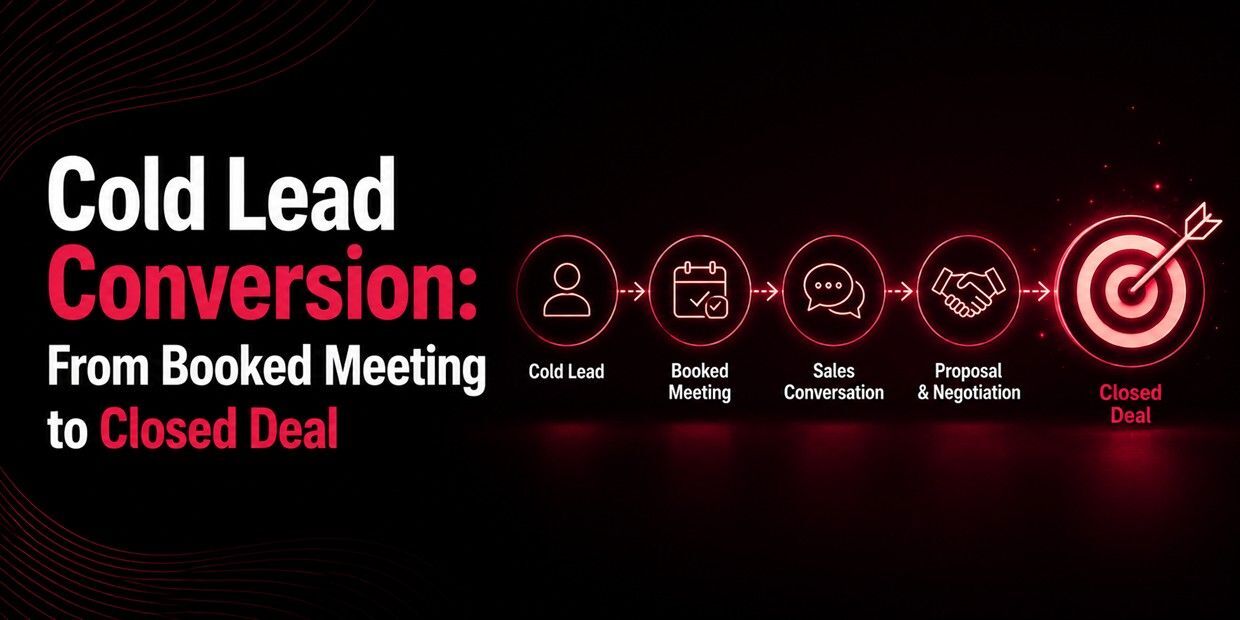
The Cold Lead Conversion Funnel
Most teams visualize their funnel as leads → meeting → closed, which hides the two stages that quietly destroy pipeline. Here's the real shape:
Where cold leads actually leak
The two largest losses in a cold-outreach funnel happen between booking and showing up (no-shows) and between the first call and the second call (no defined next step). Both are addressable without touching your lead source.
Pre-Call Education: 5 to 7 Touchpoints From Booking to Call
The most common reason a first call goes flat is that the prospect arrived having forgotten why they booked. The fix is a deliberate sequence of 5–7 touchpoints between the moment they hit "confirm" on Calendly and the moment the call starts. The volume comes from layering marketing automation and salesperson touches, not from one person sending six emails.
A 7-day pre-call education sequence
A workable cadence: marketing automation fires the moment Calendly confirms the booking; the salesperson layers two custom touches; Calendly reminders stay strictly time-based. The closer to the call, the more content-rich the touch.
| When | From | Touchpoint | Goal |
|---|---|---|---|
| Immediately on booking | Marketing | Confirmation email + 1–2 case studies in 48h | Reinforce what they'll get on the call |
| Same day | Salesperson | LinkedIn connect + custom email mentioning the call | Put a face on the meeting; build familiarity |
| Day 1–4 | Marketing | Relevant FAQ video, peer benchmark, or insight | Answer the predictable questions before the call |
| Day before | Salesperson | Short agenda + confirmation | Lock in attendance; set expectations |
| Day of | Calendly | Standard time reminder (no content) | The reminder, nothing else |
Don't - stuff your Calendly reminder full of "education." Use it for the time and link only. Content belongs in marketing automation and direct salesperson outreach.
How to Reduce No-Show Rates: 10 Tactics That Move the Number
No-shows are the silent killer of cold lead conversion. A 50–60% baseline show rate isn't a law of physics, it's a result of the gap between booking and meeting. With a deliberate confirmation motion, well-run cold-outreach programs reach 80–90% show rates against the same target audience.
Here are ten tactics, ordered from highest impact to easiest to implement. Most teams get the biggest lift from items 1–4 alone.
Time-to-meeting is the single strongest predictor of show rate. If a prospect wants to talk today and you have availability, take the call today, don't gate it behind 48 hours of "education." The longer the gap, the more time for plans to change, urgency to fade, and competing priorities to win.
Not the Calendly auto-confirmation, a human email that references something specific about them: their company, a recent post, the topic they want to cover. This single message is one of the highest-leverage no-show preventers because it converts an anonymous booking into a relationship.
A short connection request, "just connected, looking forward to our chat on Thursday", puts a face on the meeting and creates a second channel you'll need if the email goes quiet. It also signals you're a real person, not a sales-tool drip.
Three or four bullet points covering what you'll discuss, plus a single question for them to think about. Sets expectations, creates commitment, and dramatically lowers the "wait, what is this meeting again?" cancellation reflex on the morning of.
Clear title (not "Meeting with [Vendor]"), correct time zone for them, agenda in the description, prominent join link, and a dial-in fallback. For most calendar-driven users the invite is the meeting; if it looks confusing or templated, attendance suffers.
A two-sentence message, "looking forward to tomorrow at 2; I'll bring the benchmark I mentioned", sent personally, not by Calendly. This is the highest-friction tactic and one of the highest-impact ones. Teams that do this consistently see show-rate lifts in the first week.
Short, friendly, content-free: "looking forward to our chat at 2, calendar invite has the link." This is exactly what Calendly reminders are for. Use them for time only; never for content.
One-click join. No software install. Mobile-friendly. If prospects have to dig for the link, paste a password, or sign into yet another tool, you'll lose a portion who otherwise meant to attend. Audit your join experience from a prospect's phone occasionally.
Counter-intuitive but effective: include a "if you need to move this, click here" line in your confirmation. Prospects who know they can reschedule are far more likely to reschedule (and attend the new time) than to ghost a meeting that suddenly doesn't fit.
The fastest way to fix no-shows is to stop booking meetings that should never have happened. If the prospect doesn't have a clear reason to attend, no confirmation motion will rescue them. Tighten ICP fit and meeting qualification at the SDR level and your show rate climbs without changing anything downstream.
Most no-shows aren't disinterested. They've forgotten why they booked, or they never had a strong reason to begin with.
First-Call Anatomy: A 30-Minute Structure That Closes to a Second Call
If pre-call education works, your prospect arrives knowing roughly who you are and why they're there. That earns you the right to run a structured call instead of a generic one. The single biggest mistake on first calls is presenting all the way to minute 28 and then panicking about the next step. Reverse it: tell them the next step in the first two minutes, and reserve the last five for objections and closing on it.
The 30-minute first call, broken down
The two minutes at the start and the five minutes at the end are where the call is actually won. The rest is the part most teams already know how to do.
"If this call goes well, our next step is X", a whiteboard session, a program audit, an ROI walk-through. Saying it now lets you close on it later without it feeling sudden.
Skip "how's the weather." Compliment something specific from their LinkedIn or company. People love talking about where they're from and what they've built.
"Anything from the case studies or video stand out?", saves time on what they've absorbed and surfaces gaps in what they haven't.
Open-ended questions, real differentiation, and analysis of their world. Don't pepper them with questions and then dump information at the end.
Hard stop. If you're still presenting at minute 28, the call is already lost.
"At the start I mentioned our next step is X, does that fit?" Then be quiet. Objections will surface; that's the point. Handle them now, on the call. Don't push them into "I'll send you some info."
If your first call ends with "I'll send you a bunch of information," the probability of a ghost is roughly 100%.
The Three Offers Every Cold-Outreach Motion Needs
Most teams obsess over the first-call offer (the reason to take the meeting) and forget the other two, which is exactly why second-call rates collapse and why "not now" leads quietly die.
| Offer | Fires | Purpose | Weak version | Strong version |
|---|---|---|---|---|
| First-call offer | Pre-meeting | Give a reason to actually attend | 30-min intro call | "We'll show you how 3 peer companies cut CAC 30%" |
| Second-call offer | End of first call | Commit them to a defined next step | Hop on a demo | Whiteboard session · program audit · ROI walk-through |
| Nurture offer | For "not now" leads | Stay top of mind without pestering | "We'll be in touch" | Curated monthly insight · quarterly check-in · invite-only webinar |
Stop Calling the Second Call a "Demo"
Naming matters more than most teams admit. A demo is something a prospect sits through; a whiteboard session, audit, or review is something they participate in, and they bring colleagues, which is the single best signal that you're winning the deal. Rename your second call to match what it actually delivers.
| If you sell… | Old name (avoid) | Better name |
|---|---|---|
| SaaS / software | "Book a demo" | Tailored rollout plan · config walkthrough |
| Demand gen / outbound services | "Discovery 2.0" | Campaign whiteboard session · pipeline walk-through |
| Consulting / agencies | "Follow-up call" | Program audit · scorecard review |
| Recruiting | "Next call" | Let's draft the job posting together |
| Cybersecurity / IT services | "Technical deep-dive" | Threat model + roadmap session |
The Pattern: What a Process Restructure Actually Looks Like
The cleanest demonstration that this is a process problem, not a leads problem, is the typical pattern we see when teams restructure the gap between booking and second call. Same lead list. Same ICP. Different process between those two milestones.
Before vs after: same leads, same ICP, restructured process
Illustrative pattern across B2B teams that restructure the process between booking and second call, same ICP, same lead source. The "after" period typically books fewer meetings overall but converts dramatically more of them.
What actually changed
- Pre-call education was put in place where there had been none, a 5–7 touchpoint sequence between booking and meeting.
- Two clear, well-named offers were defined, a specific first-call offer that gave prospects a reason to attend, and a second-call offer worth showing up to colleagues for.
- Call recordings were actually reviewed weekly instead of just being captured and ignored.
- No-show prevention became a deliberate motion, confirmation touches, day-before agendas, and frictionless join experience.
Red Flags That Kill Cold Lead Conversion
If prospects open the first call this way, your pre-call education is missing or broken. Almost no one who opens with that line closes.
The single most reliable ghosting trigger in B2B. Replace it with a calendar-confirmed second call before you end the meeting.
If your AEs aren't all doing the same thing between booking and call, you can't isolate what's working, and the inconsistency itself is dragging show rate down.
Capturing calls without auditing them is theater. Block an hour a week for QA, or stop pretending to do it.
It's vague, vendor-flavored, and gives no reason to bring colleagues. Rename and reframe it.
Cold leads need your most experienced closers first. Open the motion up to the wider team only after the playbook is working.
Using AI to Audit Your Sales Calls
The cheapest, highest-leverage thing most teams aren't doing is feeding call transcripts back into AI for pattern analysis. Twenty calls in a folder is a goldmine; nobody has time to listen to all twenty, but a model can read all of them in seconds. Tools like Fireflies or Fathom handle the recording side for around $20 a month and export transcripts cleanly.
- Across these 20 call transcripts, what are the most common questions prospects ask in the first five minutes?
- Which questions seem to get the prospect to talk the most? List them with example excerpts.
- Identify calls where the rep didn't leave at least five minutes at the end for objections and closing.
- Find calls where the next step at the end was vague or undefined ("I'll send you information").
- What objections come up most frequently, and how did the rep handle each?
- Where in the call does the prospect's engagement seem to drop?
Two passes a week, twenty transcripts each, will surface more sales-process issues than a quarter of internal debate. The output usually becomes your next pre-call FAQ, your next objection handler, and your next script tweak.
How Revnew Operationalizes Cold Lead Conversion
Most agencies hand you a list of meetings and walk away. Revnew is built for what happens after.
Firmographic, technographic, and behavioral intent signals on 50M+ B2B buyers narrow outreach to accounts already showing buying behavior, fewer meetings, higher show and second-call rates.
The 5–7 touchpoint cadence in Section 05 is built into every campaign, not an afterthought. Tele Intent™ drives the calling layer; Land Inbox™ protects deliverability.
Personalized confirmation, day-before agenda, frictionless join experience, applied to every booked meeting, not just the priority ones. For one energy client (CGE Energy), this kind of disciplined sequencing turned dismal show rates into a roughly 90% show-up rate, enabling in-person pitch meetings the client could actually close.
Trained SDRs carry qualified interest from first signal to a booked, sales-ready meeting, and reframe the second-call ask so it's worth showing up for.
Show rate, first-to-second-call conversion, and pipeline value, not dial counts.
Want this process operationalized end-to-end, intent targeting, pre-call education, no-show prevention, first-call structure, and an SDR layer that converts to second calls?
Book a strategy callFrequently Asked Questions
How do you reduce sales meeting no-show rates?
Combine four things: a personal, custom confirmation within an hour of booking; a day-before agenda from the salesperson; the shortest realistic time between booking and meeting; and a frictionless join experience. Most teams that add these consistently lift show rates from the 50–60% baseline into the 80%+ range.
How many pre-call touches do I really need between booking and the meeting?
Plan for 5–7 touches across marketing automation and direct salesperson outreach, not all from the same source. Three to four marketing touches plus one or two from the rep, with Calendly reminders kept strictly time-based, is a workable cadence.
What's a "second-call offer" and why does it matter so much?
It's a concrete, branded next step that the prospect actively wants to attend, a whiteboard session, a program audit, an ROI walk-through. Without one, the first call ends in "I'll send you some information" and the deal dies in the inbox.
Should our SDRs run the first call on cold leads?
Not at first. Run cold leads through your most experienced closers until the playbook is consistently producing second calls. Open the motion up to SDRs only after the process is proven.
What's the fastest way to lift show rates?
Add real pre-call education and a human day-before confirmation. Most no-shows aren't disinterested, they've forgotten why they booked. Two or three pieces of value plus a personal confirmation typically move show rate noticeably in the first month.
How do I know if it's a leads problem or a process problem?
Check whether your meetings are landing with the right job titles inside the right companies. If the ICP is correct and meetings still don't convert, it's a process problem, almost every time.
How long should the first call be?
Default to 30 minutes, structured: 2 minutes to open and pre-announce the next step, 3 for rapport, 3 to confirm context, 14 for discovery and presentation, 3 as a buffer, and 5 for objections and closing on the second call.
Is "I'll send you more information" ever the right close?
Almost never. If a prospect genuinely needs material, book the second call to walk them through it, don't email-and-pray. Sending information without a scheduled next step is the most reliable way to get ghosted.
How much time should leadership spend reviewing calls?
A few hours a week. Block fixed time on the calendar for call review and coaching, without it, you have recordings, not insight.
Stop Leaking Pipeline Between Meeting and Second Call
Revnew runs intent-led outbound with built-in pre-call education, no-show prevention, and an SDR layer that closes to a sales-ready second call, so the same lead list produces more pipeline, not just more meetings.
Book a free strategy callIntent targeting · pre-call education · SDR-led second-call conversion