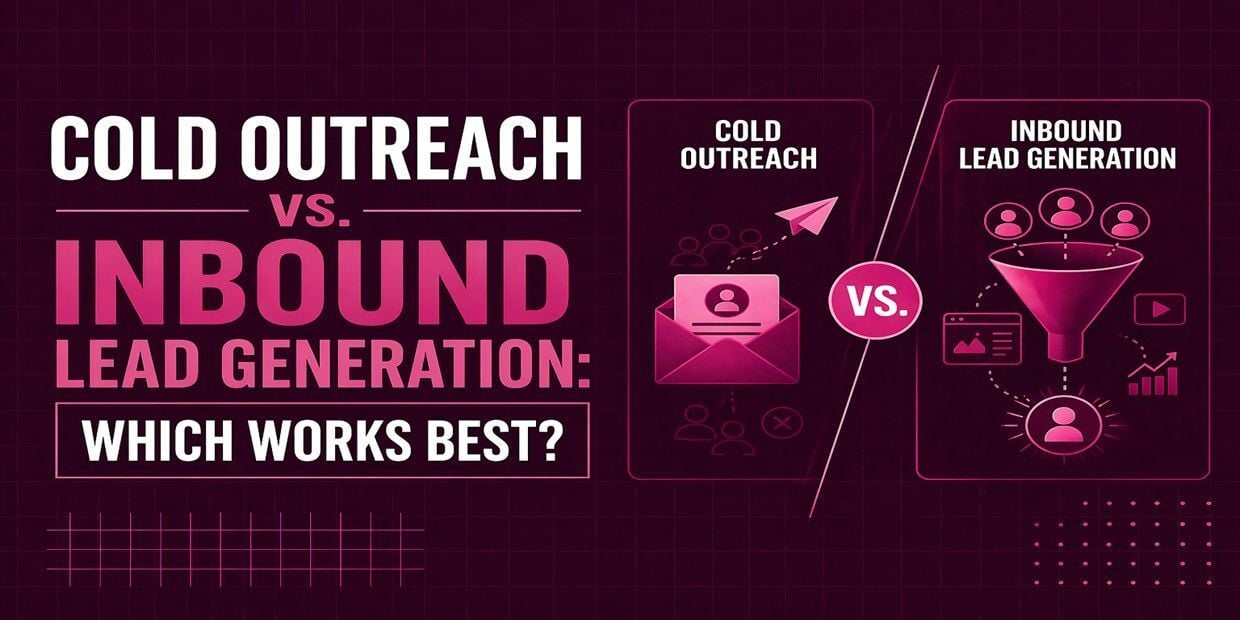

Cold Outreach vs. Inbound Lead Generation: Which Works Best in 2026?
"Should we focus on cold outreach or inbound?"
The question itself is the problem.
Cold outreach gives you speed, control, and precision targeting. Inbound gives you compounding returns, lower cost-per-lead, and higher-converting traffic. Teams that choose one over the other leave a serious pipeline on the table. Teams that intelligently combine both consistently outperform their single-channel peers.
This blog breaks down the real strengths, weaknesses, benchmarks, and ROI of each and shows exactly when to use cold email outreach services, when to invest in inbound, and how to build the hybrid model that outperforms both.
Cold Outreach: What It Is, What It Does, What the Data Says
Cold outreach, also called outbound prospecting, is the practice of initiating contact with prospects who haven't previously engaged with your brand. In B2B lead generation, this means cold email outreach, cold calling, LinkedIn direct messaging, and paid advertising to cold audiences.
The Case for Cold Outreach
Cold outreach does things inbound simply can't:
- Immediate results. You can build a list, launch a campaign, and book meetings in weeks — not months. There's no content production lag, no domain authority build-up, no waiting for organic traffic to scale.
- Surgical targeting. You choose exactly who to contact: specific industries, job titles, company sizes, geographies, technology stacks. Inbound attracts whoever shows up. Outbound reaches who you decide.
- New market penetration. When you're entering a market where nobody knows your brand exists, inbound can't generate demand that doesn't already exist. Cold outreach creates awareness by design.
- ABM execution. Account-based marketing requires targeted outreach to specific high-value accounts — something that inbound channels can't execute with precision.
57% of C-level and VP-level buyers say they prefer to be contacted by phone, making cold calling the preferred channel for reaching senior decision-makers (RAIN Group via CIENCE, 2026). 82% of buyers accept meetings from sellers who reach out proactively (InsightMark Research, 2026).
Cold outreach isn't dead. It just requires execution precision that most teams lack.
Cold Outreach Benchmarks in 2026
|
Metric |
Industry Average |
Top Performers |
|
Cold email open rate |
27.7% (Snovio, 2026) |
45%+ |
|
Cold email reply rate |
5.1% (Sopro, 2026) |
15–25% |
|
Cold call success rate |
2.3% |
6.7% (with optimized data) |
|
Cold call connect rate |
16.6% of dials reach a live conversation |
65.6% success rate on connection (Martal, 2025) |
|
LinkedIn InMail response rate |
10–25% (Marketing LTB, 2025) |
— |
|
Inbound vs. cold lead close rate |
Cold: 1.7% / Inbound: 14.6% (HubSpot via ConnectSafely, 2026) |
— |
The close-rate gap between cold and inbound leads — 1.7% vs. 14.6% — is the single most important number in this entire debate. Cold outreach generates volume. Inbound generates quality. Understanding this trade-off is what separates strategy from guesswork.
Where Cold Outreach Goes Wrong
Most cold outreach underperforms not because outbound doesn't work, but because of avoidable execution failures:
- Poor list quality. B2B contact data decays at 30% per year. Stale lists mean bounces, spam complaints, and damaged sender reputation.
- No personalization. Decision-makers receive an average of 15 cold emails per week, and 71% report ignoring emails that lack relevance (Digital Bloom, 2025). Generic templates get deleted.
- Single-touch abandonment. 48% of reps never send a second email (Martal, 2026), yet follow-up emails collectively generate 42% of all campaign replies. Most pipelines are left on the table after the first touch.
- Deliverability failures. Gmail tightened enforcement in late 2025: spam complaint rates must stay below 0.1%, and SPF/DKIM/DMARC authentication is non-negotiable for high-volume senders. Non-compliant campaigns underperform systematically.
What Makes Cold Email Outreach Services Actually Work
Advanced personalization (beyond first-name merge tags) sees reply rates up to 18%, double the average, yet only 5% of senders personalize every message (Martal, 2026). Personalization at the level of referencing a specific trigger event, a recent hire, or a company initiative is what separates high-performing cold email outreach services from noise.
The 3-7-7 follow-up cadence (Day 0, Day 3, Day 10, Day 17) captures 93% of total replies by Day 10 (Digital Bloom, 2025). Sending beyond that point yields diminishing or negative returns.
Multi-channel cold outreach that combines email + LinkedIn + phone in a coordinated sequence boosts results by over 287% compared to email alone (Martal, 2026).
Inbound Lead Generation: What It Is, What It Does, What the Data Says
Inbound lead generation attracts prospects to you through content, SEO, social media, webinars, and other value-creating channels. Prospects find your content during their self-directed research, engage with it on their own terms, and initiate contact when they're ready.
The Case for Inbound
Inbound does things outbound can't:
- Higher-quality leads. Inbound leads are self-selected — they found you because they were looking for what you offer. This is why inbound leads close at 14.6% versus 1.7% for cold outreach.
- Compounding returns. A piece of SEO content published today can generate leads for years without incremental spend. Cold outreach stops the moment you stop sending.
- Lower long-term CPL. Content marketing generates 3x more leads than outbound at 62% lower cost (Salesmate via InsightMark, 2026).
- Trust-first buyer relationships. Inbound leads arrive having already read your content, evaluated your expertise, and chosen to engage. The trust foundation is built before the first conversation.
60% of marketers believe inbound marketing is the best way to generate high-quality leads (Salesmate, 2026). Companies doing inbound are 3x more likely to generate higher ROI than those relying only on outbound.
Inbound Benchmarks in 2026
- SEO-driven leads close at 14.6% versus 1.7% for outbound (G2, 2026)
- B2B companies using inbound saw a 36% increase in organic leads in 2025 (InsightMark Research, 2026)
- Companies that publish 4+ blog posts per week generate 3.5x more traffic than those posting once per week
- Businesses with active blogs generate 97% more inbound links than those without
- A consistent inbound strategy can produce a 127% ROI within three years (InsightMark Research, 2026)
- 64% of buyers say they need 3–5 pieces of content before contacting sales, inbound nurtures that journey
- 74% of high-growth companies use multi-touch attribution and see 15–30% higher marketing ROI from inbound as a result (Whitehat SEO, 2026)
Where Inbound Fails
Inbound isn't a magic pipeline machine either:
- Slow to start. SEO results take 3–6 months of consistent investment before generating significant volume. For companies needing immediate pipeline, inbound alone is a risk.
- Not targetable. You can't control who finds your content. Inbound attracts whoever searches, which may include prospects far outside your ICP.
- Dependent on content quality. Poor content doesn't rank, doesn't engage, and doesn't convert. Inbound requires sustained investment in high-quality, expert-level material.
- Invisible to buyers who don't search. Not every buyer is actively searching for a solution like yours. Inbound only captures existing demand — it doesn't create it.
Head-to-Head: Cold Outreach vs. Inbound
|
Factor |
Cold Email Outreach |
Inbound Lead Generation |
|
Speed to results |
Weeks |
3–6 months |
|
Lead close rate |
1.7% |
14.6% |
|
Cost per lead |
Higher (short-term) |
Lower (long-term) |
|
Targeting precision |
Very high (you choose) |
Low (whoever searches) |
|
Scalability |
High (with automation) |
High (compounds over time) |
|
Trust level at first contact |
Low (cold start) |
High (earned through content) |
|
New market entry |
Excellent |
Poor |
|
ABM capability |
Excellent |
Poor |
|
Pipeline predictability |
High (controllable volume) |
Variable (dependent on search volume) |
|
Long-term ROI |
Moderate |
High (127% over 3 years) |
|
Maintenance required |
Ongoing (active campaigns) |
Ongoing (content production) |
Neither wins across every dimension. That's the point.
The Answer: The Allbound Model
The highest-performing B2B teams in 2026 don't choose between cold outreach and inbound. They combine both in a coordinated strategy what practitioners call the "allbound" model.
Cross-channel inbound-outbound campaigns boost revenue by 9.5% year-over-year on average, compared to 3.4% for single-channel approaches (GrowLeads via OutreachBloom, 2026). Outbound + inbound combined increases total lead volume by 73% (Marketing LTB, 2025).
How the Allbound Model Works
Cold outreach fills short-term pipeline gaps and targets specific high-value accounts:
- Identifies in-market accounts using intent data and trigger signals
- Reaches decision-makers at target accounts who may never search for your product organically
- Generates immediate pipeline while inbound content compounds
- Executes ABM sequences across multi-stakeholder buying committees
Inbound builds the content infrastructure that makes cold outreach more effective:
- Published thought leadership that prospects find before the SDR email arrives
- SEO content that builds brand credibility and supports conversion when cold-outreached prospects research you
- Case studies and social proof that cold outreach references and links to
- Webinars and gated content that convert inbound traffic into contacts for nurturing
The compound effect: When a prospect receives a cold email and then visits your website and finds expert content that directly addresses their problem, the conversion rate of that cold outreach rises dramatically. Cold and inbound reinforce each other — they're not competing.
When to Lead With Cold Outreach
Cold email outreach services and outbound-first strategies make the most sense when:
- You need pipeline immediately — new company, new market entry, new product launch
- You're targeting a specific, identifiable account list where inbound content can't reach
- Your ICP is narrow and well-defined — you know exactly who to contact
- You're entering a category that doesn't have active search demand for your solution
- Your AEs have capacity to close but need more meetings
- Budget is available for SDR infrastructure or outreach services but not for sustained content production
When to Lead With Inbound
Inbound-first strategies make the most sense when:
- You're playing a long-term market positioning game and can absorb a 3–6 month ramp
- Your buyers actively research solutions like yours online before vendor engagement
- You need a scalable, lower-cost pipeline engine that reduces CPL over time
- Brand credibility is a key purchasing factor in your industry (professional services, financial services, enterprise tech)
- You have subject matter expertise that can differentiate through published content
- You want to reduce dependence on active outreach for consistent lead flow
Making Cold Email Outreach Services Work: 2026 Best Practices
If you're investing in cold email outreach, whether in-house or through a B2B lead generation partner, these are the execution requirements that separate results from wasted budget:
Technical foundation first:
- Custom domain with SPF, DKIM, and DMARC authentication
- Domain warmup before high-volume sends
- Spam complaint rate maintained below 0.1%
- Unsubscribe functionality (one-click required)
List quality over list size:
- Verified, enriched contact data not scraped or purchased raw lists
- ICP-matched prospects only
- Trigger-event filtering (funding rounds, leadership changes, tech stack signals)
Personalization at depth:
- Reference the specific company, role, and business context, not just first name
- Trigger-based hooks (timeline hooks achieve 10% reply rates vs. 3.4% for generic problem statements) (Digital Bloom, 2025)
- Role-specific messaging — CFO messaging ≠ CTO messaging ≠ VP of Operations messaging
Follow-up discipline:
- 3–4 touches over 2–3 weeks (Day 0, Day 3, Day 10, Day 17)
- Each follow-up adds new value — don't just resend the same email
- Multi-channel: email + LinkedIn + phone in coordinated sequence
Wednesday timing:
- Wednesday between 7–11 AM in the prospect's local timezone consistently outperforms other send windows (Snovio, 2026)
Bottom Line
The "cold outreach vs. inbound" debate is a false choice that costs B2B teams pipeline.
Cold outreach is fast, precise, and controllable but produces lower-converting leads that require more sales effort to close. Cold email outreach services are most valuable when speed, precision targeting, or new market entry is the priority.
Inbound is slow to start but compounds over time — producing higher-quality leads at lower long-term cost. It's most valuable for building sustainable, scalable pipeline that doesn't require constant active investment.
The companies consistently outperforming in 2026 aren't choosing. They're running both letting inbound build authority and attract ready buyers while outbound fills gaps, targets specific accounts, and generates immediate pipeline. The combination produces results neither achieves alone.
Ready to Build a Pipeline Strategy That Uses Both?
Revnew combines multi-channel cold email outreach services with inbound strategy to build B2B lead generation engines that generate consistent, qualified pipeline without betting everything on one channel.