
The Real Cost of Bad Leads in 2026 Analysis and Prevention Guide
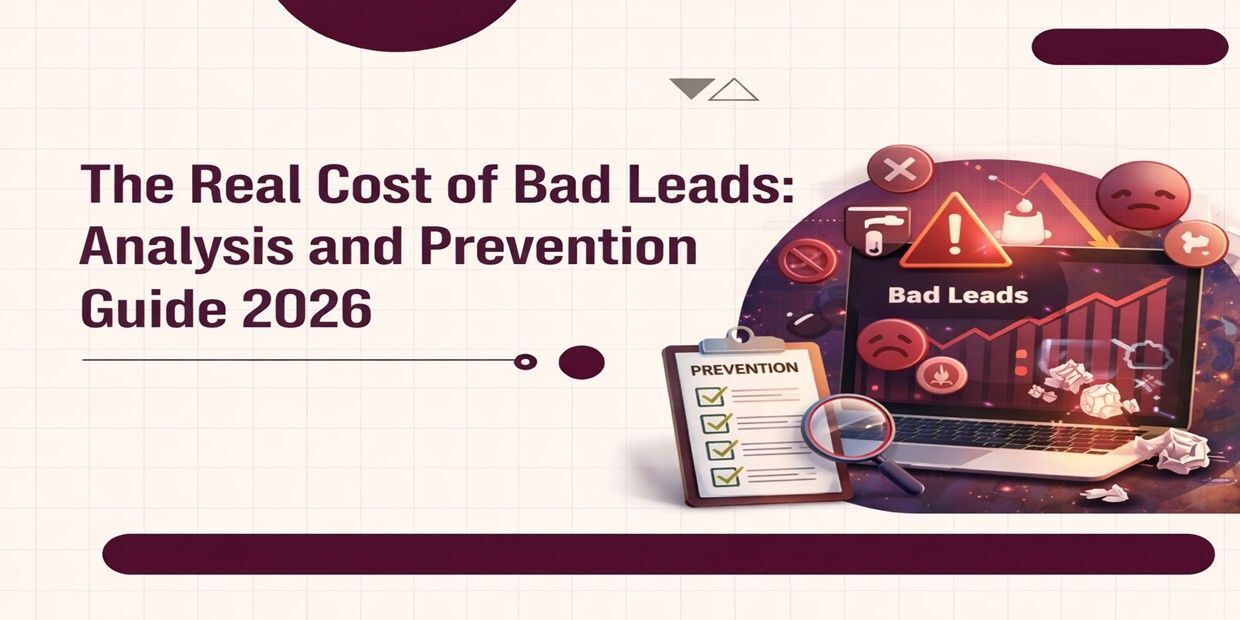
Every bad lead your team chases costs you more than you think and most companies have absolutely no idea how much.
It's not just a missed deal. It's your SDR's salary burning on a dead-end call. It's your AE's quota slipping because they spent Tuesday on a prospect with no budget. It's your marketing team celebrating MQL numbers that sales will never close. It's a slow leak that quietly drains your revenue, your team's morale, and your pipeline's credibility quarter after quarter.
In 2026, B2B quality leads aren't just a nice-to-have. They're the difference between a sales team that hits number and one that burns out chasing ghosts.
This guide breaks down the real, quantified cost of bad leads and exactly how to stop them from poisoning your B2B lead generation engine.
The Numbers Are Worse Than You Think
Before strategies, look at the damage bad leads are already doing:
- Gartner estimates poor data quality costs organizations an average of $12.9–$15 million per year (Gartner via Integrate.io, 2026)
- U.S. businesses lose approximately $3.1 trillion annually due to poor data quality (IBM)
- 79% of marketing leads never convert into sales due to poor lead quality and ineffective nurturing (Salesforce via G2, 2026)
- 50–80% of incoming leads are unqualified at the point of handoff to sales (Salesforce via AgentiveAIQ, 2025)
- 67% of lost sales opportunities stem directly from reps not properly qualifying leads before pursuit (Landbase, 2026)
- Bad data causes B2B marketers to target the wrong decision-makers 86% of the time (FirstEigen, 2025)
The headline stat most companies overlook? Only 35% of sales professionals completely trust their own customer data, meaning the pipeline they're working from is already suspect before a single call is made (Kondo, 2025).
What Is a "Bad Lead" in B2B?
Not all bad leads look the same. They fall into four categories:
1. Wrong-fit leads — Companies or contacts that don't match your ICP. Wrong industry, wrong company size, wrong geography. No amount of nurturing converts them.
2. Outdated leads — Contacts who have changed jobs, companies that have pivoted or been acquired. B2B contact data decays at ~30% per year, meaning a list that was accurate last January is already 30% garbage (ZoomInfo via Peliqan, 2026).
3. Low-intent leads — Contacts who downloaded a whitepaper out of curiosity, not because they're evaluating your solution. They inflate MQL counts and mislead your pipeline forecast.
4. No-authority leads — Practitioners and individual contributors passed off as decision-makers. 61% of initial leads lack either budget allocation or purchasing authority (Landbase, 2026), the two most critical qualification factors in B2B.
The Hidden Costs: Where Bad Leads Actually Hit You
1. Wasted Selling Time
This is the most direct cost and the most underestimated.
- Sales reps lose 27.3% of their time because of bad contact data (ZoomInfo via Leads at Scale, 2025)
- Unqualified leads waste 33% of a sales rep's time, more than one full day per week (Forrester via AgentiveAIQ, 2025)
- Nearly 50% of sales reps' time gets wasted on poorly matched prospects (SalesHive, 2025)
- Sales reps already spend only 28–30% of their time actually selling, the rest goes to admin, data entry, and chasing cold leads (Salesforce State of Sales, 2024)
Run the math on your team. If an SDR costs $80,000/year and spends a third of their time on leads that will never convert, you're burning $26,000+ per rep per year on bad data alone — before factoring in tools, benefits, and management overhead.
2. Damaged Email Deliverability
Bad leads don't just waste time. They actively break your outbound infrastructure.
- High bounce rates from stale contacts trigger spam filters and damage your sender reputation
- Once blacklisted, your domain's deliverability can take months to recover
- Every email that bounces or gets marked as spam reduces inbox placement for every email you send including to real prospects
The average B2B cold email reply rate has already collapsed to 5.1% in 2026 (SalesSo, 2025). A poisoned sender reputation pushes that number even lower.
3. Skewed Forecasting and Pipeline Bloat
When bad leads enter your CRM, they don't just sit there. They distort everything downstream:
- Inflated pipeline — Revenue forecasts built on unqualified opportunities miss badly, eroding leadership trust in marketing
- Wasted AE time — Account executives spend time on "opportunities" that were never real
- Misallocated territory planning — Resources go to regions and segments that look good on paper but don't convert
85% of B2B marketers struggle to connect marketing performance to business outcomes (G2 Lead Generation Statistics, 2026) and bad leads are the primary reason why.
4. Sales-Marketing Misalignment
Nothing poisons the relationship between sales and marketing faster than a steady stream of low-quality leads.
- 41% of B2B marketers report difficulty aligning marketing-generated leads with sales expectations (G2, 2026)
- Only 13% of leads passed from marketing to sales become SQLs, meaning 87% of what marketing sends over fails sales qualification (Landbase, 2026)
- 61% of B2B marketers send all leads directly to sales without qualification, even though only 27% are actually sales-ready (HubSpot via Clickback)
The result? Sales distrusts marketing. Marketing resents sales. And both teams lose.
5. Rep Burnout and Turnover
This is the cost nobody puts in a spreadsheet but every sales leader feels it.
Chasing unqualified leads is demoralizing. Repeated rejection from wrong-fit prospects erodes confidence. Bad leads don't just cost money, they cost you your best people.
- SDR attrition rates run 35–40% annually
- Replacing an SDR costs between $30,000–$60,000 in recruiting, onboarding, and ramp time
- New reps take 6–12 months to reach full productivity
When bad leads are a constant, top performers leave. Entry-level reps follow. The cycle repeats.
What Generates B2B Quality Leads? A Prevention Framework
Diagnosing the problem is half the battle. Here's how to fix it.
Step 1: Define Your ICP With Ruthless Precision
Vague ICPs produce bad leads at the source. Before any lead enters your pipeline, you need sharp criteria:
- Firmographics: Industry, company size (employees + revenue), geography, growth stage
- Technographics: What tools they currently use (especially if you integrate with or displace them)
- Behavioral signals: What topics are they researching? Are they in-market now or just curious?
- Authority signals: Does the contact have budget ownership or at minimum meaningful influence?
Only 25% of leads have sufficient quality to advance directly to sales (Landbase, 2026). A well-defined ICP is what ensures the other 75% never waste your sales team's time in the first place.
Step 2: Implement Intent-Based Prospecting
Stop building lists of who could buy. Start targeting who is actively researching solutions like yours.
Intent data platforms (Bombora, 6sense, G2 Buyer Intent) track third-party signals: which companies are consuming content about your category, visiting competitor sites, or engaging with industry publications.
The impact is real: teams that nail lead qualification see 7x higher conversion rates and close deals 30% faster than those that don't (SalesSo, 2025).
Step 3: Build a Lead Scoring System — Then Actually Use It
Only 44% of companies score leads at all (SPOTIO, 2026). That means more than half of B2B teams are routing leads to sales based on gut feel.
An effective lead scoring model weights:
- Fit signals (ICP match: industry, company size, title)
- Intent signals (content downloads, page visits, email engagement, third-party intent)
- BANT factors (Budget, Authority, Need, Timeline)
- Negative signals (student emails, wrong geography, competitor employees)
Set a minimum threshold — leads below 60/100 go to nurture, not sales. This single change alone can recover significant rep time.
Step 4: Enforce a Lead Qualification Gate Before Sales Handoff
Marketing and sales need a jointly defined, documented Service Level Agreement (SLA) for what constitutes an SQL.
- Marketing qualifies based on: engagement, content consumption, form fills
- Sales qualifies based on: BANT criteria, confirmed ICP fit, verified contact authority
- The gate between them — the Sales Accepted Lead (SAL) stage is where qualification discipline makes or breaks your pipeline quality
Organizations implementing structured qualification frameworks report immediate improvements in win rates and resource allocation efficiency (Landbase, 2026).
Step 5: Clean and Enrich Your CRM Data Continuously
A one-time data cleanup isn't enough. With B2B contacts decaying at 30% per year, your CRM needs ongoing hygiene:
- Deduplicate records quarterly
- Use data enrichment tools (ZoomInfo, Cognism, Apollo) to refresh titles, company info, and direct dials
- Remove or re-route contacts who have bounced, gone cold, or changed companies
- Validate email addresses before any campaign goes out
43% of COOs now identify data quality issues as their most significant data priority (IBM Institute for Business Value, 2025) and the companies that act on it protect both pipeline health and sender reputation.
Step 6: Respond to High-Intent Leads Fast
Lead quality only converts into revenue when follow-up is timely.
- Responding within the first hour multiplies qualification odds 7x over leads contacted after 24 hours
- Companies that follow up within 5 minutes see contact rates 10x higher than those who wait 10+ minutes (SPOTIO, 2026)
- Yet the average lead response time is still 47 hours an inexcusable gap for any team serious about converting intent signals into pipeline
Speed-to-lead is especially critical in B2B because high-quality leads are often evaluating multiple vendors simultaneously. The first rep in the conversation sets the frame.
Quick-Reference: Bad Lead Cost Calculator
|
Cost Category |
Estimated Annual Impact |
|
Rep time wasted on bad data (27–33%) |
$26,000–$49,000 per SDR |
|
Poor data quality (avg. org) |
$12.9M–$15M (Gartner) |
|
Revenue lost to bad data (MIT Sloan) |
15–25% of potential revenue |
|
SDR replacement from burnout/turnover |
$30,000–$60,000 per rep |
|
Email deliverability damage |
Campaign-level revenue loss |
|
Skewed forecasting |
Missed quota + budget misallocation |
Bottom Line
Bad leads don't just fail to convert. They actively cost you in time, in money, in team morale, and in the credibility of your entire go-to-market motion.
The companies that win in B2B in 2026 aren't the ones generating the most leads. They're the ones generating the right leads qualified by fit, verified by data, timed by intent, and routed to sales fast enough to matter.
Quality over quantity isn't a platitude. In B2B lead generation, it's the only math that makes sense.
Stop Filling Your Pipeline With Leads That Don't Convert
If your sales team is wasting time on bad leads or your MQL numbers look great but SQLs tell a different story that's a solvable problem.
Revnew specializes in B2B lead generation built around fit, intent, and qualification. We don't hand your team a list. We hand your team conversations.
Sources:
- Gartner / Integrate.io — Data Quality Cost 2026
- IBM — True Cost of Poor Data Quality, 2026
- G2 — Lead Generation Statistics 2026
- Landbase — Lead Qualification Statistics 2026
- SalesSo — Sales Qualified Lead Statistics 2025
- SPOTIO — 140+ Sales Statistics, 2026 Update
- Leads at Scale — Cold Calling Statistics 2025
- AgentiveAIQ — When to Disqualify a Lead, 2025
- Peliqan — Data Quality Best Practices, 2026
- FirstEigen — Cost of Bad Data, 2025