

The Complete Firmographic Data Guide for B2B Sales & Marketing
The VP asks one question: "How many of these companies could actually afford us?"
Silence.
That's a firmographic data problem. Not a sales execution problem. Not a messaging problem. The filter was missing from the start.
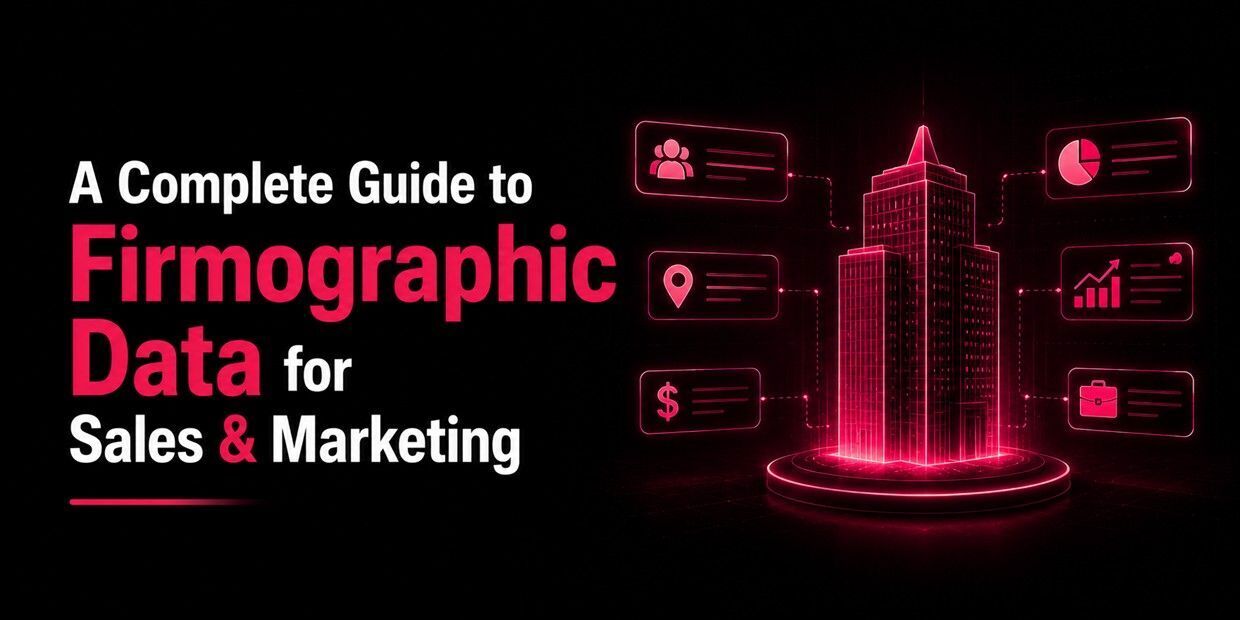
Firmographics are the organizational equivalent of demographics, but instead of describing a person, they describe a company: industry, headcount, revenue, location, and legal structure. Together, they answer the single most important question before any outreach begins: Is this company even a fit?
In 2026, with AI making it easier than ever to reach more people faster, the teams without a firmographic filter aren't just wasting time; they're burning budget at scale. This firmographic data guide breaks down the variables that matter, real firmographic data examples, and a step-by-step model for building segments that actually drive revenue.
What Is Firmographic Data?
Firmographic data is the set of attributes that describe a company rather than an individual buyer. Where B2C marketers lean on demographics (age, gender, income), B2B teams rely on firmographics to qualify accounts before a single email goes out.
Used well, firmographics become your first revenue filter, the thing that stops your reps from spending Tuesday morning calling companies that could never sign your contract. Used poorly (or not at all), they're the silent reason your win rate won't move, no matter how good your sequences get.
The 5 Core Firmographic Variables (Firmographic Data Examples)
Most B2B teams use just two firmographic filters: industry and company size. That's a start. Here's the full picture — five firmographic data examples and what each one actually tells you.
1. Industry — classified through SIC or NAICS codes. This isn't only about relevance; it's about win rate. If your product wins 34% of deals in Financial Services and 6% in Retail, your industry classification data is a revenue decision, not just a targeting preference.
2. Company Size — measured by employee count. A 15-person startup and a 5,000-person enterprise are not the same buyer, even if they share the same job title in the same industry. They have different budgets, procurement processes, and risk tolerances. Treating them identically results in generic messaging that resonates with no one, which is exactly why company-size segmentation matters.
3. Annual Revenue — the most underused firmographic variable. Employee count tells you size; revenue tells you purchasing power. A professional services firm with 80 employees could be doing $40M ARR. A funded startup with 200 employees might still be pre-revenue. Revenue-based targeting stops you from pitching enterprise contracts to companies that can't write the check.
4. Location — beyond just "where they are." In 2026, location data drives territory management, compliance relevance (GDPR vs. CCPA), and, in some industries, physical-asset targeting. For Revnew clients selling to field-based businesses, location firmographics are often the primary segmentation layer.
5. Legal Status — publicly traded, private, PE-backed, non-profit. A PE-backed company post-acquisition is in a completely different buying mode than a bootstrapped company in year three. This one variable can change your entire pitch angle.
On r/sales, an SDR team lead described what happens when you skip this layer:
"We had no revenue filter on our ICP. We were calling everyone from $1M startups to $500M enterprises with the same deck. Win rate was 4%. Added a revenue floor of $20M ARR, tightened the industry to three verticals. Win rate went to 14% in 60 days. Same product, same reps." — r/sales, u/icp_or_die
Firmographics vs. Technographics vs. Intent: Why You Need All Three
Here's where most firmographic data guides stop too early. Firmographics tell you who a company is. They don't tell you what it's running or whether it's buying right now.
|
Data Type |
Example |
What It Answers |
|
Firmographics |
$80M revenue, 200 employees, FinTech |
Are they a fit? |
|
Technographics |
Uses Salesforce, AWS, Workday |
Will our product integrate? |
|
Intent Data |
Surging searches on "compliance automation." |
Are they looking right now? |
The teams winning in 2026 use all three in sequence. Firmographics set the filter. Technographics confirm compatibility. Intent data determines timing.
At Revnew, we ran this three-layer approach for a compliance SaaS client who had solid meeting volume but poor close rates. The firmographic audit came first: they were booking meetings with companies in their revenue range, but the wrong industry mix, 30% of the pipeline sat in verticals where the product had a sub-8% historical win rate.
We tightened the industry classification data to four high-win verticals, added a technographic filter (companies running legacy GRC tools), and overlaid intent signals for compliance-related search surges. Pipeline quality improved immediately. Close rate climbed from 11% to 23% over two quarters, without increasing outreach volume.
How to Build Firmographic Segments That Drive Revenue
Strong firmographic segmentation isn't a one-time list scrub. It's a repeatable model. Here's the three-step version that works in practice.
Step 1: Build Revenue Tiers, Then Separate Your Plays
SMB, Mid-Market, and Enterprise aren't just size labels; they're completely different sales motions:
- SMB needs speed and self-serve proof.
- Mid-Market needs ROI justification and champion enablement.
- Enterprise needs multi-stakeholder sequencing and procurement patience.
If your team runs the same play across all three tiers, your firmographic segmentation isn't doing its job. This is where revenue-based targeting and company size segmentation intersect to define how you actually sell, not just who you sell to.
Step 2: Filter by Win-Rate Vertical, Not Just Relevant Vertical
There's a difference between industries where your product could work and industries where you actually win. Pull your last 24 months of closed-won data and build your industry filter based on win rate, not assumptions. Done right, your industry classification data and company size filters intersect to reveal your real ICP sweet spot.
Step 3: Add Growth Signal as a Dynamic Layer
Static firmographics miss one of the strongest buying signals in B2B: growth velocity. A company that jumped from 50 to 150 employees in 12 months has urgent infrastructure needs, systems are breaking, and a budget has already been approved for fixes.
Year-over-year headcount growth is now trackable in real time through LinkedIn Sales Navigator and ZoomInfo, and it's one of the most reliable ways to use firmographic data in B2B to time your outbound. If you want to know when to reach out, the growth signal is your trigger.
A thread on r/B2Bmarketing captured why this matters:
"We started filtering our Outreach sequences by 30%+ YoY headcount growth within our ICP verticals. Response rates went up significantly. These companies aren't just a fit, they're actively in pain and have budget to fix it." — r/B2Bmarketing, u/segmentation_nerd
At Revnew, we typically run a firmographic data audit before building any outbound program. In a recent engagement with an HR tech client, the audit revealed no revenue floor in their ICP; they were actively sequencing companies doing under $5M ARR with an enterprise-tier product starting at $60K ACV. 42% of their active pipeline had no purchasing capacity.
Removing those accounts and reallocating that effort to revenue-qualified companies doubled their meeting-to-opportunity conversion rate in the first month. And if your internal team doesn't have the bandwidth to redirect outreach at that scale, Revnew's SDR Outsourcing Services put trained reps behind your revenue-qualified segments so the right accounts actually get worked.
FAQs
Q: What's the most important firmographic variable to define first when building an ICP?
Annual revenue, because it directly determines purchasing power. Employee count is a useful proxy, but it can mislead; a 50-person consulting firm and a 50-person funded startup have very different budget realities. Start with a revenue floor and ceiling, then layer in industry and headcount. This order prevents the most common ICP mistake: targeting the right-sized company that simply can't afford you.
Q: How often should firmographic data be refreshed?
At a minimum, quarterly for your active pipeline, and monthly for high-priority accounts. Companies change fast; headcount, revenue stage, leadership, and funding status all shift. A firmographic profile that was accurate six months ago may no longer reflect an account that is buying-ready. ZoomInfo and LinkedIn Sales Navigator both support dynamic list updates that can automate this refresh cycle.
Q: How does firmographic segmentation change the actual sales message?
Dramatically. A CFO at a 200-person mid-market manufacturing firm cares about supply-chain cost reduction and implementation risk. A CFO at a 200-person high-growth SaaS company cares about scalability and speed to value. Same title, same headcount, completely different conversation. Firmographic segmentation is what gives your messaging its specificity; without it, you're writing for a fictional average buyer that doesn't exist in any real account.
Q: What's the difference between firmographic data examples like revenue and intent data?
Firmographic data examples (revenue, headcount, industry, location, legal status) describe what a company is and whether it fits your ICP. Intent data describes what a company is doing right now, the research and search behavior that signals active buying. You need both: firmographics to qualify, and intent to time the outreach.
Before your next campaign launches, ask the question your VP will eventually ask: Do you have a revenue floor in your ICP, or are your reps sequencing companies that couldn't sign your contract even if they wanted to?
If the honest answer is "I'm not sure," start with a firmographic data audit; it's the fastest way to stop burning budget on accounts that were never a fit.