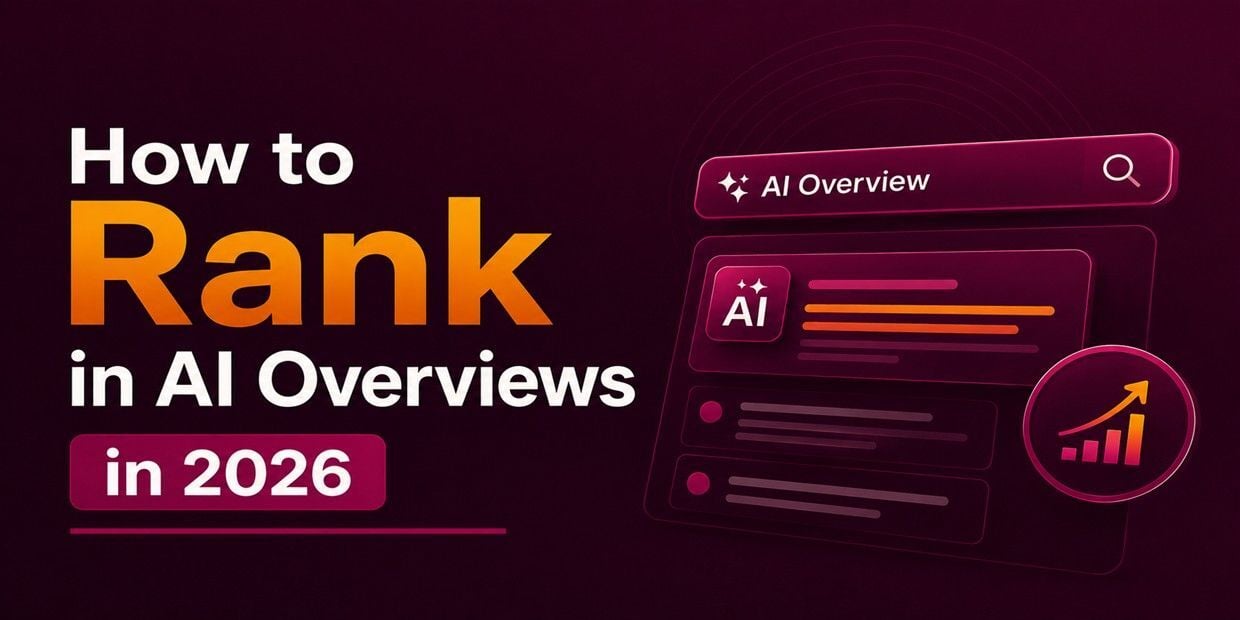

How to Rank in AI Overviews And Appear In AI Answers In 2026
Your organic traffic quietly started dropping with no algorithm update to blame.
Here's what actually happened: your buyers stopped clicking. They're getting answers directly from ChatGPT, Google AI Overviews, and Perplexity without ever visiting your site. That #1 ranking you worked so hard for? It's now sitting below an AI-generated summary that already answered the question.
Organic CTRs have dropped 61% for queries where an AI Overview appears. (SEOmator, 2026)
This blog walks you through exactly what to do, step by step.
Rank in AI Overviews & AI Answers In 2026
Start Writing for AI Citations.
Here's the mental shift that changes everything: AI engines don't rank pages, they quote them. Your job is no longer just to rank, it's to become the source an AI confidently cites when a user asks a question.
Two terms you'll hear constantly:
AEO (Answer Engine Optimization) — Getting your content featured directly inside AI answer boxes like Google AI Overviews or ChatGPT responses.
GEO (Generative Engine Optimization) — Broader visibility across all AI-generated outputs, using structure, schema, and entity signals so LLMs can understand and surface your content.
The difference from traditional SEO? Traditional SEO gets you a click. GEO gets you quoted, even when no one clicks at all.
Rewrite Your Content With the Answer Up Front (Do This First)
This is the single highest-impact change you can make today.
44.2% of all LLM citations come from the first 30% of a page's content. (Position Digital, 2026) If your key point is buried in paragraph six, AI engines will skip it entirely.
The fix — use the Inverted Pyramid:
- Answer the question directly in your first 1–2 sentences
- Support it with data and context
- Close with examples and nuance
Example — Before (typical blog intro): "Content marketing has evolved significantly over the past decade. In this post, we'll explore several strategies that businesses can use to improve their visibility online..."
Example — After (AI-ready): "The fastest way to appear in AI Overviews is to lead every page section with a direct, one-sentence answer to the question your heading asks. AI engines extract answers from the top of content first."
See the difference? The second version is quotable in two seconds. Go through your top 10 pages and rewrite the first paragraph of every H2 section this way.
Structure Every Page So a Machine Can Read It in 10 Seconds
AI crawlers don't read your content the way humans do. They scan for structure, extract key claims, and move on. If your page looks like a wall of text, it gets ignored.
Your page structure checklist:
- H2 and H3 headers phrased as questions or clear topic labels ("How Does Schema Markup Help AI Visibility?" not "More About Schema")
- Paragraphs capped at 3 sentences
- Bullet points and numbered lists wherever you're listing anything
- A dedicated FAQ section at the bottom of every post
- FAQ Schema and Article Schema implemented in JSON-LD
Real example: Semrush consistently appears in AI-generated answers across ChatGPT and Google. Look at any of their blog posts, every H2 section opens with a 1–2 sentence direct answer, followed by a tight list. They've essentially built their entire content library as an extraction-ready database.
Pages with structured data appear 60% more often in AI-generated answers. (Lform, 2025) This isn't optional formatting, it's infrastructure.
Build Topical Authority Before You Chase Individual Keywords
One great article won't cut it. AI systems evaluate your entire domain's depth on a subject before deciding whether to trust and cite you.
Think of it like this: if you've published 3 articles on B2B lead generation, you're a visitor to that topic. If you've published 30 deeply interconnected articles on it, you're an authority — and AI engines treat you accordingly.
How to build it:
- Pick 2–3 core topic areas your business owns and go deep, not wide
- Create a pillar page for each topic, then build 6–10 supporting sub-topic articles that link back to it
- Update your existing content every 3–4 months, Perplexity alone pulls 50% of its citations from content published in 2025 only
A B2B SaaS company in eLearning Industry's case study did exactly this: they stopped spreading thin across topics, focused deeply on one subject at a time, and saw a 32% increase in clicks and 43% growth in impressions with consistent AI Overview placements as a result.
Get Your Brand Mentioned Everywhere, Not Just Ranked Somewhere
Here's the stat that should change your entire marketing perspective:
Branded web mentions have a 0.664 correlation with AI Overview appearances. Backlinks? Only 0.218. (SEOmator, 2026)
AI engines don't just look at your website. They scan the entire web for signals that your brand is real, trusted, and worth citing. If you only exist on your own domain, AI treats you with skepticism.
Actions to take this month:
- Pitch 2–3 industry publications for a contributed article or expert quote — you want your name on someone else's domain
- Get listed and reviewed on G2 or Capterra — AI engines surface these heavily
- Answer questions authentically in relevant Reddit threads and LinkedIn discussions (not promotional — genuinely helpful)
- Make sure your brand name, description, and positioning are consistent across every external mention — AI cross-references these for a "consensus signal"
Think of digital PR not as a link-building tactic, but as your AI visibility engine.
Optimize for ChatGPT and Perplexity Differently, They Work Nothing Alike
Most brands treat AI SEO services as SEO done embedding AI in the process. It's not. ChatGPT, Perplexity, and Google AI Overviews pull from different sources and reward different behaviors.
For ChatGPT: 92% of the time, ChatGPT agents use Bing's index to search. (Search Engine Land, 2025) That means your Bing presence matters. Set up Bing Webmaster Tools, submit your sitemap there, and monitor your Bing rankings the same way you track Google.
For Perplexity: It searches the live web on every query and shows clickable citations; meaning it can drive real, trackable traffic. It heavily favors fresh content, original data, and question-framed headers. If your article's H2 matches exactly how a user would phrase their question, you're already ahead. Also check your robots.txt. Many sites accidentally block PerplexityBot without realizing it.
For Google AI Overviews: This one is most tied to traditional SEO. 76.1% of AIO citations already rank in Google's top 10. (Ahrefs, 2025) So the foundation is solid organic SEO, but layered with FAQ schema, answer-first formatting, and E-E-A-T signals like author bios with real credentials.
Only 13.7% of domains are cited by both ChatGPT and Google AI Overviews. (SEOmator, 2026) Success on one does not guarantee the other. Build for both intentionally.
Measure What Actually Matters In 2026
Ranking reports alone won't show you what's happening. Add these to your reporting:
- Manual prompt testing weekly — search your top 20 keywords in ChatGPT, Perplexity, and Google AI. Screenshot what appears. Track whether your brand shows up and how it's described.
- AI referral traffic in GA4 — create a custom channel group for chatgpt.com and perplexity.ai referrals, separate from standard organic
- Bing rankings — as a leading indicator for ChatGPT citation eligibility
- Brand mention volume — use a tool like Semrush Brand Monitoring or similar to track off-site references across the web
Only 16% of brands track AI search performance systematically. (McKinsey, 2025) The ones who start now will have a compounding data advantage in 12 months.
Start Here: What to Actually Do This Week
- Rewrite the first paragraph of every H2 on your top 10 pages — lead with the direct answer
- Add FAQ sections and FAQ Schema to your 5 highest-traffic posts
- Set up Bing Webmaster Tools and submit your sitemap
- Check robots.txt — make sure GPTBot, PerplexityBot, and Google-Extended aren't blocked
- Pitch one industry publication for a contributed piece or expert quote
Integrating AI SEO services is something you must do as a brand to let your audience know you exist.
At Revnew, we help B2B teams build demand generation strategies built for this new search reality. If you want to talk about where your pipeline stands in the age of AI search, let's connect.
FAQs
Does traditional SEO still matter for AI visibility?
Yes, it's still the foundation. 76.1% of AI Overview citations come from pages already ranking in Google's top 10. But structure, E-E-A-T, and off-site mentions now matter just as much as rankings alone.
How is ChatGPT citation different from Google AI Overview citation?
ChatGPT runs on Bing's index; Google AI Overviews run on Google's. Only 13.7% of domains appear in both. Optimize for each platform separately.
How do I measure AI search visibility?
Start with manual prompt testing across ChatGPT, Perplexity, and Google AI. Layer in GA4 AI referral tracking and Bing rank monitoring as proxy signals for ChatGPT citation eligibility.