
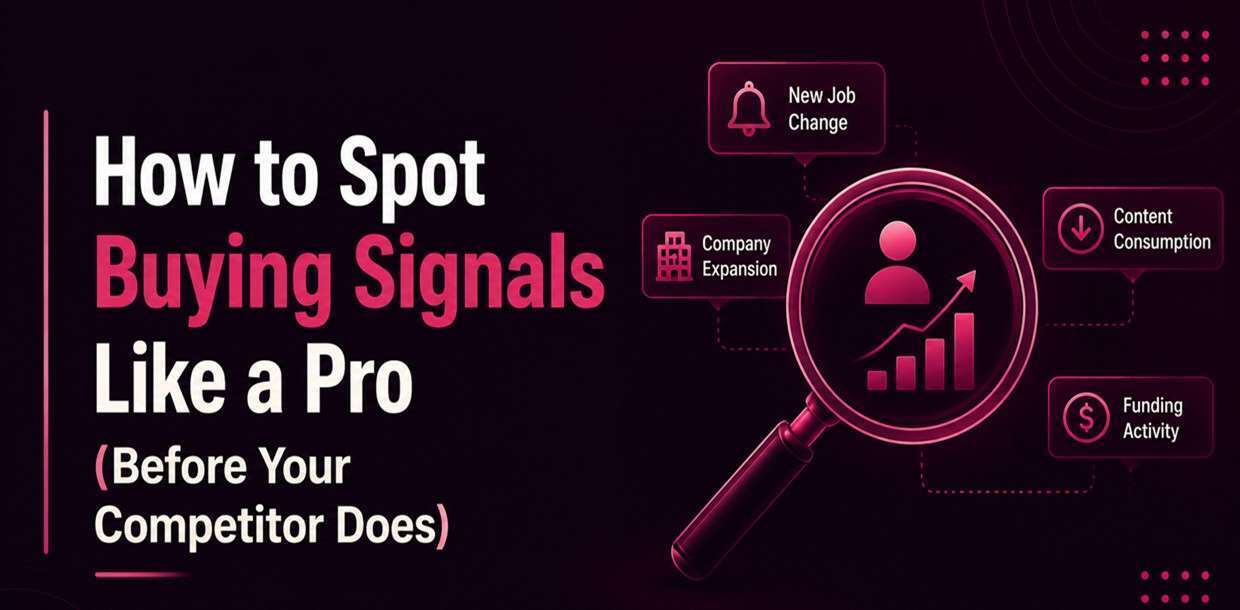

How to Spot Buying Signals Like a Pro
Buying signals are behavioral and intent-based actions that indicate a prospect may be ready to enter a sales conversation. These signals can include pricing page visits, funding announcements, job changes, content engagement, demo requests, technology adoption, or increased research activity across digital channels.
Learning how to spot buying signals like a pro helps B2B sales and marketing teams prioritize high-intent accounts, improve outreach timing, and increase conversion rates. Instead of relying on cold outreach alone, modern revenue teams use intent data, engagement tracking, and trigger-based prospecting to identify when buyers are actively evaluating solutions.
In 2026, the companies winning pipeline aren't necessarily doing more outreach, they're reacting faster to real-time buying intent.
How to Actually Spot Buying Signals in 2026.
1. Not All Page Views Are Equal. Weight Your Website Engagement Signals
This is where most teams get it wrong. They look at "time on site" and feel good. Meanwhile, the signals that actually predict revenue are hiding in plain sight.
The pages that matter: Pricing, Security/Compliance, and Competitor Comparison pages. If someone visits your pricing page three or more times in 48 hours, they are not browsing. They are building a business case. According to MarketBetter (2026), prospects who visit a pricing page three or more times are 4.2x more likely to convert than those who only read your blog.
Why the security page specifically? In 2026, "Does this pass our InfoSec review?" is often the first internal question before a deal can move. If they're on your SOC2 or compliance page, procurement is already in the conversation.
On r/sales, a senior AE described exactly this pattern:
"I started filtering my intent alerts to only fire when someone hit the pricing page AND the security docs within the same week. My connect rate on those accounts went from 8% to 22%." — r/sales, u/pipeline_or_bust
At Revnew, we ran this exact experiment for a cybersecurity SaaS client. We split their prospect list: one group triggered by any website visit, another triggered only by pricing + compliance page visits. The second group booked meetings at 3.1x the rate of the first, with half the outreach volume.
Intent signals for sales only work when you're weighting the right ones.
2. The Multi-Stakeholder Cluster: When One Person Becomes a Committee
Individual curiosity is a lead. A buying committee showing up together is a deal in motion.
The average B2B buying committee in 2026 has grown to 11.2 stakeholders (Gartner, 2026). When you see traffic from the same company IP, but across multiple devices, different times of day, hitting different pages, that's not one person doing research. That's internal alignment happening in real time.
The pro move: use identity resolution tools to map who from the account is looking at what. If the VP of Finance is on your ROI calculator while the Head of Engineering is reading your integration docs simultaneously, you don't have a lead, you have a live deal. And you should be doing multi-threaded outreach immediately, not waiting for one person to respond to your sequence.
This is one of the most underused prospect readiness indicators in B2B sales. Teams see the traffic. They just don't connect the dots.
3. Trigger Events: The Strongest Customer Purchase Signals Happen Off Your Website
Some of the most reliable customer purchase signals have nothing to do with your content at all. They're external context shifts that create urgency inside a company.
The big three:
- New executive hire — A new Head of Revenue Ops or VP of Sales almost always has a 90-day mandate to audit and replace existing tools. They want to make a change. They need a reason to act.
- Funding round or M&A activity — New capital means new headcount, new infrastructure needs, new budget holders who didn't choose the current stack.
- Competitor bad news — A major outage, a price hike, or a public controversy at a competitor creates an immediate "in-market" window for their entire customer base.
Sales teams that prioritize outreach based on these trigger events see a 30% higher win rate than those working static lists (Salesmotion, 2026).
A rep on r/salestechniques described how they used this in practice:
"Whenever TechCrunch or Crunchbase shows a Series B for a company in our ICP, I have a Zapier workflow that drops them into a priority sequence within the hour. I've closed three deals this quarter just from being first in the door after a funding announcement." — r/salestechniques, u/sequencethis
Revnew built a trigger-event layer for a HR tech client who was struggling with flat outbound results. We set up real-time alerts for three signals, funding rounds, new CHRO hires, and headcount growth above 20% in 60 days, and tied those to a dedicated fast-response sequence. Pipeline from outbound grew 41% in one quarter, entirely from accounts that hadn't been on their radar before.
4. The Champion Signal: Someone Is Selling For You Internally
This is the most underrated sales qualification signal in the entire process, and most reps fumble it.
If a prospect asks for an editable version of your deck, a white-labeled one-pager, or an ROI spreadsheet they can share internally, stop what you're doing. That person is now your internal champion. They are literally selling your solution to their CFO or CTO without you in the room.
Your job at this point is not to follow up with another email. Your job is to arm them. Give them everything: clean slides, a customized ROI model with their numbers already in it, a one-page executive summary their CFO will actually read. Make it easy for them to win the internal argument.
The deals that stall at this stage almost always stall because the champion didn't have the right material, not because the buyer wasn't interested.
5. Conversational Cues: Listen for "How" and "When," Not "Why"
Once you're in a meeting, the language shift tells you everything.
"Why should we consider this?" = still evaluating the category.
"How does this integrate with Salesforce?" or "What does implementation look like in week one?" = they're already mentally inside a future where they bought it.
Any question involving how or when is a live buying signal. Questions involving why mean you're still in education mode. Adjust your approach accordingly, don't pitch features to someone who's already past that stage.
The Bottom Line:
Spotting buying signals like a pro isn't intuition. It's data orchestration, connecting a LinkedIn comment, a pricing page visit, and a new hire announcement into a single prioritized action within 24 hours.
The highest-performing teams also rely on an intent data provider to identify real-time engagement signals and uncover which accounts are actively researching solutions before competitors even notice.
Most sales teams miss the live buying window because they're too busy executing a static sequence to notice the signals firing around them.
The fix isn't more outreach. It's smarter triggers.
FAQs
Q: What's the single highest-value buying signal to prioritize if I can only track one?
Pricing page visits, specifically repeat visits within a short window. It's the clearest indicator that someone is past curiosity and building an internal case. If you're only going to set up one alert, make it: "Account visited pricing page 2+ times in 7 days."
Q: How do we avoid false positives chasing signals that turn out to be noise?
Stack your signals before triggering outreach. A single signal (one page visit, one email open) is noise. Three independent signals from two or more sources, that's a buying window. At Revnew, we don't recommend activating a priority sequence until an account hits at least a first-party signal plus one external trigger event.
Q: How quickly should a rep respond once a strong buying signal fires?
Within the same business day, ideally within two hours for the highest-intent signals (pricing page + competitor comparison visit combo). Research from Salesmotion (2026) shows response time within one hour of a trigger event increases connection rates by up to 35%. Speed is a competitive advantage here, your competitor has access to the same intent data.
Quick gut check: does your team get alerted the moment a high-value account hits your pricing page, or are you still reviewing intent reports once a week?