.jpg?width=60&name=deepti%20(2).jpg)
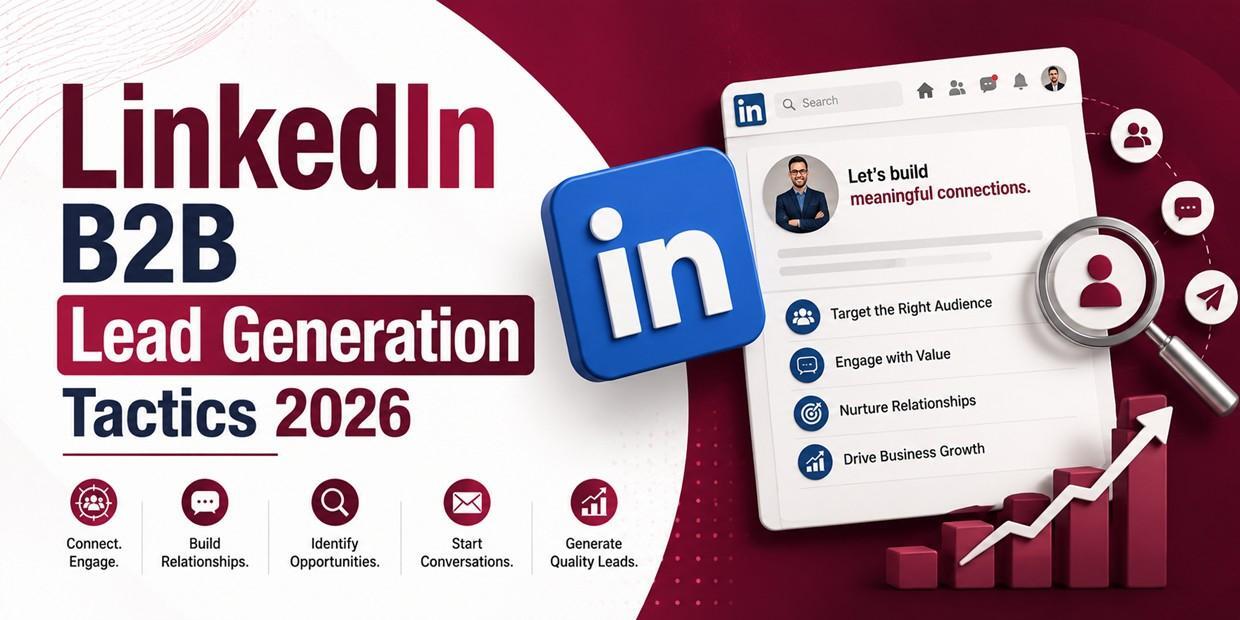
LinkedIn B2B Lead Generation Tactics 2026
The most effective LinkedIn B2B lead generation tactics in 2026 are ICP-filtered connection outreach triggered by behavioral signals, personalized InMail sequences under 75 words, thought leadership content from personal profiles rather than company pages, LinkedIn Sales Navigator for buying committee mapping, Lead Gen Forms for gated asset capture, and a post-connection nurture sequence that moves leads from awareness to booked meeting over 21 days.
Suppose you’re a B2B marketer or sales professional aiming to drive growth. In that case, this guide will walk you through the most effective strategies, practical steps, and proven techniques for a successful LinkedIn lead generation service, from profile optimization to personalized outreach.
80% of B2B social media leads come from LinkedIn. But the teams generating those leads aren't sending 200 connection requests a week from a generic profile. They're running LinkedIn as a coordinated outreach channel: with ICP targeting, signal-based timing, structured message sequences, and nurture tracks that maintain relevance between touchpoints.
Why LinkedIn Is Critical for B2B Lead Generation
LinkedIn’s value in B2B marketing lies in its unique professional audience and intent-based engagement. Unlike other social media platforms, LinkedIn users are business-oriented, and nearly half are decision-makers with purchasing power. For businesses seeking a reliable LinkedIn lead generation service, LinkedIn offers a perfect environment for effective outreach and meaningful connections
Here are the ten tactics that actually move the pipeline on LinkedIn in 2026.
Tactic 1: Optimize Your Profile as a Buyer-Facing Landing Page
Before any outreach goes out, your profile needs to pass one test: when a prospect who received your connection request looks at your profile, do they immediately understand what you do, who you help, and why it's relevant to them?
Most LinkedIn profiles fail this test because they're written for recruiters, not buyers. They lead with job titles, list responsibilities, and describe the company — none of which answers the buyer's actual question: "Is this person worth talking to?"
The five profile elements that build buyer trust:
|
Element |
Current Approach (Weak) |
Optimized Approach (Strong) |
|
Headline |
"Sales Manager at Revnew Inc." |
"Helping B2B SaaS Teams Build Predictable Pipeline — [Your Name] at Revnew" |
|
About section |
Career history and company description |
Lead with the problem you solve, who you solve it for, and one specific result |
|
Featured section |
Empty or generic company content |
Case study, relevant article, or gated asset that your ICP would want |
|
Experience section |
Job responsibilities |
Client outcomes and specific results |
|
Activity/posts |
Sporadic or absent |
Regular, relevant content that demonstrates category expertise |
The profile optimization isn't vanity work. A strong profile increases connection acceptance rates by 20–30%, meaning the same outreach volume produces more conversations before a single message is sent.
Tactic 2. Define and Target Your Ideal Customer Profile
For any LinkedIn lead generation service to succeed, it’s crucial to identify and target your ICP. LinkedIn offers numerous ways to define your ICP by criteria like industry, job title, company size, and location, making it easier to pinpoint high-quality leads.
-
Create a Clear ICP for LinkedIn
To maximize the effectiveness of your LinkedIn lead generation efforts, narrow your target audience based on relevant criteria.
For example, a consulting firm targeting manufacturers might focus on titles like “Operations Director” or “Supply Chain Manager” within companies of a specific size and geographic area.
-
Use LinkedIn Sales Navigator to Identify High-Quality Leads
LinkedIn Sales Navigator is an invaluable tool for a targeted LinkedIn lead generation service. Its advanced filters help businesses locate leads that precisely match their ICP.
Sales Navigator also offers insights on recent lead activities, such as recent content shares or profile updates, making it easier to identify leads showing signs of interest.
Tactic 3: Use LinkedIn Sales Navigator for Buying Committee Mapping
Single-threaded LinkedIn outreach creates single-threaded relationships, and single-threaded deals collapse when a champion leaves or loses internal support.
LinkedIn Sales Navigator changes the model. Instead of finding one contact per account, use it to map the full buying committee: Economic Buyer (CFO, VP of Finance), Technical Gatekeeper (CTO, IT Director, CISO), Champion (Head of Revenue Ops, VP of Sales), and End Users (the team actually using the product day-to-day).
Sales Navigator features that support buying committee coverage:
- Account lists — save target accounts and get real-time alerts for executive changes, funding, and growth signals
- Lead lists — build persona-specific lists for each buying committee role within the same account
- TeamLink — identifies warm paths to prospects through your colleagues' networks
- Intent data — surfaces accounts showing increased engagement with content in your category
- Alerts — notifies you when a contact changes roles, is mentioned in the news, or shares relevant content
The goal isn't to reach everyone at every account. It's to ensure that when your champion is trying to build internal consensus, other stakeholders at their company have already encountered your brand through a separate LinkedIn touchpoint.
Tactic 4: Build a Signal-Based LinkedIn Outreach Strategy
The most effective LinkedIn outreach strategy in 2026 isn't built around a fixed weekly cadence; it's built around signals that indicate when an account is in an active evaluation window.
The signals that should trigger LinkedIn outreach:
|
Signal |
What It Means |
Outreach Angle |
|
New executive hire in a relevant role |
90-day mandate to evaluate tools |
Reference their new position and offer relevant insight |
|
Company funding announcement |
New budget, new infrastructure needs |
Reference the growth and connect to scaling challenges |
|
Job posting for a role your solution supports |
Active problem in that function |
Reference the hiring signal and offer a relevant resource |
|
Competitor pricing change or outage news |
Potential dissatisfaction with the incumbent |
Reference the market event, not the competitor directly |
|
Prospect commented on relevant content |
Active engagement in your category |
Reference the content they engaged with |
|
Prospect viewed your profile |
Inbound interest signal |
Outreach within 24 hours while attention is fresh |
Signal-based outreach converts at 3–5x the rate of static-list outreach because the timing creates context: the prospect intuitively knows why you're reaching out now, even if you don't explicitly state the signal.
At Revnew, we rebuilt the LinkedIn outreach strategy for a B2B IT services client who was running volume-based connection campaigns, 150 connection requests per week, to a static list, with a generic follow-up message to everyone who accepted. Connection acceptance rate was 24%. Reply rate to follow-up was 1.8%.
We switched to signal-triggered outreach, connecting only with prospects who had shown a qualifying signal in the previous 14 days (role change, funding, a relevant job posting, or competitor news). Connection acceptance rate went to 52%. Reply rate to follow-up went to 7.3%. Volume dropped by 60%. Qualified pipeline from LinkedIn increased 38% in one quarter.
Tactic 5: Write LinkedIn Connection Requests That Don't Sound Like Sales Pitches
The connection request is the most wasted real estate in LinkedIn B2B lead generation. Most reps either send no note at all or send a note that reads like an introductory email, too long, too product-focused, and clearly templated.
The connection request framework that consistently gets accepted:
- Under 50 words total
- Reference something specific to them (post, role, company, shared connection)
- No pitch, no product mention, no CTA
- End with a statement, not a question; questions create commitment anxiety before trust is established
Examples:
Weak: "Hi [Name], I'd love to connect and learn more about your work at [Company]. We help companies like yours with [product pitch]."
Strong: "Hi [Name], saw your post on [topic], you made a point about [specific observation] that I haven't seen framed that way before. Would love to add you to my network."
Strong (trigger-event): "Hi [Name], congrats on the new role at [Company]. Exciting time to be joining that team. Would love to connect."
The goal of the connection request is one thing: get accepted. The conversation comes after.
Tactic 6: Use a Structured LinkedIn Outreach Sequence, Not Ad Hoc Messages
Once a connection is accepted, most reps either pitch immediately (too fast) or go quiet (too slow). Neither converts.
A structured LinkedIn outreach sequence gives you a system for building relevance before asking for anything.
The 5-touch LinkedIn outreach sequence:
|
Touch |
Timing |
Message Type |
Goal |
|
Touch 1 |
Day 0 — connection accepted |
Thank you + value-led observation |
Warm the connection |
|
Touch 2 |
Day 3–5 |
Share a relevant resource (case study, insight, article) |
Establish credibility |
|
Touch 3 |
Day 7–10 |
Reference something they posted or their company news |
Show genuine attention |
|
Touch 4 |
Day 14 |
Soft ask — offer something specific, one yes/no question |
Test buying readiness |
|
Touch 5 |
Day 21 |
Break-up message — remove pressure, invite future conversation |
Trigger a reply from fence-sitters |
Template for Touch 1 (Post-Connection Thank You):
Hi [Name], thanks for connecting. I noticed [specific observation about their role, company, or recent post]. We work with [similar company type] on [relevant challenge] and are happy to share anything useful if it's relevant to what you're working on.
Template for Touch 4 (Soft Ask):
Hi [Name], following up from a few weeks ago. Quick question: is [specific challenge your solution addresses] something your team is actively working on right now? Happy to share how we've approached it with [similar company] if it's useful.
Template for Touch 5 (Break-Up):
Hi [Name], I've reached out a couple of times, completely understand if the timing isn't right. I'll leave you to it, but if [specific problem] becomes a priority later, happy to reconnect.
Tactic 7: Create LinkedIn Content That Attracts Inbound Leads
Outbound LinkedIn outreach generates a pipeline. LinkedIn content generates inbound, prospects who come to you after seeing something that resonated.
The important distinction in 2026 is that company page posts have dramatically lower organic reach than personal profile posts. Your founders, sales leaders, and subject matter experts posting from their personal profiles will consistently reach the same content posted from the company page.
The content types that generate the most B2B lead generation on LinkedIn:
|
Content Type |
Engagement Level |
Lead Quality |
Best For |
|
Original takes on industry problems |
High |
High |
Building authority and inbound |
|
Contrarian perspectives |
Very high |
High |
Category leadership |
|
Behind-the-scenes results/learnings |
High |
High |
Trust-building |
|
Short-form video (under 90 seconds) |
Very high |
Medium |
Awareness and reach |
|
Carousels with tactical frameworks |
High |
Medium |
Save-and-share content |
|
Company news (product launches, hires) |
Low |
Low |
Awareness only |
|
Industry report summaries |
Medium |
High |
Mid-funnel consideration |
The content that generates the most qualified inbound leads is content that demonstrates a specific point of view about a problem your ICP faces, not content that announces your product or celebrates your company milestones.
Tactic 8: Use LinkedIn Ads for ABM and Buying Committee Coverage
Organic LinkedIn outreach reaches the prospects you've identified. LinkedIn Ads reach those who haven't responded yet, and the buying committee members you haven't contacted directly.
The three LinkedIn ad formats that drive B2B lead generation:
Sponsored Content — appears natively in the feed. Best for awareness and mid-funnel content distribution. Target by job title, company size, and industry simultaneously.
Lead Gen Forms — pre-filled forms that capture contact information without requiring the prospect to leave LinkedIn. Conversion rates run 3–5x higher than forms that require an external landing page. Use for gated assets: white papers, benchmark reports, webinar registrations.
InMail Ads (Message Ads) — sponsored messages delivered directly to LinkedIn inboxes. Best when personalized to a specific audience segment rather than broad blasts. Open rates average 50%+ because LinkedIn inboxes have less noise than email.
For ABM campaigns: upload your target account list to LinkedIn Matched Audiences and serve different ad creatives to each buying committee persona at the same company simultaneously. The Economic Buyer sees ROI-focused content. The Technical Gatekeeper sees compliance and integration content. The Champion sees content on efficiency and workflow improvement.
At Revnew, we built this buying committee ad layer for a cybersecurity SaaS client running LinkedIn ABM against 150 target accounts. Rather than a single campaign for all contacts, we ran three parallel campaigns: CFO/Finance, CISO/IT, and VP Sales/Revenue, each with persona-specific messaging and assets. Accounts with three or more stakeholders engaged converted to pipeline at 2.4x the rate of single-stakeholder accounts. The LinkedIn Ads budget was the same. The targeting architecture changed.
Tactic 9: Build a LinkedIn Lead Nurturing Sequence That Converts Connections to Meetings
Most LinkedIn lead-nurturing efforts fail because they conflate "staying in touch" with "adding value." Liking someone's posts every few weeks isn't nurturing. It's background noise.
Effective LinkedIn lead nurturing delivers specific, relevant value at predictable intervals, creating the kind of repeated exposure that builds familiarity, then trust, then pipeline.
The 30-day LinkedIn lead nurturing framework:
|
Week |
Action |
Purpose |
|
Week 1 |
Post content relevant to their function; engage with their posts genuinely |
Build passive familiarity |
|
Week 2 |
Share a case study or insight directly relevant to their industry via DM |
Establish direct value |
|
Week 3 |
Reference something specific they posted; ask one thoughtful question |
Demonstrate genuine attention |
|
Week 4 |
Soft CTA, offer a specific resource or a 15-minute call with clear context |
Convert attention to conversation |
The key variable that separates nurturing that works from nurturing that gets ignored: specificity. "Thought you'd find this interesting" is not nurturing. "Saw you're expanding into APAC, we helped [Company] navigate the same challenge last quarter, happy to share what we learned" is nurturing.
Metrics to track for LinkedIn lead nurturing effectiveness:
|
Metric |
What It Measures |
Target |
|
Message response rate |
% of outreach messages that generate a reply |
15–25% for personalized sequences |
|
Connection-to-meeting rate |
% of accepted connections that book a call |
5–10% over 30-day sequence |
|
Profile view to respond |
% of prospects who viewed your profile and then replied |
20–35% with strong profiles |
|
Content engagement to DM |
Prospects who engaged with content then initiated contact |
Track as an inbound quality signal |
Tactic 10: Measure the Right LinkedIn Lead Generation Metrics
The metrics most LinkedIn lead generation reports focus on: followers, impressions, and connection counts, tell you about reach. These metrics tell you about the pipeline:
|
Metric |
What It Actually Measures |
|
Connection acceptance rate |
Profile strength + outreach relevance |
|
Message reply rate |
Message quality + targeting precision |
|
Content-to-DM rate |
Content resonates with ICP |
|
LinkedIn-sourced meetings booked |
Full-funnel conversion |
|
LinkedIn-influenced pipeline |
Revenue contribution |
|
Lead Gen Form conversion rate |
Ad targeting + asset relevance |
The final metric, LinkedIn-influenced pipeline, requires CRM integration to track correctly. Tag all LinkedIn-sourced leads at the point of connection in Integrating LinkedIn with CRM tool like HubSpot so you can trace which LinkedIn activities (content, outreach, ads) are producing revenue, not just activity.
The LinkedIn audit worth running this week: pull your last 50 connection requests and check your acceptance rate. If it's below 30%, the problem is either profile strength or message relevance, both of which are fixable before you send another connection request.
Bottom Line
LinkedIn remains the most effective B2B social platform for building relationships with decision-makers, but success no longer comes from sending more connection requests. It comes from targeting the right prospects, acting on buying signals, delivering personalized value, and nurturing conversations until they're ready to buy.
The highest-performing sales teams in 2026 treat LinkedIn as a strategic revenue channel rather than just a networking platform. They combine Sales Navigator, intent signals, thought leadership, structured outreach, and consistent follow-up to create a predictable pipeline of qualified opportunities.
If your team is struggling to turn LinkedIn activity into booked meetings, it may be time to rethink your approach. Revnew helps B2B companies accelerate pipeline growth through data-driven LinkedIn Outreach Services that combine ICP targeting, personalized messaging, multi-touch nurturing, and sales-qualified appointment setting. Instead of chasing connections, build meaningful conversations that convert into revenue.
FAQs
Q: What is the most effective LinkedIn B2B lead generation tactic in 2026?
Signal-based connection outreach consistently produces the highest connection acceptance and reply rates, specifically, reaching out to ICP-fit prospects within 14 days of a qualifying signal (new role, funding round, job posting, or relevant content engagement). This works because the signal creates natural relevance: the prospect understands implicitly why they're receiving outreach now, making the message feel intentional rather than mass-produced. Combine signal-based outreach with a structured 5-touch follow-up sequence over 21 days for the highest connection-to-meeting conversion rate.
Q: How many LinkedIn connection requests should you send per week for B2B lead generation?
Quality over volume is the dominant principle for B2B lead generation on LinkedIn in 2026. LinkedIn's connection limits (approximately 100 per week for standard accounts, more with Sales Navigator) make mass outreach difficult; more importantly, high-volume, low-relevance outreach yields poor results regardless of volume. A targeted list of 30–50 ICP-fit prospects per week, with personalized, signal-triggered connection requests, will consistently outperform 150 generic connection requests. Focus on the connection acceptance rate as the primary quality signal; anything below 30% indicates either ICP or message quality needs improvement.
Q: How do you nurture LinkedIn leads without being pushy?
LinkedIn lead nurturing works when it consistently delivers specific, relevant value rather than repeatedly asking for a meeting. The framework that converts: engage genuinely with their content in week one, share a directly relevant resource via DM in week two, reference something specific they've shared in week three, and offer a specific low-friction CTA in week four. The distinction between helpful and pushy is specificity; generic "just checking in" messages are pushy regardless of frequency. A message that references their specific situation and offers something genuinely useful is helpful even if sent more frequently.