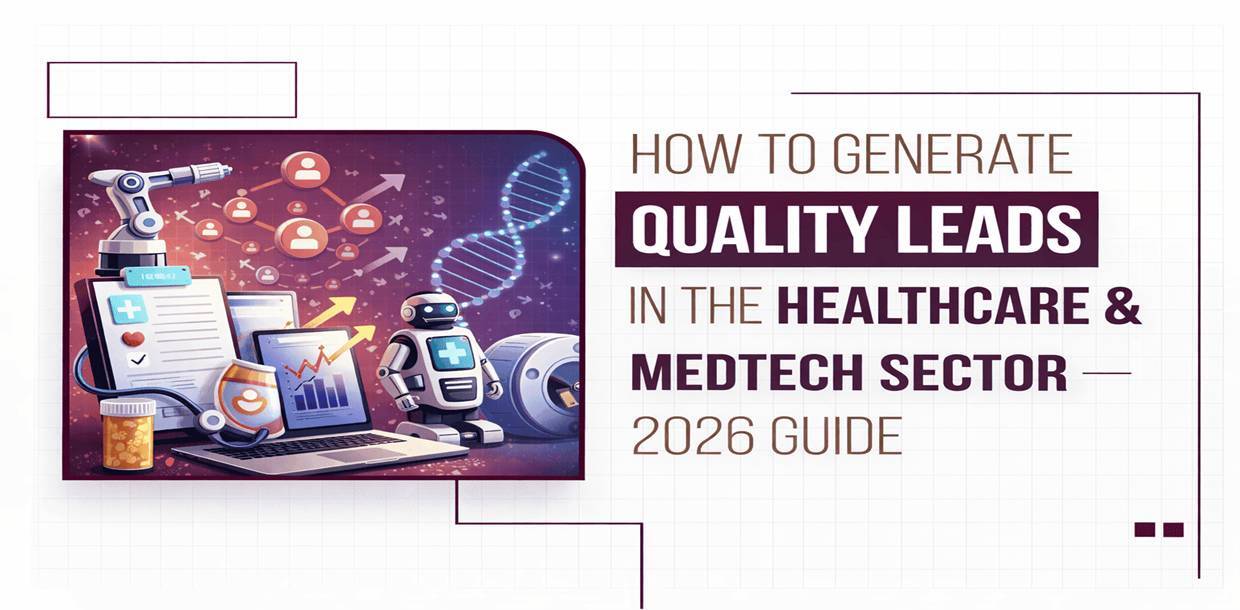


Healthcare & MedTech Lead Generation Guide in 2026
The MedTech and healthcare B2B space is one of the most rewarding and one of the most demanding sectors for lead generation. Long sales cycles, multi-stakeholder buying committees, heavy compliance considerations, and increasingly cautious decision-makers all make it harder than ever to generate leads that actually convert.
The global medical device market approaches $955B by 2030 amid chronic disease surges (Source).
If you're already familiar with the basics and are now looking to sharpen your outbound strategy, you've landed in the right place. This guide helps you move prospects who know you exist toward meaningful sales conversations.
Why MedTech Lead Generation Is Different from Every Other Industry
Why do standard B2B lead generation frameworks often underperform in healthcare and MedTech? The dynamics here are fundamentally different, and recognizing that is the first step to fixing your pipeline.
Healthcare buyers, whether they're hospital procurement directors, clinical informatics officers, or biotech VPs, operate under layers of institutional oversight. A 2023 Bain & Company report found that the average B2B healthcare purchase involves 6 to 10 decision-makers, compared to 3 to 4 in most other industries. This means your outreach needs to engage not just one champion but an entire buying committee simultaneously.
Additionally, trust is the currency of this industry. Healthcare organizations are slow to adopt new vendors because the cost of a wrong decision isn't just financial, it's clinical and reputational. This means your lead generation approach must prioritize credibility building at every touchpoint, not just aggressive pipeline filling.
Understanding Your Ideal Customer Profile in Healthcare
One of the most common mistakes in B2B healthcare outreach strategy is casting too wide a net. A well-defined Ideal Customer Profile (ICP) isn't just a nice-to-have in MedTech, it's the foundation of your entire outbound motion.
Segmenting by Buyer Persona
Different stakeholders in a healthcare organization have different priorities. Your messaging needs to reflect that. Here's how to think about the most common personas:
Table 1: Key Buyer Personas in MedTech & Healthcare
| Persona | Title Examples | Primary Pain Points | What They Care About |
|---|---|---|---|
| Clinical Decision-Maker | CMO, Chief Medical Officer, Clinical Director | Patient outcomes, clinical workflow disruption | Evidence-based outcomes, peer validation |
| IT & Informatics Lead | CIO, VP of IT, Health Informatics Manager | Integration complexity, data security, EHR compatibility | Compliance (HIPAA), interoperability, implementation support |
| Procurement & Finance | CFO, Procurement Director, Budget Analyst | Total cost of ownership, ROI timelines | Cost savings, vendor reliability, contract terms |
| Operations Leader | COO, VP of Operations, Facilities Director | Operational efficiency, staff adoption | Uptime guarantees, training support, scalability |
Understanding which persona you're speaking to at any given moment determines the angle of your outreach, the content you share, and the objections you'll need to address.
Firmographic Signals That Indicate Sales Readiness
For healthcare SaaS lead generation specifically, certain firmographic and technographic signals can indicate that an account is in-market before they raise their hand.
These include recent EHR platform migrations, new regulatory filings (particularly FDA 510(k) clearances for device companies), M&A activity, newly hired C-suite leaders, and budget cycle announcements. Monitoring these signals with tools like ZoomInfo, Definitive Healthcare, or Bombora gives your outbound team a meaningful edge.
High-Impact Tactics for MedTech Lead Generation
Knowing your audience is only half the battle. The other half is showing up in the right places, with the right message, at the right moment. Let's break down the tactics that are working in 2026.
Personalized Multi-Channel Outbound Sequences
Cold outreach in healthcare doesn't mean generic. The days of one-size-fits-all email blasts are over; especially with healthcare buyers who are bombarded with vendor communications and have near-zero tolerance for irrelevant messaging.
Effective outbound sequences for medical device lead generation and healthcare SaaS typically combine email, LinkedIn, phone, and direct mail in a structured, coordinated cadence. The key differentiator is hyper-personalization: referencing a specific pain point relevant to the prospect's institution, citing a recent news item about their health system, or mentioning a peer institution that achieved results using your solution.
Table 2: Recommended Outbound Sequence Structure for Healthcare Prospects
| Touch | Channel | Timing | Content Focus |
|---|---|---|---|
| 1 | Day 1 | Problem-aware opener with relevant industry stat | |
| 2 | LinkedIn Connection | Day 3 | Brief, non-salesy intro message |
| 3 | Day 6 | Case study or outcome-driven content | |
| 4 | Phone | Day 9 | Short voicemail referencing prior email |
| 5 | Day 13 | Thought leadership asset (white paper, report) | |
| 6 | LinkedIn Message | Day 17 | Soft CTA, invite to webinar or peer roundtable |
| 7 | Email (Breakup) | Day 22 | Low-pressure close with clear next step |
Research from Salesloft indicates that it takes an average of 8 touchpoints to generate a qualified B2B lead, and in healthcare, this number trends even higher, often between 10 and 14 before a meaningful conversation occurs.
Clinical Evidence and Case Studies as Trust Accelerators
In healthcare, social proof doesn't mean testimonials from marketing managers, it means clinical outcomes data and peer validation from comparable institutions. If you're selling a SaaS platform to hospital systems, a case study from a similar-sized hospital system with documented ROI (e.g., "reduced documentation time by 32% in 90 days") is exponentially more persuasive than a generic product overview.
Invest in producing case studies that are outcome-specific, quota-verifiable, and ideally co-authored or co-presented with your customer. Even better: facilitate peer-to-peer reference calls between your existing customers and prospective ones. This approach can shorten the sales cycle by weeks.
Webinars and Virtual Roundtables Targeting Clinical Buyers
Healthcare professionals respond well to educational, peer-learning formats. Webinars that bring in a clinical voice - a physician, a CNO, a health system CIO; rather than leading with your sales team consistently outperform product-centric demos in terms of attendance and MQL conversion.
Webinar attendees in healthcare are more likely to request a demo than those who only engage with static content.
Structure your webinars around a problem your ICP is actively trying to solve, not your product. Save the product conversation for follow-up outreach, where you now have a warm, engaged lead who has self-selected into your funnel.
LinkedIn as a B2B Healthcare Outreach Channel
LinkedIn remains the single most effective platform for B2B healthcare outreach strategy, particularly for reaching C-suite and VP-level healthcare executives who are increasingly active on the platform. Sponsored content, InMail campaigns, and organic thought leadership from your company's leadership team all play a role.
What works in 2026 specifically: short-form video content from clinical or domain experts on your team, LinkedIn Live sessions tied to regulatory or industry changes (e.g., CMS updates, FDA guidance), and executive commentary on sector trends. This positions your brand as an authority, so that when your SDRs reach out, the prospect already has a frame of reference.
Intent Data and Account-Based Marketing (ABM)
For medical device lead generation and healthcare SaaS lead generation, layering intent data into your ABM strategy significantly improves conversion rates. Tools like Bombora, TechTarget Priority Engine, and Definitive Healthcare's intelligence platform allow you to identify accounts that are actively researching topics related to your solution before they fill out a form or respond to a cold email.
When an account starts showing intent signals, that's the time to activate a coordinated ABM play: personalized ads, targeted outreach from your SDR team, and executive-to-executive outreach from your leadership. ̧
Bringing It All Together
The most successful B2B healthcare outreach strategies in 2026 are winning in medical device lead generation and healthcare SaaS lead generation right now are the ones that have stopped treating healthcare like a vertical and started treating it like a relationship. One built on trust, evidence, and a genuine understanding of what it means to operate in a regulated, high-stakes environment.
Start there, and the pipeline will follow.