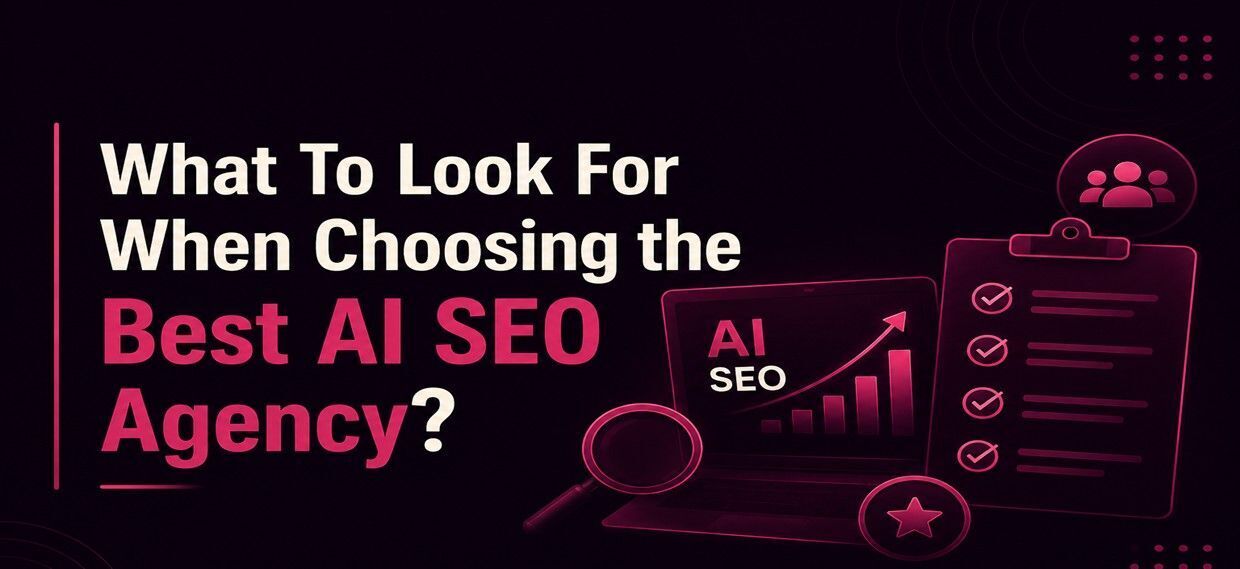

What To Look For When Choosing the Best AI SEO Agency?
The market for AI SEO services is flooded with providers who understand the vocabulary far better than the mechanics. Every agency is suddenly an "AI search optimization expert." Every retainer proposal mentions ChatGPT visibility, GEO, and AEO. Most of it is rebranded SEO with a fresh coat of jargon.
Choosing the wrong partner in this environment doesn't just waste your budget. It locks you into a strategy built on unproven tactics while your competitors quietly build real AI search authority. The brands showing up in AI-generated answers today are shaping buyer perception before prospects ever visit a website, and that window for first-mover advantage is narrowing.
This blog explains how to choose an AI SEO agency, what to look for, what questions to ask, and which red flags to walk away from.
How To Choose An AI SEO Agency: 6 Things To Exactly Look For
1. If They Understand That Traditional SEO and AI Visibility Are Not Separate Strategies
AI SEO company selection depends on how well the company understands your requirements and the market. The most important question you can ask any AI SEO agency isn't about ChatGPT. It's about whether they understand the connection between strong traditional SEO and AI search performance.
There is no GEO without SEO. AI systems like ChatGPT, Perplexity, and Google's AI Overviews draw from the same authority signals that traditional search has relied on for years; domain credibility, high-quality content, external links, technical health, and topical expertise. As SEO strategist Aleyda Solis has put it directly: GEO builds on top of SEO foundations. It doesn't replace them.
An agency that pitches AI SEO as a standalone product disconnected from your existing content and technical foundation is either uninformed or selling you something that won't work. The right AI SEO company selection process starts with a baseline audit: rankings, crawlability, backlink profile, and E‑E‑A‑T signals. That audit shows the infrastructure AI platforms evaluate before deciding what to cite.
What good looks like: An agency that asks about your existing content strategy, organic traffic trends, and technical SEO health before proposing any AI optimization work. One that talks about building authority across both traditional and AI surfaces simultaneously, not trading one for the other.
This is a core part of SEO agency selection tips focused on true AI search optimization.
2. If They Can Explain How They Actually Measure AI Visibility
Measurement is the biggest gap in the AI SEO market right now. Marketers accustomed to Google Analytics dashboards have no equivalent visibility into AI search performance and most agencies aren't filling that gap in any meaningful way (eMarketer, 2026).
GEO measurement is genuinely hard. ChatGPT, Perplexity, Gemini, and DeepSeek don't expose public APIs for rank tracking. Their answers are probabilistic; ask the same question twice and you may get different results. That's why real GEO tracking requires what researchers call synthetic probing: running large volumes of carefully designed prompts across AI platforms, then analyzing how often your brand appears, in what context, and with what sentiment (Topify, 2026).
Before signing with any agency, ask these three questions:
"How do you measure AI visibility?" A real answer involves specific tools (Searchable.co, Peec AI, BrandMentions, or comparable platforms), a methodology for prompt testing, and defined metrics like citation frequency, brand mention rate, and share of voice in AI answers. If their answer focuses on keyword rankings or organic traffic, they're not measuring AI search, they're rebranding their existing reporting.
"Which AI platforms do you track?" At minimum: ChatGPT, Perplexity, Claude, Google AI Overviews, and Bing Copilot. Stronger agencies also track Gemini, DeepSeek, and Google's AI Mode. If they can't name specific platforms or explain how each one pulls citations differently, they don't have platform-level expertise, they have a marketing slide (AI Advantage Agency, 2026).
"Can you show me a sample report?" The report should include prompt-level visibility data, citation rate trends over time, which of your URLs are being cited, competitor citation comparison, and how AI visibility correlates with downstream business outcomes. A report that only shows traditional SEO metrics is not an AI SEO report.
If their reporting focuses only on keyword rankings or organic traffic, they’re offering traditional SEO under the AI SEO label. This is a red flag in AI SEO company selection.
3. They Prioritize Content That Converts Over Content That Just Ranks
This is where many "AI SEO agencies" that emerged in 2025 quietly fail their clients.
The AI SEO market has created a surge in content volume, agencies pushing out large quantities of AI-generated blog posts targeting informational keywords under the banner of "building topical authority." The problem: bottom-of-funnel, conversion-focused content is what actually drives business outcomes. Top-of-funnel informational content can build awareness, but it rarely generates a qualified pipeline on its own.
A strong AI SEO agency asks about your ICP, your actual buyer questions, and which content formats are most likely to earn citations in AI-generated responses to commercial queries. They know that 44.2% of LLM citations come from the first 30% of text (Position Digital, 2026), which means intro-heavy, answer-first content structure matters more than long-form for AI citations. They write for conversion and citation simultaneously, not for volume.
They write for conversion and citation simultaneously. Asking “How do you decide what content to prioritize?” helps you apply SEO agency selection tips that matter to your business.
Their content process is human‑led, not AI‑led
What to ask: "Walk me through how you decide what content to prioritize." If the answer is primarily keyword volume and traffic potential, ask them specifically how they approach bottom-of-funnel content and how they structure content for AI extraction. Vagueness here is a signal.
4. Their Content Process Is Human-Led, Not AI-Led
This is a critical distinction that most agencies won't tell you upfront.
AI tools are exceptional at generating outlines, first drafts, keyword clusters, and optimization suggestions. They dramatically accelerate content production, agencies using AI tools can publish 47% more content per month than traditional agencies (SEOProfy, 2026). But AI-generated content that isn't meaningfully edited, enriched with genuine expertise, and aligned with your brand voice fails on two fronts: Google's E-E-A-T requirements, and the credibility signals AI platforms evaluate when deciding what to cite.
The best AI SEO agencies use AI to accelerate the process while keeping human strategy and editorial judgment at the center. The most cited content in AI answers shares a common trait: it contains specific data, original perspective, and demonstrable expertise that commodity AI content simply cannot produce at scale.
What to ask: "What percentage of your content is AI-generated versus human-written? What does your editorial review process look like?" Any AI SEO agency that can’t describe a clear human‑in‑the‑loop quality process is a risk. This is a key differentiator when selecting among top AI SEO companies.
5. They Build External Authority, Not Just On-Site Content
Getting cited by AI platforms is not purely an on-site content problem. AI systems are evaluating cross-source credibility; they're looking for consistent, multi-platform validation of your brand's expertise before recommending you.
This means a real AI SEO agency has a clear strategy for:
- Earned media and digital PR — getting your brand mentioned in credible industry publications, which significantly increases AI citation likelihood. Distributing content across a wide range of third-party publications can increase AI citations by up to 325% compared to publishing only on your own site (Stacker via Position Digital, 2026)
- Review platform presence — G2, Capterra, Trustpilot, and industry-specific review sites that AI systems regularly pull from as credibility signals
- Brand mentions on high-authority platforms — Reddit, LinkedIn, industry forums, and research platforms where AI models evaluate community consensus
- Structured external citations — links and mentions from sources that AI training data weighs as authoritative within your category
An agency proposing AI SEO work without an external authority-building component is missing half the picture. This is one of the core SEO agency selection tips for AI‑first brands and a strong indicator of a true AEO agency or GEO services‑focused partner.
6. They Can Show Proof, Not Just Promises
This is a critical filter in choosing an AI SEO agency.
AI SEO is newer than traditional SEO, and the honest truth is that the evidence base is still developing. But that doesn't excuse an agency from showing you any results at all.
Even if published case studies don't exist, a credible AI SEO agency should be able to:
- Show a before-and-after benchmark: where did the client appear in AI-generated responses before the engagement, and where do they appear now?
- Demonstrate citation rate improvement across specific query types over a defined period
- Share organic traffic and conversion data from content optimized for AI extraction
- Explain a specific client situation where their methodology changed AI search visibility and what the outcome was
The baseline test you should run yourself: Before your first agency call, open ChatGPT and Perplexity in a private browser window and search your core buying questions, the things a prospect would ask when evaluating solutions like yours. If your brand doesn't appear, document that gap.
Any AI SEO agency review candidate that can’t explain exactly how they’d close it within a defined timeframe isn’t ready.
The Red Flags That Tell You to Walk Away
- They lead with tactics over strategy — recommending llms.txt files, FAQ schema, or heading rewrites as headline deliverables without explaining the strategic framework those tactics support. Most of these are unproven or have limited measurable impact in controlled tests (Grow & Convert, 2026).
- Their reporting is only traditional SEO metrics — rankings, impressions, organic traffic. If AI visibility isn't tracked with its own dedicated metrics, it isn't being managed. This usually indicates the agency is not offering real GEO services or an AEO agency‑style approach.
- They guarantee specific AI rankings — AI platform responses are probabilistic and non-deterministic. No credible agency guarantees placement in ChatGPT or Perplexity answers.
- They don't ask about your business — any agency that proposes a scope of work without understanding your ICP, deal cycle, conversion goals, and competitive landscape is running a template, not a strategy.
- They separate GEO/AEO from SEO entirely — treating GEO/AEO as separate from SEO rather than complementary layers. True AI SEO agencies integrate GEO services and AEO agency‑style work into the same visibility system.
Bottom Line
Choosing the best AI SEO agency in 2026 requires a fundamentally different vetting rubric than evaluating a traditional SEO partner. The core questions aren't about keyword rankings and domain authority anymore, they're about whether the agency can explain the technical foundations of AI search clearly, measure performance across AI platforms with real methodology, produce content that earns citations rather than just traffic, and build the cross-platform authority that AI systems actually use to decide what to recommend.
The agency market is loud right now. The practitioners doing real work are quieter, their evidence is more specific, and their questions about your business go deeper. That combination, specific methodology, measurable proof, and genuine curiosity about your situation, is what you're looking for.