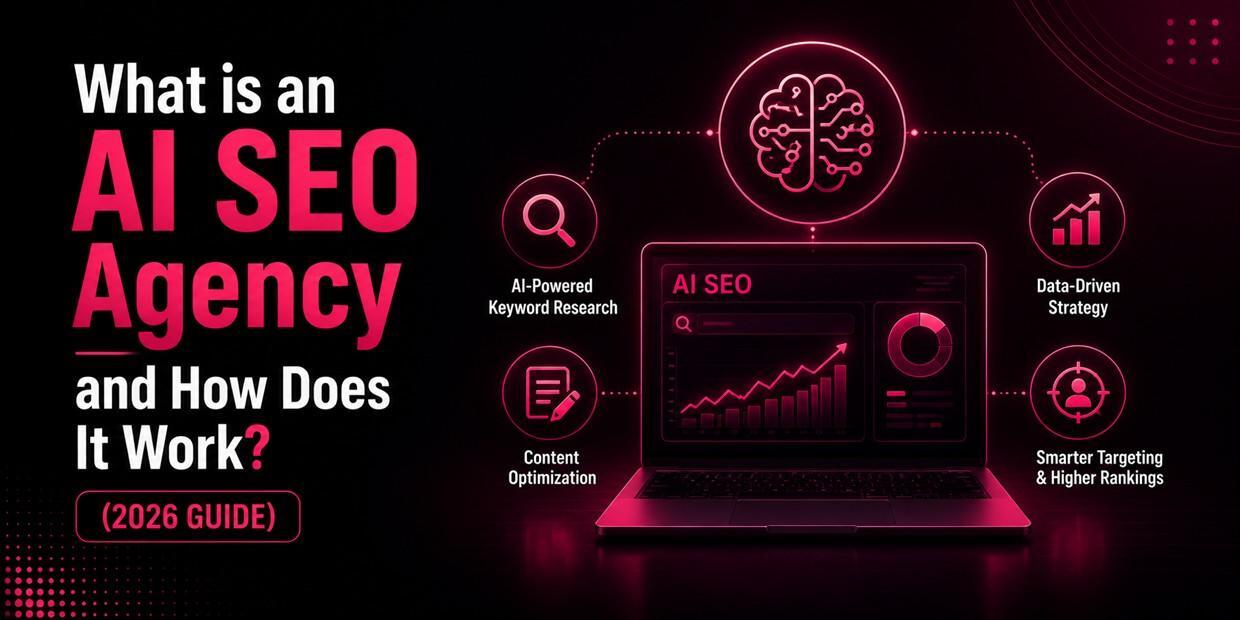

What Is an AI SEO Agency and How Does It Work? (2026 Guide)
Search has changed more in the last 18 months than in the previous decade and most businesses haven't caught up yet.
The old playbook was simple: rank on Google, get traffic, generate leads. But 58.5% of U.S. Google searches now end without a single click (SparkToro via GenOptima, 2026). Buyers are getting answers directly from AI Overviews, ChatGPT, Perplexity, and Gemini without ever visiting a website. And meanwhile, AI-referred sessions grew 527% year-over-year through mid-2025 (Search Engine Land via Revvgrowth, 2026).
This is what an AI SEO agency was built for: not just to rank pages in Google, but to make your brand visible across the entire AI-driven search visibility ecosystem that is rapidly becoming the dominant way buyers find and evaluate vendors.
What Is an AI SEO Agency?
An AI SEO agency is a specialized digital marketing partner that combines traditional search engine optimization with AI search optimization workflows and AI-powered SEO services designed to maximize visibility across both conventional search engines and AI-generated answer platforms.
In practice, that means your agency delivers a blend of AI-powered SEO services, content strategy, and technical implementation tailored for AI-first discovery.
Where a traditional SEO agency focuses on keyword rankings and organic Google traffic, an AI SEO agency also optimizes for:
- Google AI Overviews — which now appear in more than 50% of search results (Searchbloom via DannyAvila, 2026)
- ChatGPT and Perplexity answers — where buyers increasingly research vendors before any website visit
- Featured snippets and answer boxes — zero-click visibility that builds brand authority
- AI-generated citations and mentions — ensuring your brand is the one being recommended when prospects ask AI tools for solutions in your category
The core difference: a traditional SEO agency optimizes for ranking. An AI SEO agency optimizes for being cited, recommended, and referenced across every surface where your buyers look for answers.
Why AI SEO Services Are Now Essential
The numbers make the urgency clear:
- Google AI Overviews — which now appear in more than 50% of search results (Searchbloom via DannyAvila, 2026), a core target of AI search optimization and AEO services
- ChatGPT and Perplexity answers — where buyers increasingly research vendors before any website visit, making GEO strategy essential
- Featured snippets and answer boxes — zero-click visibility that builds brand authority and reinforces your AI-driven search visibility
- AI-generated citations and mentions — ensuring your brand is the one being recommended when prospects ask AI tools for solutions in your category, a key outcome of modern AI-powered SEO services
The shift isn't coming. It's here. Brands that continue to optimize only for traditional Google rankings are losing ground to competitors who are already being cited and recommended by the AI tools their buyers use every day.
The Three Disciplines an AI SEO Agency Masters
A full-service AI SEO agency or Generative Engine Optimization agency operates across three distinct but complementary optimization disciplines.
Understanding how they fit together is key to understanding what you're actually buying when you partner with one.
1. Traditional SEO — Still the Foundation
Traditional SEO remains essential. Rankings, backlinks, technical site health, page speed, crawlability, and content relevance are still how you build the foundational authority that every other optimization layer depends on.
AI SEO agencies enhance this with AI-powered tools that make SEO more efficient: automated keyword clustering, competitor gap analysis at scale, real-time algorithm change detection, and AI-assisted content briefs that ensure every piece of content is strategically aligned before a word is written.
The AI difference: Agencies using AI tools can publish 47% more content per month than traditional agencies while maintaining strategic coherence (SEOProfy, 2026) and 68% of marketers confirm that AI helped them achieve higher ROI from their content programs.
2. AEO (Answer Engine Optimization) — Winning Featured Snippets and Zero-Click Visibility
Answer Engine Optimization (AEO) is the practice of structuring your content to be selected as direct answers in featured snippets, voice results, and Google's AI Overviews.
Where traditional SEO asks "does this page rank?", AEO asks "is our brand the answer that appears when someone asks this question?"
This matters because the featured snippet — or an AI Overview position — often generates more brand awareness and trust than even the #1 organic result. An AI SEO agency implementing AEO will:
- Structure content with clear question-and-answer formatting and FAQ schema markup
- Write content that directly and concisely answers the specific questions buyers ask
- Build structured data (schema.org markup) that makes content machine-extractable
- Target the specific question formats that trigger answer box appearances
The impact: AI Overview presence can generate more clicks and brand visibility than holding the #1 organic position on the same query, according to 2025-2026 SERP analysis (TaylorScherSEO, 2026).
3. GEO (Generative Engine Optimization) — Getting Cited by AI Platforms
Generative Engine Optimization (GEO) is the newest and most distinct discipline. It focuses on getting your brand cited and recommended by AI platforms like ChatGPT, Google Gemini, Perplexity, Claude, and Microsoft Copilot, when users ask questions related to your category.
This is fundamentally different from traditional SEO. AI systems don't rank pages in order, they synthesize information from multiple sources and generate a single response that may or may not mention your brand. Getting into that response requires a different kind of authority.
An AI SEO agency implementing GEO focuses on:
- Entity authority — ensuring your brand, products, and key claims are consistently represented and cross-referenced across multiple credible sources
- Multi-platform citation building — earned media, third-party reviews, research citations, and press mentions that create "source triangulation" AI models rely on
- Content structure for AI extraction — formatting content so AI systems can extract and accurately synthesize key facts (44.2% of LLM citations come from the first 30% of text, so intros matter enormously) (Position Digital, 2026)
- Topical authority depth — comprehensive, authoritative coverage of topics within your category that signals expertise to AI models evaluating which brands to cite
The GEO payoff: In controlled tests, GEO-style changes increased content visibility in generative engine responses by up to 40% (arXiv via SEOProfy, 2026). And distributing content to a wide range of third-party publications can increase AI citations by up to 325% compared to publishing only on your own site (Stacker via Position Digital, 2026).
How an AI SEO Agency Actually Works: The Process
Here's what working with a quality AI SEO agency looks like in practice:
Discovery and audit: The agency starts by assessing your current visibility, not just Google rankings, but whether and how your brand appears in AI-generated responses for key buying queries. A quick test: search your core value propositions in ChatGPT and Perplexity. Does your brand appear? Do competitors?
ICP and topic strategy: The agency maps the exact questions your ideal buyers ask at each stage of their research journey, then builds a content strategy designed to make your brand the answer to those questions across every search surface.
Content creation with AI acceleration: Using AI tools to scale content production, the agency publishes expert-level content faster than human-only teams can produce, while maintaining the authority, specificity, and originality that AI systems actually cite.
Technical optimization: Structured data, schema markup, page speed, E-E-A-T (Experience, Expertise, Authoritativeness, Trustworthiness) signals, and content formatting that makes your pages machine-extractable.
Authority and citation building: Third-party placements, PR, earned media, review platforms, and digital PR campaigns that create the multi-source credibility that AI platforms use to validate which brands to recommend.
Measurement across all surfaces: Tracking traditional SEO KPIs (rankings, organic traffic, conversions) alongside GEO/AEO KPIs (AI citation rate, brand mention frequency, share of voice in AI-generated answers, AI-referred traffic), the new metrics that traditional dashboards don't show.
Who Needs AI SEO Services?
Any B2B company where buyers research solutions online before contacting vendors. That includes software companies, professional services firms, financial services providers, healthcare technology companies, and any category where buyers ask questions like "what is the best [solution] for [problem]?" before building a shortlist.
If your buyers are using AI tools to research before they reach your sales team, and they increasingly are, then being invisible to those tools means being removed from consideration before the conversation even begins.
Bottom Line
An AI SEO agency isn't a replacement for traditional SEO. It's an expansion of it, adding the disciplines and tools needed to stay visible in a search environment that now spans Google rankings, AI Overviews, and conversational AI platforms simultaneously.
The brands being cited as authoritative answers by ChatGPT and Google AI Overviews today will build compounding visibility advantages that traditional SEO alone can no longer create. The question isn't whether AI search matters to your business, it's whether your agency is built to compete in it.
.jpeg?width=352&name=How%20Does%20AI%20SEO%20Differ%20from%20Traditional%20SEO%20(2).jpeg)