


7 Best Content Types for Content Syndication For Lead Gen
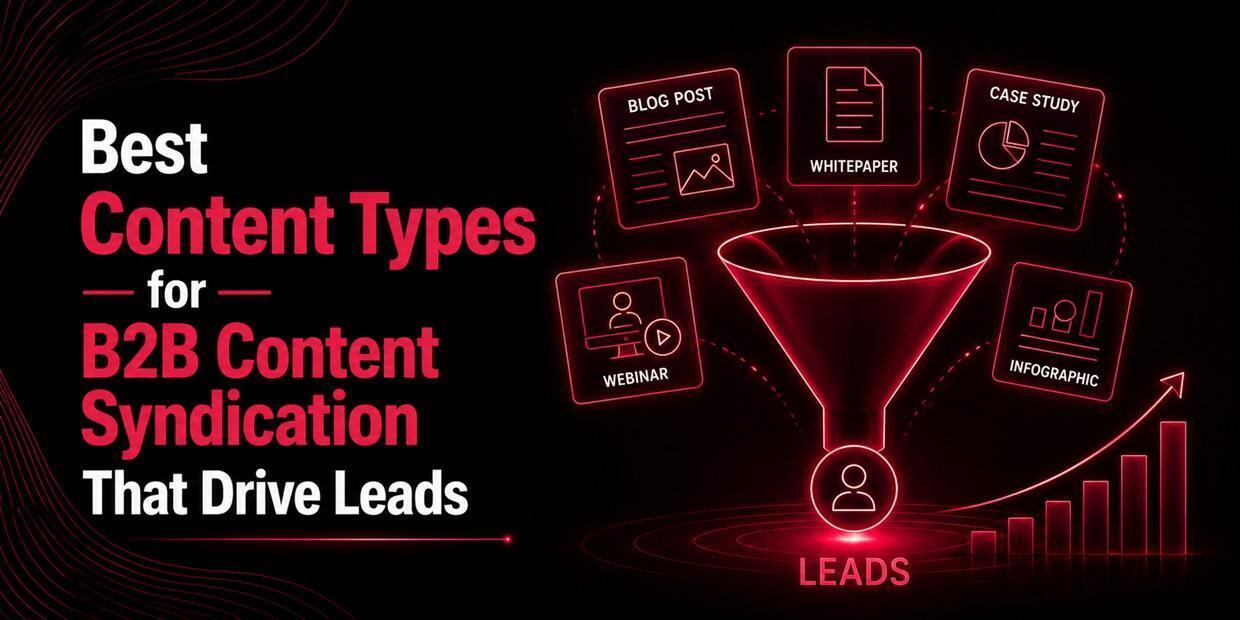
The best content types for content syndication are white papers, eBooks, industry reports, case studies, webinars, buyer's guides, and research-backed infographics. These assets consistently generate higher-quality leads because they offer valuable insights in exchange for contact information, helping B2B marketers attract decision-makers, capture intent signals, and accelerate pipeline growth.
Most B2B content syndication programs fail for the same reason: the content going in is wrong.
Not wrong as in poorly written. Wrong as in mismatched to how syndication actually works. You can't take a blog post written for Google, push it through NetLine or DemandScience, and expect high-intent leads to come out the other side. The audience on content syndication platforms B2B is different. Their context is different. Their threshold for giving up their contact information is higher.
So before we get into the seven content types that actually convert, let's be clear on what content syndication in B2B actually is and what it isn't.
What is Content Syndication in B2B, Really?
Content syndication is the process of distributing gated assets through third-party platforms or publishers to reach a pre-qualified audience you don't own. The prospect consumes your content on a platform they already trust, exchanges their contact information to access it, and enters your pipeline as a lead.
The key word is gated. Unlike a blog post anyone can read for free, syndicated content asks for something in return. That changes the conversion math entirely — and it means the content has to be worth the exchange.
On r/marketing, a demand gen manager at a mid-market SaaS company described exactly why most programs underperform:
"We syndicated four pieces last quarter. Three were repurposed blog posts we'd slapped a gate on. One was an original benchmark report with data we'd collected from 200 customers. Guess which one drove 80% of the leads and the only two deals that came from the whole program?" — r/marketing, u/demandgen_realist
That's the whole lesson. Here are the seven content types that earn the gate.
1. Original Research and State of the Industry Reports
This is the single highest-performing content type across content syndication platforms B2B and the most underproduced because it requires actual work.
The reason it converts: it offers information gain that doesn't exist anywhere else. AI search engines and human buyers both prioritize new data over recycled opinions. A "State of [Your Category] 2026" report built from proprietary survey data or customer benchmarks cannot be replicated by a competitor or summarized by ChatGPT from existing sources. It's original, and in 2026, original is rare.
At Revnew, we helped a HR tech client build their first benchmark report using anonymized data from 180 of their existing customers. It took six weeks to produce. When syndicated through a niche HR publisher network, it generated 340 gated leads in 45 days, more than their previous four syndication campaigns combined. Eleven of those leads converted to qualified opportunities within 90 days. The content that required the most effort delivered the most pipeline.
2. ROI Calculators and Practical Worksheets
If original research is the highest-volume performer, ROI calculators are the highest-intent performer. The person downloading a worksheet titled "How to Calculate the Cost of Your Current SDR Model" isn't browsing. They're building a business case.
This is the content type that solves a specific job-to-be-done, specifically, the job of justifying a budget decision to a CFO or VP. That's decision-stage behavior. The lead quality from gated content lead generation around ROI tools is consistently higher than awareness-stage assets, even if the volume is lower.
A thread on r/B2Bmarketing confirmed this pattern:
"We A/B tested a thought leadership ebook vs. an ROI calculator for the same campaign. Ebooks got 3x the downloads. The calculator got 4x the pipeline. Sometimes less volume is exactly what you want." — r/B2Bmarketing, u/pipeline_over_pageviews
3. Comprehensive Buyer's Guides
B2B buyers in the consideration stage are drowning in options and short on time. A guide that helps them build an evaluation framework, one that doesn't read like a vendor pitch, is genuinely useful. That utility is what earns the gate.
The counterintuitive play: write the buyer's guide as if you could recommend a competitor and still be comfortable with the content. Focus on the criteria a buyer should use to evaluate any vendor in your category. If your product is actually strong, you'll show up well against those criteria anyway, and you'll have built credibility that a self-promotional piece never could.
Revnew built this type of asset for a compliance SaaS client who was competing in a crowded category where buyers were comparing five to seven vendors simultaneously. We created a "2026 Compliance Platform Evaluation Guide", vendor-neutral criteria, structured comparison framework, deployment checklist.
Syndicated through two industry-specific publishers. Average lead-to-meeting conversion rate from that asset was 18%, compared to 6% from their previous ebook campaigns. The guide didn't sell. It is educational. The pipeline followed.
4. Technical White Papers
For categories like cybersecurity, fintech, DevOps, or data infrastructure, lightweight content doesn't close the credibility gap with the Technical Gatekeeper. They need to see that you understand their actual environment, not just the business case.
A deep-dive technical white paper that explains architecture decisions, integration approaches, and security posture in real depth is the gold standard for B2B lead gen content types in technical categories. Volume will be lower. Intent will be substantially higher. The person downloading a 20-page technical architecture document is not casually browsing.
5. Vertical-Specific Case Study Bundles
Single case studies belong on your website. For content syndication services, bundles perform better, specifically, vertical-specific bundles that show a prospect exactly how you've solved problems for companies like theirs.
"5 Ways Manufacturing Companies Cut Procurement Costs with [Your Product]" is more persuasive than a single case study because it demonstrates pattern, not exception. It says: this isn't a lucky win. This is what we do in your industry.
The specificity is the point. A generic "customer success story" competes with every other PDF in the syndication network. A vertical-focused bundle speaks directly to one audience and nobody else, which is exactly what makes it convert.
6. Webinar Transcripts and Key Takeaway Summaries
Not everyone has 45 minutes for a webinar. Most people will read a five-page "Key Takeaways" document from the same content in ten minutes during a commute.
Repurposing high-production webinars into scannable, syndication-friendly summaries is one of the most efficient moves in B2B lead generation content types because the hard work, the expert insight, the research, the production, is already done. The syndication asset is the extraction.
7. Compliance and Security Checklists
In 2026, regulatory compliance like CCPA, GDPR, SOC2 readiness, is a top-of-mind concern for B2B leaders across virtually every category. A well-constructed checklist addresses a fear that's already present, which makes the gate feel like a fair exchange rather than a friction point.
2026 Data Security Readiness Checklist or "CCPA Compliance Audit for Revenue Teams", these are evergreen assets that remain relevant as regulations evolve and work across multiple verticals simultaneously.
Performance Reality Check
|
Content Type |
Lead Volume |
Lead Intent |
Best Funnel Stage |
|
Industry Reports |
High |
Medium |
Awareness and trust |
|
ROI Calculators |
Medium |
Very high |
Decision stage |
|
Technical White Papers |
Low |
High |
Technical validation |
|
Buyer's Guides |
Medium |
High |
Consideration stage |
|
Case Study Bundles |
Medium |
High |
Consideration to decision |
|
Checklists |
High |
Medium |
Top of funnel |
|
Webinar Summaries |
Medium |
Medium |
Mid-funnel nurture |
The honest read on this table: if your syndicated content for B2B leads is heavy on checklists and light on original research and ROI tools, you're generating volume without intent. Dashboard metrics will look fine. Pipeline won't.
FAQs
Q: What's the minimum content investment to make B2B content syndication worth running?
One high-quality asset beats ten mediocre ones every time. If budget is limited, invest it entirely in one original research report or ROI calculator rather than syndicating five repurposed blog posts. The lead quality difference is significant enough that a single strong asset will outperform a large volume of weak ones and produce better data for your next campaign.
Q: How do you choose which content syndication platforms B2B to use?
Match the platform to your ICP, not just your category. NetLine and DemandScience offer broad B2B reach with firmographic filtering. Industry-specific publishers like niche newsletters, trade association content networks, vertical media outlets, often deliver smaller volumes with dramatically higher intent because the audience self-selected into that niche. At Revnew, we typically recommend testing one broad platform and one vertical-specific publisher simultaneously to compare lead quality before scaling.
Q: How long does it take for syndicated content to generate pipeline, not just leads?
Expect a 60–90 day lag between lead capture and pipeline contribution for most content types. Decision-stage assets like ROI calculators move faster, sometimes 30 days. Awareness-stage assets like industry reports take longer to nurture through to a qualified conversation. Build your attribution model around 90-day windows and resist the urge to kill a syndication program based on 30-day lead volume alone.
The audit question worth running this week: which of your existing internal assets, customer data, benchmark findings, ROI frameworks, could become a gated syndication asset without requiring you to build something from scratch?