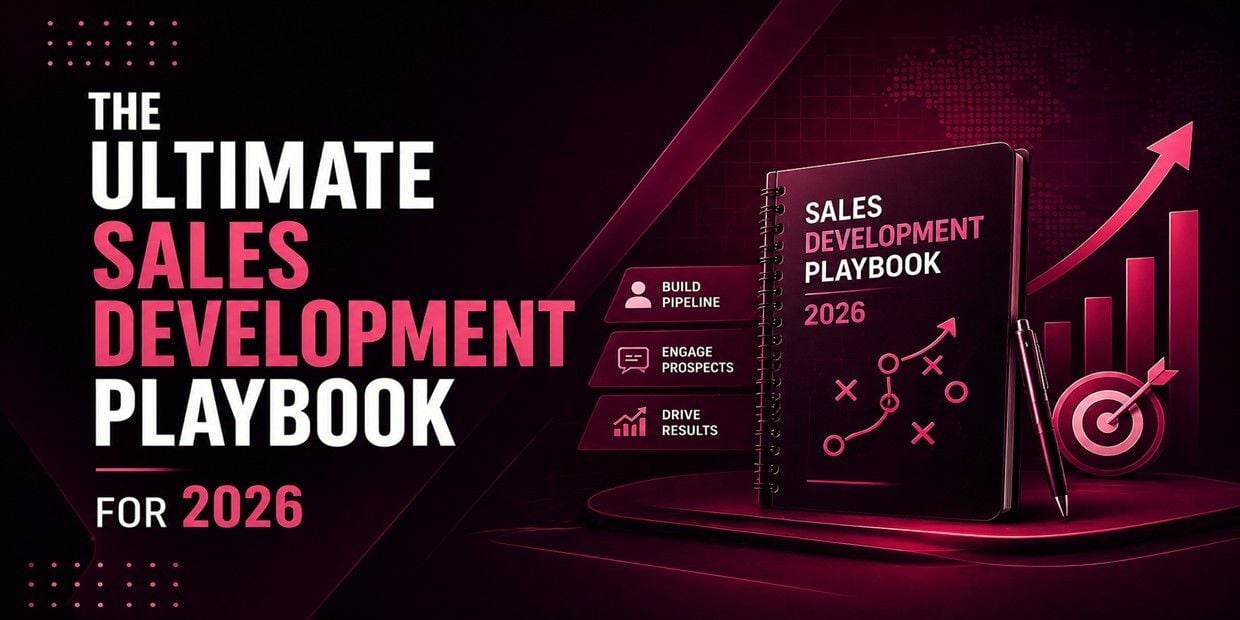


The Ultimate Sales Development Playbook for 2026
Only 27–30% of B2B sales reps hit quota in 2025. That's not a rep problem. That's a system problem.
The average SDR spends just 28% of their time on actual selling activities, the other 72% goes to admin, CRM updates, research, and internal coordination. Your highest-leverage resource is spending most of its day on everything except the one thing it was hired to do.
Meanwhile, buyers are more elusive than ever. Cold email reply rates have dropped to 5.1%. Quality conversations per SDR per day have fallen 45% since 2014. And buying committees have expanded to an average of 13 decision-makers, each requiring their own outreach.
The teams building reliable, scalable pipeline in 2026 aren't grinding harder. They're building better systems: tighter ICPs, signal-based targeting, AI-assisted research, and multi-channel cadences that reach the right person at the right moment with a message that actually lands.
This is the complete playbook.
Why Sales Development Is Harder Than It's Ever Been And What's Changed
The SDR role was invented to separate prospecting from closing, creating a scalable, specialized function that feeds AEs with qualified opportunities. It works — when it's executed correctly.
But the environment has shifted dramatically:
- Outbound volume is at an all-time high while response rates are at an all-time low. More companies are sending more emails to the same buyers, and buyer fatigue is real.
- Buyers are more informed and more skeptical. They do extensive independent research before any vendor contact. They enter conversations with a shortlist already formed.
- Buying committees are larger and more complex. The average B2B deal now involves 13 internal stakeholders plus 9 external influencers (Forrester, 2026). Single-threading to one contact is the fastest path to a stalled deal.
- Sales reps spend only 28% of their time selling. Admin, research, CRM updates, and internal meetings consume the other 72% (Salesforce State of Sales, 2024).
- AI adoption in sales has surged from 39% to 81% in just two years. Teams that haven't adopted AI are competing against those that have — and losing (Salesforce/Sopro, 2025 via Autobound, 2026).
Understanding these structural realities is the starting point for building a playbook that actually works.
Part 1: ICP Development — The Foundation Everything Else Stands On
Before a single email gets written or a single call gets made, your team needs a ruthlessly precise Ideal Customer Profile.
60% of prospects are lost to poor targeting (Prospeo, 2026). Not because the messaging was wrong. Because the list was wrong. No amount of personalization fixes outreach sent to the wrong people.
A complete ICP for sales development includes:
Firmographic fit:
- Industry, sub-industry, and vertical
- Company size (employees and revenue range)
- Growth stage (startup, growth, mature)
- Geography and market
Technographic fit:
- What tools they currently use (signals for compatibility or displacement opportunities)
- What they don't use (signals for gap problems you solve)
Behavioral fit:
- Trigger events that indicate buying readiness (new funding, executive hire, product launch, regulatory deadline, tech stack migration)
- Content consumption and intent signals
- Hiring patterns that reveal strategic priorities
Negative ICP: Equally important — which companies or contacts explicitly don't fit, regardless of how attractive they appear. Document these. Disqualifying the right prospects early saves more time than any other efficiency improvement.
Persona mapping within accounts: For each ICP account, map the buying committee. Who initiates? Who holds budget? Who has technical veto? Who is the champion? Who is the skeptic? Each role requires different messaging.
The 2026 shift: Static ICP documents reviewed annually are no longer sufficient. High-performing teams are updating their ICPs quarterly based on closed-won data analysis, win/loss patterns, and evolving intent signal clusters.
Part 2: The Signal-Based Prospecting Framework
The teams with the highest outbound reply rates aren't the ones with the best copywriters. They're the ones with the best timing.
Signal-personalized outreach achieves 15–25% reply rates versus the 3–5% industry average for cold email (Autobound, 2026). The difference isn't a better subject line — it's reaching prospects at the exact moment a business event makes your solution relevant.
Trigger Event Categories to Monitor
Company-level triggers:
- New funding rounds (Series A–C signal budget for new infrastructure)
- Leadership changes (new CTO, CFO, or VP of Sales = mandate to evaluate vendors)
- M&A announcements (tech stack consolidation reviews)
- Product or market expansion announcements
- Job postings revealing strategic initiatives (hiring a "Head of Revenue Operations" signals sales infrastructure investment)
- Public earnings call mentions of specific pain points
Contact-level triggers:
- Job changes (prospects who move to new companies often replace incumbent vendors)
- Promotions into decision-making roles
- LinkedIn engagement with content relevant to your solution
- Profile updates reflecting new responsibilities
Intent-level triggers (third-party):
- Spikes in research on topics related to your category (tracked via Bombora, 6sense, G2 Buyer Intent)
- Competitor review activity on G2 or Capterra
- Website visits to pricing or comparison pages
The Trigger Outreach Formula
Every high-converting outbound message in 2026 follows a simple formula:
[Specific trigger] + [Problem that trigger creates] + [How you solve it] + [Proof from a similar company] + [Clear, low-friction CTA]
Example: "Saw [Company] announced [Series B] last week — congratulations. Teams in that stage typically hit a wall with manual SDR processes right as pipeline demands scale. We helped [Similar Company at Series B] go from 8 to 35 qualified meetings per month in 90 days without adding headcount. Worth a 15-minute conversation?"
This is infinitely more effective than: "Hi [Name], I wanted to reach out because we help companies like yours with lead generation..."
Part 3: Multi-Channel Cadence Design
Single-channel outreach is the source of most underperformance. Combining email, phone, and LinkedIn in a coordinated sequence boosts results by 287% versus email alone (Martal, 2026).
The 2026 SDR Cadence Framework
A high-performing 10-touch, 3-week cadence for B2B sales development:
|
Day |
Channel |
Action |
|
Day 1 |
|
Trigger-based first touch. Reference the specific event. No pitch. |
|
Day 2 |
|
View profile + like a recent post (creates awareness) |
|
Day 3 |
|
Value-add follow-up. Share a relevant case study, research, or insight |
|
Day 5 |
Phone |
First call. Reference the email. Leave a brief voicemail if no answer |
|
Day 7 |
|
Send connection request with a brief, relevant personalized note |
|
Day 10 |
|
Third email. Different angle — peer proof or "what if we're wrong about your situation?" |
|
Day 12 |
Phone |
Second call attempt. Different time of day |
|
Day 14 |
|
If connected: InMail or DM with a direct, low-friction ask |
|
Day 17 |
|
Break-up email. "I'll stop reaching out after this — just wanted to share one more thing before I do..." |
|
Day 21 |
Phone |
Final call attempt |
Critical data point: 58% of replies come from the first email, but 42% come from follow-ups in steps 2–7 (Prospeo, 2026). Teams running 2-step sequences are abandoning nearly half of all potential responses. The follow-up is not optional.
Channel-Specific Optimization
Email:
- Wednesday is the peak engagement day; launch new sequences Monday for Wednesday follow-ups
- Send between 9:30–11:30 AM in prospect's local timezone
- Plain text converts 20% higher than HTML-heavy designs
- Subject lines with prospect's first name or company see 43% higher open rates (Smartlead, 2025)
- Advanced personalization beyond first name drives reply rates up to 18%
Phone:
- Decision-makers are most reachable between 10:00–11:00 AM and 4:00–5:00 PM prospect local time
- It takes an average of 18 dials to connect with a B2B prospect (Gartner)
- 57% of C-level and VP-level buyers say they prefer to be contacted by phone (RAIN Group via CIENCE, 2026)
- Voicemails should be under 30 seconds and reference something specific to the company
LinkedIn:
- InMail achieves 10–25% response rates — significantly above cold email averages
- Engaging with prospect content before direct outreach improves acceptance and response rates
- Video messages on LinkedIn see 45% higher reply rates than text messages
Part 4: SDR Performance Benchmarks — What "Good" Looks Like in 2026
The most dangerous thing in sales management is measuring the wrong metrics. Activity volume without conversion context produces a false sense of productivity.
Activity Benchmarks (2026)
|
Metric |
Average |
Top Performer |
|
Dials per day (SMB) |
80–100 |
— |
|
Dials per day (Enterprise) |
30–50 |
— |
|
Emails per day |
40–50 |
— |
|
Quality conversations per day |
3.6–4.1 (Bridge Group) |
6–8 |
|
Meetings booked per month (outbound) |
10–15 |
20–25 |
|
Meeting show rate |
75–80% |
85%+ |
|
Meetings held per month |
8–12 |
16–20 |
|
SAL-to-SQL conversion |
52.7% (Bridge Group) |
60%+ |
|
Pipeline generated per SDR per quarter |
$300K–500K (Autobound, 2026) |
$600K+ |
The 5 Metrics That Actually Predict Pipeline
- Quality conversations per day — the single leading indicator that correlates most directly with pipeline. A conversation is a live, two-way interaction with a qualified prospect — not a voicemail or a bounced email.
- Meeting-to-opportunity conversion rate — what percentage of booked meetings advance to a real sales opportunity. A 10–15% benchmark; anything below 10% signals a qualification problem.
- Pipeline generated per SDR — the ultimate outcome metric. Median is $3M annually per SDR (Bridge Group). Outbound SDRs are responsible for 53% of total pipeline conversion (SalesSo, 2025).
- Contact-to-reply rate by sequence — which cadences generate the highest engagement. Identifies what messaging and timing works.
- Ramp time to first qualified meeting — how quickly new SDRs start contributing. Industry average is 3–6 months; top teams using signal-based playbooks cut this to 30–60 days.
What not to measure as a primary KPI: Dials per day in isolation, emails sent, or "touches completed." These are activity metrics, not outcome metrics. An SDR logging 120 activities a day with zero conversations booked is not performing — they're performing theater.
Part 5: AI in Sales Development — What's Real in 2026
AI adoption in sales has surged from 39% to 81% in two years (Salesforce, 2024). Teams using AI are 3.7x more likely to hit quota than those that don't (Salesforce, 2026). The gap between AI-enabled and non-AI-enabled teams is widening, and it's widening fast.
Where AI Creates Measurable SDR Lift
Research and account intelligence (the biggest time win):
- Gartner predicts 95% of seller research workflows will begin with AI by 2027 (Gartner, 2025 via Close, 2025)
- AI tools reduce prospecting research time by up to 50% while improving ICP accuracy
- Account briefs that used to take 45 minutes to compile now take 5
Personalization at scale:
- Generative AI drafts trigger-based first-touch emails from CRM data, improving response rates by an average of 28% (LinkedIn, 2025)
- AI-generated personalization works when combined with human review — teams using AI drafts with human editing outperform both fully automated and fully manual approaches by 3x
Lead scoring and prioritization:
- AI-powered lead scoring improves conversion rates by 30% on average versus manual scoring (Forrester, 2024 via CIENCE)
- Companies implementing AI tools see a 20% increase in pipeline volume and 30% improvement in lead conversion rates (SalesSo, 2025)
AI sales tools can increase leads by 50%, reduce costs by 60%, and shorten call times by up to 70% (McKinsey, 2025).
The Human-AI Balance in SDR Teams
AI handles: initial research, first-draft outreach, CRM hygiene, lead scoring, call summaries, follow-up scheduling.
Humans handle: relationship building, trust development, complex objection handling, emotional intelligence, strategic judgment, multi-stakeholder navigation.
The winning model in 2026 is not "replace SDRs with AI." It's "give every SDR AI tools that eliminate 2+ hours of daily admin so they can spend that time on conversations instead."
"Your job will not be taken by AI. It will be taken by a person who knows how to use AI." — Christina Inge, Harvard
Part 6: In-House SDR Team vs. SDR Outsourcing
For many B2B companies, the most strategic decision in sales development isn't what methodology to use, it's whether to build an internal SDR team or leverage SDR outsourcing services.
The In-House Case
In-house SDRs offer deeper product knowledge, full brand alignment, and closer collaboration with AEs and marketing. Over time, top-performing in-house reps develop domain expertise that creates compounding pipeline value.
The cost reality:
- Fully loaded in-house SDR: $140,000/year (salary, benefits, tools, management, recruiting) (Martal, 2026)
- Ramp time: 3–6 months before consistent performance
- Annual turnover: 39–60% — creating a constant rebuilding cycle (Prospeo, 2026)
- Cost per SDR departure: $78,000–$149,000 when replacement and ramp are factored in (MarketBetter, 2026)
The SDR Outsourcing Case
SDR outsourcing services solve the three biggest problems with in-house teams: cost, speed, and the hiring/ramp/turnover cycle.
- 50–70% lower cost than fully loaded in-house equivalent (Martal, 2026)
- First qualified meetings in 30–60 days versus 4–6 months for in-house
- Outsourced SDR teams ramp 3x faster using existing playbooks, tools, and verified data (Digitechniks, 2025)
- 5:1 revenue-to-cost ROI within first 90 days for high-performing partners
- Over 70% of B2B companies plan to expand outsourced SDR investment through 2026 (Activated Scale via demandDrive, 2026)
The Hybrid Model That Most High-Growth Companies Use
The most common 2026 model for scaling B2B companies: outsourced SDRs generate 40–50% of pipeline through volume outreach and new market testing, while in-house SDRs own enterprise and expansion accounts where product depth and relationship continuity matter most.
This approach combines speed-to-market, lower risk, and the ability to scale intelligently without betting the entire pipeline on a single hire.
Decision Framework
|
Scenario |
Recommended Model |
|
Early-stage startup needing immediate pipeline |
Outsource |
|
Testing a new market or ICP segment |
Outsource |
|
Complex technical sale requiring deep product knowledge |
In-house |
|
Consistent pipeline need + limited hiring bandwidth |
Outsource |
|
High-volume outreach + enterprise close |
Hybrid |
|
Strong in-house team needing overflow capacity |
Hybrid |
Part 7: The SDR Tech Stack for 2026
A modern SDR team needs tools across six functional areas:
|
Category |
Purpose |
Key Tools |
|
Contact data |
Verified emails and direct dials |
ZoomInfo, Apollo, Cognism, Lusha |
|
Intent data |
In-market account identification |
Bombora, 6sense, G2 Buyer Intent |
|
Sales engagement |
Sequence automation, multi-channel cadences |
Outreach, Salesloft, Apollo sequences |
|
CRM |
Pipeline tracking, activity logging |
HubSpot, Salesforce |
|
AI assistance |
Research, draft generation, lead scoring |
Autobound, Clay, ChatGPT |
|
Call intelligence |
Call recording, coaching, analytics |
Gong, Chorus, Orum |
The tool overload warning: The average B2B seller currently uses 8 tools to close a deal, and 42% of sales reps feel overwhelmed by too many tools — making them 45% less likely to attain quota (Salesforce, 2026). Consolidation and integration matter as much as capability.
Bottom Line
The SDR function remains the engine of B2B pipeline. But the playbook that worked in 2020 isn't the playbook that works in 2026.
The teams building consistent, scalable pipeline today are:
- Building tighter ICPs — and updating them quarterly
- Doing signal-based prospecting — reaching buyers at the moment of maximum relevance, not random intervals
- Running multi-channel, multi-touch cadences — because 42% of replies come from follow-ups most reps never send
- Using AI to eliminate research overhead — so reps spend more time in conversations and less time in spreadsheets
- Making the in-house vs. outsourcing decision intentionally — not defaulting to in-house because it feels like "real" sales development
The quota problem isn't a motivation problem. It's a systems problem. And systems can be built.
Want to Build a Sales Development Engine That Consistently Delivers?
Whether you're building an in-house SDR team or evaluating SDR outsourcing services for the first time, Revnew specializes in sales development programs designed around your ICP, your market, and your revenue targets with the reporting to prove what's working.