
The Systematic B2B Webinar Promotion Strategies in 2026
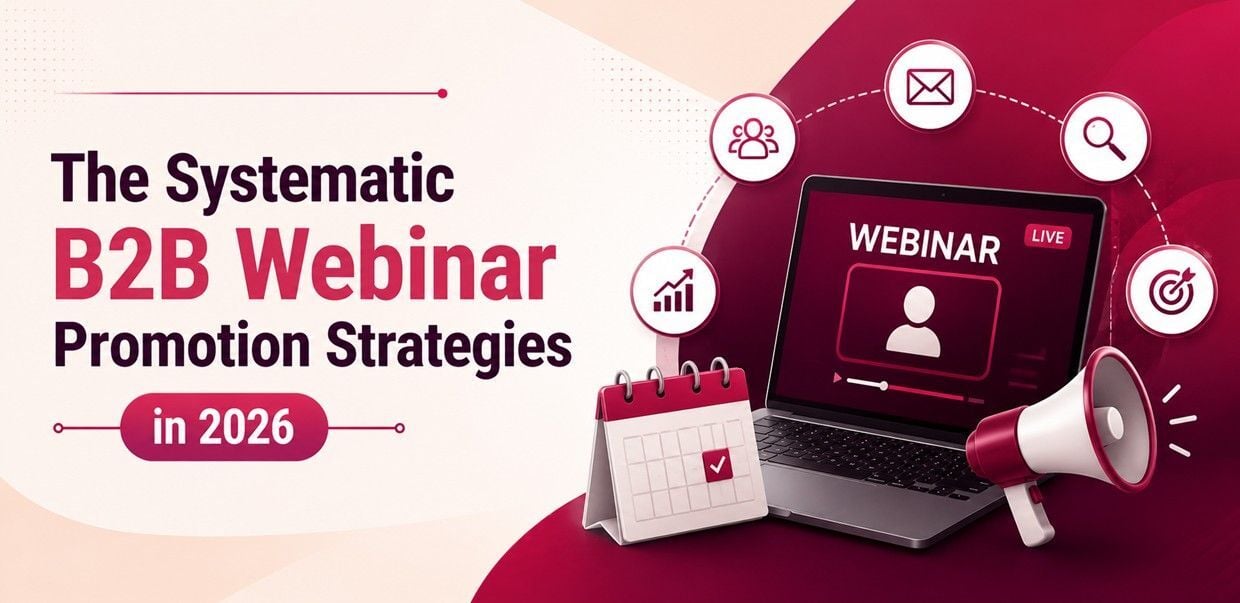
The most effective webinar promotion strategies in 2026 combine email sequences as the primary channel (driving 57 to 71% of registrations), LinkedIn promotion through both organic posts and sponsored content, a 28-day pre-event timeline starting with broad awareness and concentrating effort in the final 7 days when 49% of registrations happen, co-marketing partnerships that add 30 to 50% more registrations, and post-event on-demand distribution that generates 2.4x more total views than the live session. The single biggest mistake in B2B webinar promotion is treating registration volume as the success metric rather than attended-to-MQL conversion, which sits at 38% for well-promoted webinars.
Most B2B webinars fail before a single attendee shows up.
Not because the content is weak. Not because the topic is wrong. Because the promotion strategy is built on hope rather than a system. The average B2B webinar generates fewer than 50 live attendees, according to ProperExpression's B2B webinar research. Meanwhile, the top-performing programs run by companies like HubSpot, Gong, and Salesforce pull thousands. The difference is not budget. It is a repeatable promotion system.
91% of B2B professionals say webinars are their preferred type of content (Source). The demand is there. The question is whether your webinar promotion is reaching the right people at the right time through the right channels.
Here is the complete B2B webinar promotion framework built on 2026 benchmark data.
Why Webinar Promotion Is the Multiplier Most Teams Underinvest In
The ROI case for getting webinar promotion right is straightforward. Webinars generate an average 213% ROI, with B2B SaaS companies seeing peaks of 430% (Source). That return depends almost entirely on promotion quality. A well-produced webinar with poor promotion generates the same pipeline as no webinar at all.
The conversion math makes this concrete. Attended-to-MQL conversion sits at 38% for registrants who attend live or watch 25% or more of the replay. Every additional qualified attendee you bring through better promotion translates directly into pipeline at that conversion rate.
Strategy 1: Build a 28-Day Promotion Timeline
Webinar promotion is not a single email blast. It is a coordinated campaign across multiple channels over a defined window. Here is the timeline that produces consistent results.
Days 28 to 14 before the event: finalize your topic and positioning, build the registration landing page, prepare your email sequences, and brief any partner or community contacts. Promoting at least 4 weeks in advance boosts registrations by an average of 12% (Source). Launch your first promotional email and first LinkedIn posts at the 3-week mark.
Days 14 to 7 before the event: run your main promotional push across email, LinkedIn, and paid channels. Send your strongest email with outcome-led copy. Start paid LinkedIn Sponsored Content targeting your ICP. Ask your speaker to promote to their audience. This is where co-marketing conversations happen.
Final 7 days: this is your primary conversion window. 49% of all registrations happen in the 7 days before the event (Source). Increase email frequency, add urgency messaging, and push social posts daily. 17% of sign-ups happen on the event day itself, so a same-day invite can boost registrations by up to 50%.
Day of: send a final reminder one hour before and a going-live notification five minutes before the session.
Strategy 2: Build Your Email Sequence Around Behavior, Not Calendar Dates
Email is the backbone of any webinar registration campaign. Email drives 57 to 71% of all webinar registrations and is 4x more effective than the next best channel (Source). The open rate advantage is measurable: webinar invitation emails have 1.7x higher open rates and 4.5x higher click rates than general marketing emails (Source).
The email sequence structure that consistently outperforms:
|
|
Timing |
Purpose |
|
Invite 1 |
21 days before |
Primary invitation, outcome-led subject line, single CTA |
|
Invite 2 |
7 days before |
New angle, different benefit, urgency begins |
|
Last chance |
2 days before |
Urgency, limited seats framing, social proof |
|
Day-of |
Morning of event |
Final push to unregistered, reminder to registered |
|
Reminder 1 |
2 hours before |
Short, direct, join link prominent |
|
Reminder 2 |
15 minutes before |
Under 100 words, single sentence on value, join link |
The two-reminder sequence is the single most cost-effective show-up rate improvement available. Two reminders consistently outperform one, and keeping them under 100 words increases open rate because the email looks like a personal note rather than a marketing send.
At Revnew, we run this email sequence architecture for every webinar promotion engagement through our webinar marketing services. For a B2B cybersecurity client whose previous webinar had pulled 41 live attendees from a list of 2,300, we rebuilt the email sequence around behavioral triggers rather than fixed calendar sends, added a day-of invite to non-openers, and introduced segmentation by job title. Live attendance increased to 218 attendees from the same list size. The content and platform were unchanged. The email sequence changed everything.
Strategy 3: Use LinkedIn as Both Organic and Paid Promotion
LinkedIn is the second largest driver of webinar registrations for B2B programs. 94% of B2B marketers use social media posts to promote their webinars, and 86% use marketing emails (Source). For B2B audiences, LinkedIn specifically drives 14% of registrations and is the cheapest paid channel at approximately $42 per registrant compared to $78 for paid search (Digital Applied, 2026).
Organic LinkedIn webinar promotion tips:
Posts from personal profiles consistently outreach company page posts. Your speakers, founders, and subject matter experts posting about the webinar from their own profiles will generate significantly more reach than the same content posted from a company page. Post three times in the 14 days before the event: a launch announcement, a specific insight from the session, and a final push the day before.
Create a LinkedIn Event page for the webinar and promote it through the page as well as through direct invites to first-degree connections. Webinars promoted via LinkedIn Events see a 28% registration rate increase (Source).
Paid LinkedIn promotion for webinar marketing strategies:
Run LinkedIn Sponsored Content targeting your ICP by job title, seniority, and company size from 14 days before the event. LinkedIn Lead Gen Forms capture registration directly within LinkedIn without requiring the prospect to leave the platform. LinkedIn paid campaigns achieve 229% ROI for B2B (Source), making it the highest-ROI paid channel for B2B webinar promotion specifically.
On r/marketing, a webinar producer at a SaaS company described their LinkedIn promotion shift:
"We used to post once on the company page the week of the event and wonder why LinkedIn drove almost no registrations. Switched to having our 3 senior team members post from their personal profiles with different angles (one focused on the speaker, one on a specific insight, one on the outcome), plus $2,000 in LinkedIn ads targeting our ICP. LinkedIn went from 2% of our registrations to 19% in one quarter." -- r/marketing, u/linkedin_webinar_lift
Strategy 4: Use Co-Marketing to Multiply Reach Without Additional Budget
One co-host or cross-promotional partner can add 30 to 50% more registrations to any event according to WebinarNinja's 2026 webinar marketing research. Partner co-marketing drives 8% of webinar registrations on average, but for programs that actively invest in it, the share is significantly higher.
Three partner structures that consistently work for B2B webinar promotion:
Speaker partnerships: invite a recognized practitioner or subject matter expert from outside your organization as a speaker or co-host. A speaker with an existing LinkedIn audience will promote the event to their followers, effectively doubling your organic social reach at zero cost. Speakers with existing LinkedIn audiences routinely double or triple registrations compared to internal-only events.
Complementary brand co-marketing: partner with a company that serves the same ICP but does not compete. Both companies promote to their respective email lists and social audiences. Each party reaches net-new contacts they could not reach independently.
Community partnerships: niche Slack communities, LinkedIn groups, and industry forums where your ICP is active can serve as promotion channels. A post from a community moderator or admin about your webinar carries more credibility than any paid ad.
At Revnew, we built a co-marketing partnership structure for a B2B HR tech client running a webinar on compliance automation. We identified three complementary tools in their customers' tech stacks whose vendors agreed to cross-promote in exchange for reciprocal promotion on a future event. The combined email reach of the three partners was 14,000 contacts matching our client's ICP. That single co-marketing layer added 187 registrations that would not have come from owned channels alone.
Strategy 5: Build a Post-Event Promotion Plan Before the Event Launches
Most B2B webinar promotion plans end the moment the live session finishes. This is where the majority of the pipeline is left uncaptured.
On-demand distribution generates 2.4x more total views than the live session within 30 days (Digital Applied, 2026). 58% of webinar-sourced opportunities now first touch the replay, not the live event. The on-demand recording is not a consolation prize for people who missed the live session. It is where the majority of your pipeline will first encounter the content.
Post-event webinar marketing strategy checklist:
- Send a replay email to all registrants (attended and no-show) within 24 hours with a direct link to the recording
- Gate the recording on a landing page to continue capturing leads from organic and paid promotion
- Distribute the recording through your content syndication network to reach buyers who were never in your database
- Clip 2 to 3 short video segments (60 to 90 seconds each) from the session for LinkedIn and social distribution
- Send a follow-up nurture sequence to all attendees with relevant next steps based on the webinar topic
- Brief your SDR team with the attendee list and the specific segments each attendee engaged with most
Each webinar generates an average of 6.3 new content assets (Source). Plan for those assets before the webinar launches so repurposing happens in the 72 hours after the session, not weeks later when the content has cooled.
Webinar Promotion Channels at a Glance
|
Channel |
Avg % of Registrations |
Best Use |
Cost |
|
|
57 to 71% |
Primary driver, full sequence |
Low |
|
LinkedIn organic |
8 to 14% |
Speaker posts, Event page |
Zero |
|
LinkedIn paid |
5 to 9% |
ICP targeting, Lead Gen Forms |
~$42/registrant |
|
Partner co-marketing |
8% |
Reach new audiences |
Zero to low |
|
Website/blog |
5 to 7% |
SEO and existing traffic |
Zero |
|
Paid search |
3 to 5% |
High-intent capture |
~$78/registrant |
|
Communities |
2 to 4% |
Niche audiences |
Zero |
FAQs
Q: How far in advance should B2B webinar promotion start?
Start 28 days before the event to build awareness and give your audience time to plan. However, concentrate the majority of your promotional effort in the final 14 days when most registration decisions are made. Registration timing data shows 47% register more than one week before, 30% in the final week, and 23% on the day of the event. This means your promotion calendar needs both an early awareness phase and an aggressive final-week push to capture all three registration windows.
Q: What is the most effective channel for webinar promotion in 2026?
Email is the most effective single channel for B2B webinar promotion, driving 57 to 71% of all registrations and producing 4x more sign-ups than the next best channel. LinkedIn is the most effective paid channel, averaging $42 per registrant for senior B2B audiences compared to $78 for paid search. The highest-performing programs combine email as the primary driver with LinkedIn organic posts from speaker profiles, one or two co-marketing partners, and a paid LinkedIn campaign targeting the ICP. No single channel is sufficient on its own for a high-registration webinar.
Q: How do webinar marketing services improve registration and attendance rates?
Webinar marketing services improve results by bringing the promotional infrastructure that most internal teams do not have time to build from scratch. This includes segmented email list management, LinkedIn ad execution, speaker coordination, landing page optimization, reminder sequence setup, and post-event on-demand distribution. The compounding benefit is consistency: a webinar marketing agency runs the same proven promotion system for every event rather than rebuilding it each time, which is why programs managed by specialist agencies consistently outperform ad hoc internal promotion efforts.
The promotion audit worth running before your next webinar: count how many distinct promotion touchpoints you sent in the 28 days before your last event across email, LinkedIn, and partner channels. If the answer is fewer than eight total touchpoints, your registration shortfall is a promotion volume problem, not a content or topic problem.