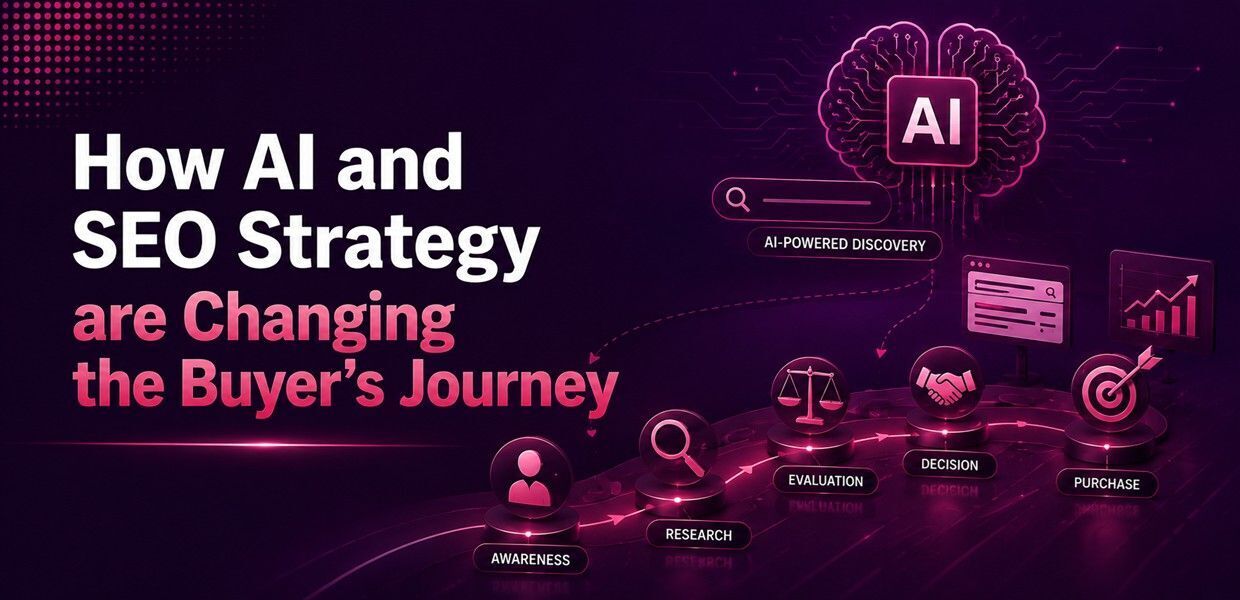

How AI and SEO Strategy are Changing the Buyer’s Journey
AI has moved the top of the B2B buyer's journey inside the model. 51% of B2B software buyers now start their research with an AI chatbot, and 69% chose a different vendor than planned because of it. AI SEO strategy shifts the goal from ranking a page to being the source AI systems cite when they answer.
Highlights
- 51% of B2B software buyers start research with an AI chatbot, and 71% use one somewhere in the process, per G2 research covered by Demand Gen Report across 1,076 buyers in March 2026.
- AI Overviews now cost top-ranking pages 58% of their clicks. Ahrefs' updated study across 300,000 keywords found the damage nearly doubled in eight months, from 34.5% to 58%.
- 69% of B2B buyers picked a different vendor than they originally intended after consulting an AI chatbot. Your shortlist is now being assembled by a system you do not control.
- Listicles are the single most-cited content type in AI answers at 21.9%, rising to 40.86% on commercial queries, according to Wix's AI Search Lab study of more than one million citations. Most of your AI visibility lives on sites you don't own.
- Traffic drops, value rises. Semrush data reported by MarTech puts the average AI search visitor at 4.4 times the value of an organic search visitor.
What Changed
For twenty years, B2B SEO worked on one assumption: a buyer types a question, sees ten links, and clicks one.
Every tactic followed from that. Rank higher. Get the click. Capture the lead.
That assumption is now false for a large and growing share of B2B research.
The buyer types a question and gets an answer. No links required. If your company appears in that answer, you are in the deal. If it doesn't, you were never considered, and you will see nothing in your analytics to tell you it happened.
That's the shift. Everything below is the detail.
The Data: What Actually Changed
Skip the opinions. Here is what the studies say.
Clicks collapsed on informational queries. Ahrefs analyzed 300,000 keywords, comparing Google Search Console click-through rates before and after the launch of AI Overviews. In April 2025, the finding was a 34.5% CTR drop for top-ranking pages. By the May 2026 update, it was 58%. Position two lost roughly half its clicks. Even position ten lost nearly 20%.
Independent research confirms the behavior change. Pew Research Center tracked actual browsing behavior from 900 US adults across 68,879 real Google searches. When an AI summary appeared, users clicked a traditional result on 8% of visits. When it did not, they clicked on 15%. Clicks on links inside the AI summary itself: 1%.
B2B buyers specifically moved. G2 surveyed 1,076 B2B software buyers in March 2026. 51% now begin research with an AI chatbot. 71% use one at some point, up from 60%. 53% say chatbot research is more productive than traditional search, up from 36%. ChatGPT holds 63% of that usage.
It changes outcomes, not just discovery. From the same G2 research: 69% chose a different vendor than they originally planned. 33% bought from a vendor they had never heard of. 85% view a vendor more favorably when an AI chatbot mentions it. 80% say AI accelerated the decision.
The traffic that survives is better. Semrush data reported by MarTech puts the average AI search visitor at 4.4 times the value of an organic search visitor. That makes sense. Someone who arrives after a model has already explained the category, compared options, and named you is much further along than someone who clicked a blog post from a search result.
One prediction to treat carefully. In February 2024, Gartner predicted traditional search engine volume would drop 25% by 2026. Whether that exact number landed is genuinely disputed. Use it as directional, not as a fact. The measured click data above is the stronger evidence.
What Is AI SEO?
AI SEO is the practice of optimizing so that AI systems, including Google AI Overviews, Google AI Mode, ChatGPT, Perplexity, Gemini, and Copilot, retrieve, understand, and cite your brand when they answer buyer questions. It extends traditional SEO rather than replacing it: you still need crawlable pages and topical authority, but the objective shifts from ranking a URL to being the source the model quotes.
You will also see this called AI search optimization, answer engine optimization (AEO), or generative engine optimization (GEO). The labels differ. The job is the same.
AI SEO vs. Traditional SEO: What Actually Differs
Most of the "SEO is dead" content gets this wrong. Traditional SEO is not dead. It is now the entry requirement rather than the whole game.
|
Traditional SEO |
AI SEO |
|
|
Goal |
Rank a URL in the top 10 |
Be the source a model cites |
|
Unit of success |
Position |
Mention and citation |
|
Where value lands |
On your site |
Often on someone else's, or in the answer itself |
|
Primary asset |
Your own pages |
Your pages plus third-party listicles, reviews, and communities |
|
Query shape |
One head keyword |
One prompt fanned out into many sub-queries |
|
Content structure |
Long-form, keyword-optimized |
Extractable: clear claims, direct answers, structured data |
|
Measurement |
Rankings, sessions, conversions |
Share of voice in AI answers, citation frequency, branded search lift |
|
Feedback loop |
Days to weeks, visible in GSC |
Slow and partly invisible. No console tells you why a model skipped you |
The last row is the operationally painful one. In traditional SEO you can see the loss. In AI SEO you usually cannot. A model considered you, decided a competitor's G2 listing was more authoritative, and named them instead. Nothing in your analytics records that event.
The 6 Ways AI Has Changed the B2B Buyer's Journey
1. Discovery moved from ranking to being cited
The old funnel entry: buyer searches "best marketing automation for mid-market," sees a list of ten blue links, clicks three.
The new funnel entry: buyer prompts "what marketing automation platform should a 200-person B2B company use, and what are the tradeoffs," and receives a synthesized answer naming four vendors with reasoning.
You are either one of those four or you are invisible. There is no page two to be on.
2. Consideration now happens inside the model, not on your site
The comparison work that used to happen across six browser tabs now happens in one conversation.
G2 found 41% of buyers use chatbots specifically to compare vendor strengths and weaknesses, and 41% use Deep Research tools for software evaluation.
That means your comparison page, your battlecard, and your "vs. competitor" landing page are no longer the venue for the comparison. The model does that work using whatever sources it can retrieve. Your job changed from hosting the comparison to supplying the inputs.
3. The shortlist gets built before you know the buyer exists
This is the part that should worry revenue leaders.
69% of B2B buyers chose a different vendor than they originally planned after consulting an AI chatbot. 33% bought from a vendor they had never heard of before.
Read that in both directions. It is the single biggest opportunity in B2B marketing right now, because an unknown vendor can enter a shortlist purely on the quality of its sourced evidence. It is also the single biggest risk, because an incumbent can be removed from a shortlist without ever seeing a lost-deal report.
4. Clicks decoupled from influence
Your analytics were built to measure visits. AI search generates influence without visits.
A buyer reads an AI answer that cites your research report. They never click. Three weeks later they search your brand name directly and land on your pricing page.
Your attribution model records that as branded direct traffic. It has no idea the AI citation caused it.
This is why teams looking only at organic sessions conclude AI search "isn't driving anything." They are measuring the one thing that AI search deliberately removed.
5. Traffic goes down and quality goes up at the same time
Two things are true simultaneously, and reporting that treats them as one number will mislead your board.
Volume falls. Ahrefs measured a 58% click reduction on top-ranking pages. Pew measured click rates roughly halving when an AI summary is present.
Value rises. The Semrush figure puts AI search visitors at 4.4x the value of organic visitors.
The correct read: stop reporting sessions as your headline organic metric. Report qualified pipeline per thousand sessions instead. Under the old model, that number was low and the volume was high. Under the new one, the volume is lower and the conversion rate is much better. A sessions-only dashboard will show you a disaster while the business improves.
6. Third parties now control most of your AI visibility
This is the finding most B2B teams have not internalized.
Wix's AI Search Lab analyzed 75,000 AI answers containing 1,056,727 citations across ChatGPT, Google AI Mode, and Perplexity. Listicles are the most-cited content type at 21.9% overall, and 40.86% on commercial queries. Articles come second at 16.7%. Product pages third at 13.7%. Comparison and alternatives pages together account for under 3%.
Think about what that means. On the exact queries where someone is choosing a vendor, the dominant citation source is a "best X tools" listicle. And you did not write it.
Perplexity is even more extreme: 17% of its citations come from discussions, more than double the average. That is Reddit, forums, and communities.
Your AI SEO strategy is therefore not mostly about your website. It is mostly about your presence on everyone else's.
How to Build an AI SEO Strategy: 7 Components
1. Make your content extractable, not just readable
Models retrieve passages, not pages. A 3,000-word narrative with the answer buried in paragraph nine will lose to a 400-word section that states the answer in the first sentence.
Practical rules:
- Put the direct answer in the first two sentences under each heading, then explain
- Write headings as the question the buyer actually asks
- Use tables for anything comparative. Tables get extracted at a much higher rate than the same information in prose
- Keep each claim self-contained, so a passage lifted out of context still makes sense
- Add a short definition block for every term you want to own
Simple test: take any section of your page, paste it alone into a document, and read it cold. If it needs the paragraph above it to make sense, a model can't use it cleanly.
2. Win the listicle layer, because you don't own it
If listicles drive 40.86% of citations on commercial queries, then getting included in third-party listicles is not PR. It's core AI SEO.
The work:
- Find every "best [your category]" listicle that ranks or gets cited. Note which ones include you and which don't
- Contact the publishers of the ones that don't. Many accept submissions or run paid inclusion
- Publish your own comparison content, including honest coverage of competitors. Models cite balanced sources more readily than one-sided ones
- Keep your G2, Capterra, TrustRadius, and Clutch profiles current, complete, and reviewed. These feed directly into model retrieval
The uncomfortable version of this: a competitor with a worse product and better third-party presence will beat you inside AI answers. Consistently.
3. Answer the fan-out, not the head term
AI systems decompose a single prompt into multiple sub-queries, retrieve for each, and synthesize. This is commonly called query fan-out.
So "best B2B marketing agency for SaaS" quietly becomes a set of sub-questions: what do B2B marketing agencies do, how much do they cost, which specialize in SaaS, how do they differ from in-house, what should you ask before hiring.
Practical implication: a page that ranks for one head keyword but answers only that one question will be cited less often than a page that thoroughly covers the full cluster of adjacent questions.
Build content around question clusters instead of keywords. Your FAQ section is no longer decoration. It is retrieval surface area.
4. Make your entity unambiguous
Models work with entities, not strings. They need to know what your company is, what category it belongs to, who it serves, and how it differs.
Do this:
- Describe your company identically everywhere: site, LinkedIn, Crunchbase, G2, directories, press
- Implement Organization, Product, FAQPage, and Article schema
- Publish a clear "what we do and who we serve" page in plain language, not brand poetry
- Name your category explicitly. If a model can't tell whether you're a lead gen agency or a martech platform, it won't confidently place you in either answer
Brand poetry is actively harmful here. "We unlock human potential through connected experiences" gives a retrieval system nothing to work with.
5. Publish original data, because it's the most citable asset there is
Models prefer sources that contain something no other source has.
A survey of 400 customers. A benchmark from your own platform data. A teardown with real numbers. Anything that produces a statistic someone else has to cite you for.
Every article on this topic, including this one, cites the Ahrefs study, the Pew study, and the G2 survey. Those organizations became a permanent part of the answer set by running research nobody else had.
That is the durable AI SEO play. One good original study will out-earn thirty AI-generated blog posts, and it is exactly the asset most B2B teams keep deprioritizing.
6. Show up where the discussions are
Perplexity draws 17% of its citations from discussions. Reddit, Stack Overflow, industry Slack and Discord communities, and niche forums are all retrieval sources.
You cannot spam your way in. You can:
- Have real subject matter experts answer real questions in communities where your buyers already are
- Encourage genuine customer reviews on the platforms that get cited
- Run AMAs, contribute to relevant threads, and let employees participate under their own names
This is slow and unglamorous and it compounds.
7. Fix the technical layer for AI crawlers
The unsexy prerequisite. If AI systems can't retrieve your content, none of the above matters.
- Check your robots.txt. Confirm you are not accidentally blocking GPTBot, ClaudeBot, PerplexityBot, or Google-Extended unless you intend to
- Server-render important content. Anything that requires JavaScript execution is at risk of not being retrieved
- Fix page speed and crawlability, which still matter for the underlying index
- Keep publish and update dates accurate and visible. Recency is a retrieval signal
- Use clean semantic HTML. Headings that are actual headings, tables that are actual tables
A note on gating
If your best research sits behind a form, no AI system can read it, cite it, or recommend you because of it.
This is now a real strategic tension. Gating captures leads. Ungating buys AI visibility.
The workable compromise most B2B teams land on: publish an ungated summary version with the headline findings, all statistics, and the methodology, then gate the full report, the dataset, or the interactive tool. The model gets something citable. You still get the lead. This is the same logic that makes content syndication and white paper distribution work, which is that reach and capture are different jobs and you need both.
How to Measure AI SEO
Your existing dashboard cannot see most of this. Here is the replacement set.
|
Old metric |
Why it now misleads |
Replacement |
|
Organic sessions |
Falls even when visibility rises |
Qualified pipeline per 1,000 sessions |
|
Keyword rankings |
Position 1 with an AI Overview above it loses 58% of clicks |
Share of voice in AI answers for your priority prompts |
|
Impressions |
Doesn't count answers you appeared in without a click |
Citation frequency across ChatGPT, Perplexity, AI Mode, Gemini |
|
Backlinks |
Still useful, no longer sufficient |
Brand mentions, cited or not |
|
Bounce rate |
AI-sourced visitors behave differently |
Branded search volume trend |
|
Blended conversion rate |
Hides that AI traffic converts far better |
Conversion rate segmented by AI referral source |
Two things to set up this month
Segment AI referral traffic in your analytics. Create a channel group for referrals from chatgpt.com, perplexity.ai, gemini.google.com, claude.ai, and copilot.microsoft.com. Most teams have never separated these, which is why they cannot see that this traffic converts several times better than the rest.
Build a prompt set and track it. Write the 30 to 50 prompts your buyers actually use. Run them monthly across the major models and log whether you appear, where you rank in the answer, and which source got cited. Do it manually in a spreadsheet if you must, or use a tracking tool such as Ahrefs Brand Radar, which monitors brand visibility across AI Overviews, AI Mode, ChatGPT, Copilot, Gemini, and Perplexity.
Your prompt set is the new rank tracker. Build it before you need it, so you have a baseline.
Set the right expectation on timing
AI visibility moves slower than rankings and is noisier. Model outputs vary between runs, training data updates on its own schedule, and retrieval indexes refresh unevenly.
Track monthly, judge quarterly. Anyone promising AI citation results in 30 days is selling you something.
Common AI SEO Mistakes
- Using AI to mass-produce the content AI already summarizes. CMI's 2026 research found 89% of organizations now use AI to write copy, but only 39% saw content performance improve. Generic content is exactly what models replace. Producing more of it is a losing trade.
- Optimizing only your own domain. If listicles carry 40.86% of commercial-query citations, a site-only strategy caps your ceiling.
- Reporting organic sessions as the headline number. You will report a decline during a period when your actual influence grew.
- Gating the research you most want cited. Nothing behind a form gets retrieved.
- Abandoning traditional SEO. AI systems retrieve from the same index. Being crawlable, fast, and authoritative is the precondition, not the alternative.
- Ignoring reviews. G2 and peer review platforms are heavily weighted retrieval sources in B2B software categories. A thin profile with six old reviews is a visibility problem, not just a social proof problem.
- Treating this as a one-time project. Prompt sets change, models update, and competitors move. It's an ongoing program.
Should You Hire an AI SEO Agency or Build In-House?
|
Dimension |
In-house |
AI SEO agency |
|
Product and category knowledge |
Deep |
Has to be built |
|
Speed to a working prompt set and baseline |
Slow if nobody owns it |
Days |
|
Third-party listicle and review placement |
Requires relationships you may not have |
Usually the main reason to hire one |
|
Tooling cost |
You buy the visibility tracking stack |
Bundled |
|
Original research capability |
Depends entirely on internal appetite |
Often a core service |
|
Technical AI crawlability fixes |
Needs dev time you compete for |
Specified and handed over |
|
Best when |
You already have SEO capability and need to extend it |
You have no baseline and no idea where you stand |
The realistic split for most B2B companies: keep strategy, product context, and original research in-house. Use a partner for the parts that need outside relationships and specialist tooling, which is third-party placement, review platform work, technical audits, and visibility tracking.
Before you hire any AI SEO agency, ask for three things: their prompt-set methodology, a client example showing citation share before and after, and a plain explanation of what they will do off your domain. If the answer to the third one is vague, they are selling you traditional SEO with a new label.
The Bottom Line
Two numbers tell the whole story.
58% of clicks now stay with Google on queries where an AI Overview appears.
69% of B2B buyers changed their intended vendor after talking to an AI chatbot.
The first number says the old distribution channel is shrinking. The second says the new one decides deals.
Most B2B teams are responding to the first number by producing more content, which is exactly the wrong move, because the thing that got commoditized is undifferentiated content.
The right response is narrower and harder:
- Build a prompt set and get a baseline this month
- Restructure your best existing pages so passages can be extracted cleanly
- Get into the third-party listicles and review platforms that carry most commercial-query citations
- Publish one piece of original research per quarter that gives models something only you have
- Segment AI referral traffic so you can see the conversion advantage you already have
You are not competing for rankings anymore. You are competing to be the source that gets quoted when a machine explains your category to your buyer.
That's a different job. Most of your competitors haven't started it yet.
If you want that visibility connected to actual pipeline rather than a rankings report, talk to us about how AI SEO fits alongside demand generation and appointment setting.
Frequently Asked Questions
How is AI changing the B2B buyer's journey?
AI moved discovery and comparison inside the model. G2 found 51% of B2B software buyers now start research with an AI chatbot, 41% use one to compare vendor strengths and weaknesses, and 69% chose a different vendor than originally planned because of it. Shortlists now form before a vendor sees any signal in its own analytics.
Is traditional SEO dead?
No. AI systems retrieve from the same underlying web index, so crawlability, site speed, topical authority, and quality content remain prerequisites. What changed is that ranking alone no longer guarantees traffic. Ahrefs measured a 58% click reduction for top-ranking pages when AI Overviews appear. Ranking is now the entry requirement, not the finish line.
How much traffic do AI Overviews actually take?
Ahrefs analyzed 300,000 keywords and found AI Overviews reduce clicks to top-ranking pages by 58%, up from 34.5% eight months earlier. Pew Research, tracking real browsing behavior across 68,879 searches, found users clicked a result on 8% of visits when an AI summary appeared versus 15% when it did not.
What is the difference between AI SEO, AEO, and GEO?
They are largely the same practice under different names. AI SEO is the broadest term. AEO (answer engine optimization) emphasizes being the direct answer. GEO (generative engine optimization) emphasizes appearing in generated responses. All three describe optimizing for retrieval and citation by AI systems rather than for blue-link rankings. Pick one term and be consistent internally.
How do you measure AI SEO performance?
Track share of voice in AI answers for a fixed prompt set, citation frequency across major models, brand mention volume, branded search trend, and conversion rate segmented by AI referral source. Replace organic sessions as your headline metric with qualified pipeline per thousand sessions, since AI search reduces volume while increasing visitor quality.
Does AI search traffic convert better than organic?
Yes, substantially. Semrush data reported by MarTech puts the average AI search visitor at 4.4 times the value of an average organic search visitor. The likely reason is qualification: someone arriving after a model has already explained the category and named you as a fit is much further into the decision than someone clicking a blog result.
Should we ungate our content for AI visibility?
Partially. Gated assets cannot be retrieved or cited, so anything behind a form is invisible to AI systems. The practical compromise is publishing an ungated summary containing the headline findings, key statistics, and methodology, while gating the full report, dataset, or interactive tool. You get citability and lead capture instead of choosing one.
How long does an AI SEO strategy take to show results?
Expect three to six months before citation patterns shift meaningfully, and treat model outputs as noisy in the short term since responses vary between runs and retrieval indexes update unevenly. Track monthly, judge quarterly. Any agency promising measurable AI citation gains inside 30 days is overselling.
What should we look for in an AI SEO agency?
Ask three questions. What is your prompt-set methodology and how do you build a baseline? Can you show a client's citation share before and after? What specifically will you do off our own domain? The third one matters most, because listicles carry 40.86% of citations on commercial queries. An agency with no off-domain plan is selling traditional SEO relabeled.