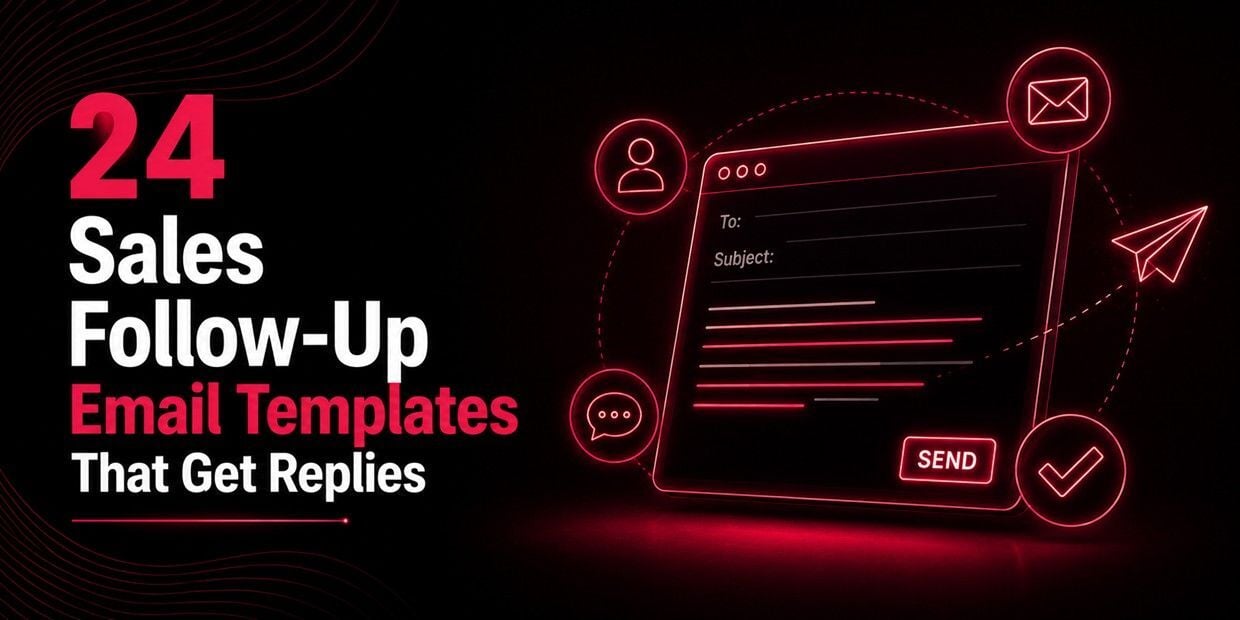

A sales follow-up email is a short message sent after an earlier touchpoint, a cold email, a call, a demo, an event to re-open the conversation and move it toward a meeting.
The ones that get replies do three things: reference the prior context, add something new (a proof point, an insight, a trigger), and ask for one easy next step. Most B2B deals need 5–8 touches before a prospect responds and the majority of replies come from follow-ups, not the first email.
At Revnew, follow-ups are where most booked meetings actually come from. Our outbound pairs intent data with multichannel sequences and a full SDR team backed by Tele Intent™ for intent-driven calling and Land Inbox™ for deliverability and it's booked meetings with names like PepsiCo and Milacron. For one energy client, the right sequencing turned dismal show rates into a roughly 90% show-up rate (see the CGE Energy story). The templates here are the kind of thing our cold email outreach team reaches for every day.
What's inside
24 copy-ready templates, a 6-touch cadence, a subject-line swipe file, and a deliverability checklist.
Who it's for
SDRs, AEs, and founders running B2B outbound who want replies, not just sends.
What Is a Sales Follow-Up Email?
A sales follow-up email is a message sent after an initial point of contact to keep a sales conversation moving nudging a prospect toward a reply, a meeting, or a decision. Unlike the first cold email (which has to earn attention from scratch), a follow-up leans on existing context: a previous email, a call, a downloaded asset, or an event you both attended. Its job isn't to repeat the original pitch. It's to give the prospect a fresh, low-friction reason to respond now. Even the most effective sales pitch email templates rely on strategic follow-ups to turn initial interest into meaningful sales conversations.
How Many Follow-Ups Should You Send (and When)?
Two questions decide whether a follow-up works: what you say and when you say it. Most reps quit too early but "more" isn't the goal either. Here's the cadence our SDR team uses as a starting point.
One or two follow-ups rarely surfaces the prospects who were simply busy.
Tight at first, looser later, persistent without becoming noise.
Around 8–10 a.m. their time; Tuesday–Thursday usually beats Mondays and Fridays. Test against your own data.
Don't re-send the same ask, rotate value, channel, and CTA.
A typical 6-touch sequence over about four weeks:
| Touch | Timing | Channel | Goal |
|---|---|---|---|
| 1 | Day 0 | Initial outreach with a relevant hook | |
| 2 | Day 2–3 | Reply in thread | Add a new angle or proof point |
| 3 | Day 5–7 | Email + LinkedIn | Share a case study or insight |
| 4 | Day 10–12 | Call + email | Different value; reference the trigger |
| 5 | Day 16–20 | Soft, low-commitment check-in | |
| 6 | Day 25–30 | Breakup / last-touch |
After the last touch, move non-responders to a "reconnect next quarter" list rather than deleting them timing, not interest, is usually what's missing.
The Anatomy of a Follow-Up That Gets Replies
Every high-performing follow-up has the same five parts.
Short, lowercase-friendly, and tied to context. A plain "quick follow-up" can work when your offer is strong; when it isn't, get specific.
Instantly remind them who you are and why you're writing. The faster they connect the dots, the further they read.
A fresh stat, case study, product update, or insight tied to their role. C-suite cares about ROI; technical buyers care about how it works.
Low-commitment for cold leads, high-commitment once they're warm. Never stack two asks.
A short signature, no wall of links, and for cold sequences, attention to deliverability so the email actually lands.
For cold or quiet leads
Invites engagement without pressure and opens the door to a future conversation.
For warm, engaged leads
Shows you've checked your own calendar and makes the request feel personal.
Follow-Up Email Subject Lines (Swipe File)
Steal these and tailor them. Each set is grouped by scenario.
- quick question,
- still worth a look?
- + - bad timing?
- should I close the loop on this?
- , as promised next steps
- recap + the case study I mentioned
- following up on
- great chatting at ,
- the takeaway I promised
- missed you at 0
- , we spoke back in
- congrats on the new role,
- thought of you after the
- should I stop reaching out?
- a 5-second reply,
- closing your file (for now)
24 Follow-Up Email Templates by Use Case
Each template includes when to send it, a subject line, a copy-ready body with , and why it works.
After no response, the second touch
Day 2–3 · reply in threadSubject: quick question,
Hi ,
Floating this back to the top of your inbox. Since I last wrote, cut by }}.
Worth a quick look for , or is this not a priority right now?
Why it works: Adds a fresh proof point instead of "just checking in," and the either/or close makes a one-word reply easy.
After no response, the value-add touch
Day 5–7Subject: thought this might help,
Hi ,
Whether or not we ever talk, I figured this might be useful: on .
Most s we work with are wrestling with right now, if that's on your plate, happy to share how handled it.
Why it works: Leading with a genuine resource (no ask attached) builds goodwill and positions you as helpful, not thirsty.
After no response, soft check-in
~2 weeks laterSubject: still worth a look?
Hi ,
I don't want to crowd your inbox, so I'll keep this short: is improving something you're looking at this quarter?
A yes or no is all I need, I'll take it from there.
Why it works: Respects their time, lowers the bar to a single word, and gives you a clean signal either way.
After a discovery / first sales call
Within a few hoursSubject: , as promised next steps
Hi ,
Thanks for walking me through your today. To recap what we landed on:
•
•
•
Here's the I mentioned: . I'll before our next call on .
Anything I missed?
Why it works: A crisp recap confirms alignment, the bullets make next steps unmissable, and a longer email is fine here because the conversation is already active.
After a product demo
Same daySubject: the you asked about
Hi ,
Great seeing in action with the team today. You asked how would handle short answer: , and here's a 2-minute clip showing it: .
Want me to put together a tailored rollout plan for ?
Why it works: Answers the exact question they raised, proves it with a quick visual, and offers a concrete next step.
After a missed call / no-show
Within an hourSubject: , missed you, let's reschedule
Hi ,
Looks like our timing slipped today, no worries, it happens. I still think a quick conversation on is worth 15 minutes for .
Grab whatever slot works here: .
Why it works: Gracious (no guilt), restates the value, and removes scheduling friction with a self-serve link.
After a proposal / quote - first nudge
Day 2–3 after sendingSubject: questions on the proposal, ?
Hi ,
Want to make sure the proposal I sent on actually fits what you need. Happy to adjust scope, walk your team through it, or answer anything on pricing or timelines.
What's the best next step from your side?
Why it works: Opens the door to objections instead of pushing for a yes, which keeps quiet deals alive.
After a proposal / quote - the silence breaker
~7 days laterSubject: , should I follow up with someone else?
Hi ,
Haven't heard back, which usually means one of three things: it's not a priority right now, the budget shifted, or I should be talking to someone else on your team.
Whichever it is, a quick note helps me get out of your way (or point this to the right person).
Why it works: The three-option framing is easy to answer and often surfaces the real blocker or the real decision-maker.
Reengaging an old lead, new development
When a change gives a reasonSubject: , we spoke back in
Hi ,
We chatted in about at . A lot's changed since we just rolled out , which directly tackles .
Worth a fresh 15 minutes to see if it's a fit now?
Why it works: A real product or market change gives a legitimate reason to reconnect, so it never reads like a generic "circling back."
Reengaging an old lead, short and direct
Long gap · senior contactSubject: , still focused on ?
Hi ,
Last we spoke, was top of mind. If it still is, we've since helped happy to show you how.
Open to a quick chat next week?
Why it works: Brevity respects a busy exec's time; one sharp result is more persuasive than a paragraph of features.
After a trade show / conference, you met
1–2 days afterSubject: great chatting at ,
Hi ,
Really enjoyed our conversation at about . As promised, here's : .
I'd love to keep it going would work for a short call to dig into ?
Why it works: References a real, shared moment while it's fresh, delivers on a promise, and proposes a specific next step.
After a conference, you didn't connect
Within a few daysSubject: missed you at ,
Hi ,
We were both at but didn't get the chance to connect. 0 was a highlight, curious what your take was.
Either way, we've been helping , and I think there's overlap with . Worth a quick intro call?
Why it works: Shared attendance warms the outreach, and referencing a session signals you were genuinely there.
After a webinar attendees
1–2 days afterSubject: thanks for joining,
Hi ,
Thanks for attending our session on . You're clearly thinking about {body_font=, footer=, global_colors=, heading_font=, global_fonts=, primary_color=, button=, tables=, spacing=, header=, secondary_color=, text=, forms=} I'd love to map how and would apply to specifically.
20 minutes on ?
Why it works: Builds on value they already opted into and ties abstract webinar content to their actual environment.
After a webinar - registered, didn't attend
1–2 days afterSubject: sorry we missed you,
Hi ,
Sorry you couldn't make our session, life gets busy. Here's the recording so you don't miss out: .
The part most s found useful was . If that's relevant to , happy to walk you through it live.
Why it works: No guilt-tripping, an instant value swap (the recording), and a teaser of the best moment to spark curiosity.
After a LinkedIn connection
A few days after they acceptSubject: , our LinkedIn connection
Hi ,
We connected on LinkedIn recently, thought I'd reach out properly. I lead at , where we help .
Would a quick virtual coffee next week be worth it to swap notes on ?
Why it works: Grounds the email in an existing connection and frames the ask as a casual exchange, not a pitch.
After a content download
1–2 days afterSubject: find the useful, ?
Hi ,
Saw you grabbed our hope it was helpful. Anything in there you'd want to go deeper on?
We're seeing a lot of s wrestle with lately. If that's you, I'm glad to share what's working for teams like .
Why it works: Ties to a specific, trackable action, invites an easy reply, and leads with help rather than a hard sell.
Trigger event - new decision-maker
Within a week or twoSubject: congrats on the new role,
Hi ,
Congrats on stepping into at ! New roles are the perfect moment to pressure-test 0 many teams find only after it bites them.
helps with exactly that: . Want a quick look at how it'd fit your first 90 days?
Why it works: The timing is naturally relevant, and tying your offer to their fresh mandate makes it feel useful, not random.
Trigger event - funding, expansion, or news
Right after the announcementSubject: thought of you after the ,
Hi ,
Saw the news about NaN congrats. Growth like that usually puts pressure on .
We've helped scale through exactly that stage. Worth a short conversation as you plan the next few quarters?
Why it works: Connects a public trigger to a predictable pain point, showing you understand their moment.
Handling "not now" - with a timeline
Right after "check back later"Subject: , a placeholder for
Hi ,
Thanks for the honesty. Since sounds better, want me to send a tentative hold for ? It's just a placeholder, easy to move if things shift.
Either way, I'll check back then.
Why it works: Locks in a concrete future moment instead of a vague "I'll reach out," while keeping all the pressure off.
Handling "not interested" - understand why
After a brief "no"Subject: , quick question
Hi ,
Appreciate you replying. So I can learn (and stop reaching out if it's not a fit): is it timing, the offer itself, or are you already set with another provider?
No pitch, just trying to understand.
Why it works: Offering a few reasons makes replying effortless, and not adding a new offer respects their "no."
After a referral / mutual connection
As soon as you have the introSubject: suggested we connect
Hi ,
mentioned you're focused on and thought we should talk. We've helped
Why it works: A warm referral borrows trust instantly, leading with the referrer's name is the single strongest opener you have.
The breakup - simple yes/no
Final touchSubject: a 5-second reply,
Hi ,
I know your inbox is full, so I'll make this easy: reply "yes" and I'll send a time to talk; reply "not now" and I'll check back next quarter.
Either way, you've got my details when moves up the list.
Why it works: Removes every open-ended question, so even the busiest prospect can answer in one word.
The breakup - numbered options
Final touch · non-C-suiteSubject: , one quick question
Hi ,
Even if isn't on the table now, I'd like to stay on your radar. Hit reply with a number so I know where things stand:
1. Not the right person (point me to ?)
2. Not a priority; try again in a few months
3. Send me info and I'll reach out when ready
Thanks for closing the loop.
Why it works: The reply-by-number format is almost frictionless, and it routes you to the right person when you've been knocking on the wrong door.
The breakup - the permission close
Zero engagementSubject: should I stop reaching out?
Hi ,
I've reached out a few times about without hearing back, so I'll assume the timing's off and stop here.
If I've got that wrong and it's worth a conversation, just say the word, otherwise, I'll leave you to it.
Why it works: The takeaway close (offering to stop) often prompts a reply from prospects who meant to respond but never got around to it.
Follow-Up Benchmarks: What "Good" Looks Like
Treat these as directional, then measure your own:
Which is exactly why quitting after one or two touches leaves pipeline on the table.
Concentrate your best angles there.
Even a single line of real personalization moves the number.
The point isn't to chase a magic percentage, it's to keep showing up with new value until the timing is right.
Why Your Follow-Ups Land in Spam (and How to Fix It)
A perfect follow-up is worthless if it never reaches the inbox and follow-ups are especially prone to filtering because they pile onto the same thread and domain. A few habits that keep you landing:
- Warm up your sending domain and keep volume steady. Sudden spikes look like spam.
- Avoid spam-trigger language ("free," "guarantee," ALL CAPS, excessive exclamation points) and heavy HTML or link stacks.
- Don't send ten near-identical messages in one thread. Vary the copy and the angle.
- Authenticate your domain (SPF, DKIM, DMARC) and monitor your sender reputation.
- Prune dead addresses so bounces don't drag down deliverability.
Getting follow-ups delivered is half the battle, before copy ever matters. It's why we built Land Inbox™ into our outreach.
See how Revnew does itRed Flags That Kill Replies
Ten unanswered emails isn't persistence, it's training people to ignore you. Leave breathing room and change angles.
"Sorry to bother you again" signals your offer isn't worth the interruption. If you bring value, own it.
No one wakes up wanting to help you hit a number. Tie every line to their problem and their outcome.
Copy-pasting your first pitch ignores the conversation and reads as spam.
Long, dense messages with five links and three asks get skimmed and dropped. One idea, one CTA.
A pile of numbers signals insecurity. Lead with the one or two stats that actually land.
Frequently Asked Questions
How many follow-up emails should I send?
Plan for 5–8 touches across a sequence. Most prospects who eventually reply do so on a follow-up, not the first email but space the touches out and change the angle each time so you stay persistent without becoming noise.
How long should I wait between follow-ups?
Start tight and widen the gaps: ~2–3 days for the first follow-up, then 5–7 days, then 1–2 weeks toward the end of the sequence. After your final touch, move non-responders to a "reconnect next quarter" list.
What's the best day and time to send a follow-up email?
Mid-morning and early afternoon tend to perform best. Around 8–10 a.m. in the prospect's time zone, with Tuesday–Thursday usually beating Mondays and Fridays. Use these as a starting point and let your own reply data decide.
What should I write in a follow-up after no response?
Don't just "check in." Reference the original context in a sentence, add one new thing (a proof point, resource, or insight), and ask a single easy question, ideally one they can answer yes/no.
How do I follow up without being annoying?
Bring new value every time, keep it short, and never apologize for existing. Respect a "no," and use a takeaway or permission close ("should I stop reaching out?") near the end, it signals confidence and often earns the reply.
Should follow-ups be in the same thread or a new one?
Reply in the original thread for the first couple of follow-ups to keep context together. For long gaps or trigger-based reengagement, a fresh subject line can stand out more.
Send Follow-Ups That Actually Get Answered
The best follow-up shows up at the right moment with something new and a single easy next step and actually lands in the inbox. If you'd rather have a team run all of it (intent-led targeting, multichannel sequences, deliverability, and SDRs that book the meeting), that's what Revnew does.
Book a free strategy callIntent-led outreach · deliverability · SDRs that book meetings